
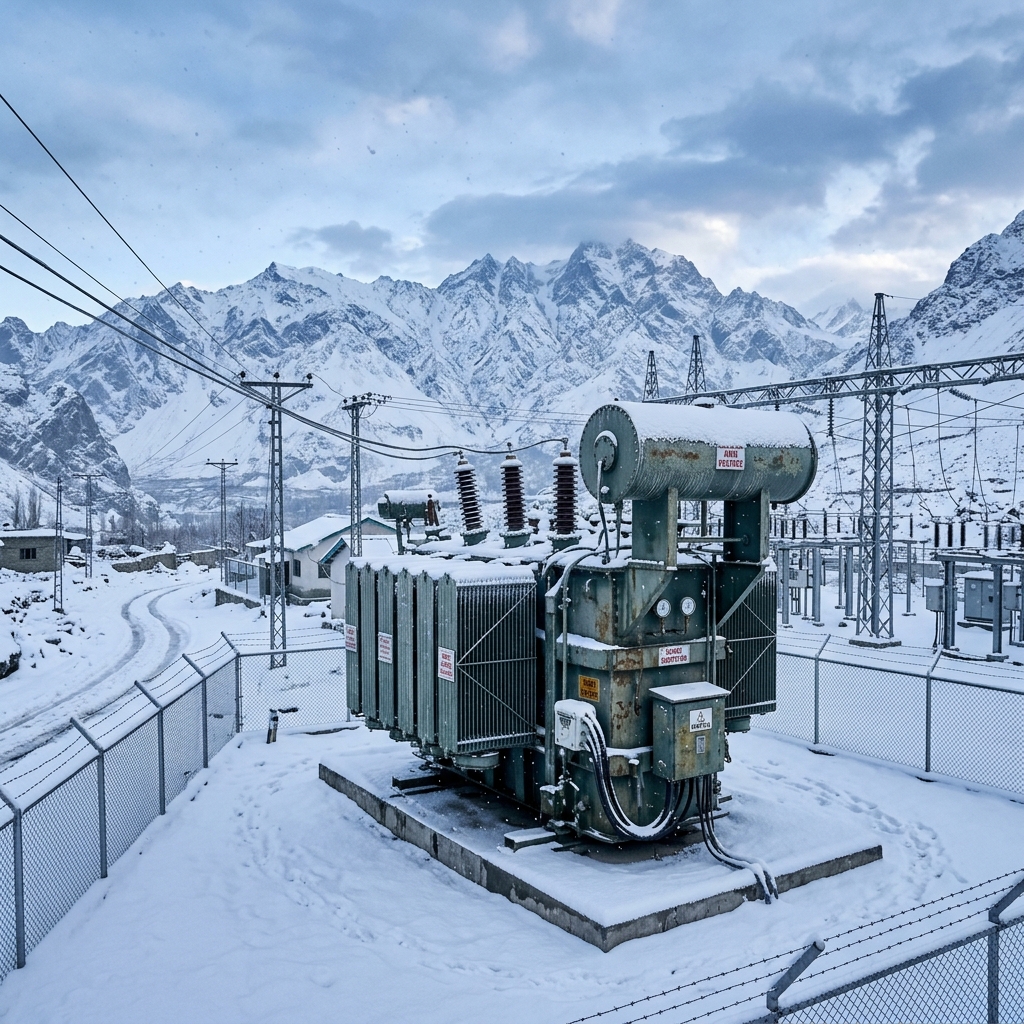
Direct Answer (Sub-Zero Oil Summary): Standard mineral transformer oil has a pour point around -10°C to -15°C. In Skardu and Hunza, sub-zero winter temperatures (-20°C) cause oil to turn gel-like, halting thermosiphon heat circulation and freezing dissolved water into ice crystals that trigger sudden coil breakdown. Supplying transformers with low-pour-point (-30°C rated) oil and cold-resistant Viton gaskets prevents winter coil burnouts.
The Physics: How Sub-Zero Cold Degrades Transformer Oil
Electrical distribution transformers rely on natural thermosiphon convection: hot oil near the copper windings expands, rises to the top of the tank, enters radiator fins to cool down, and sinks back to the bottom. This continuous cycle dissipates internal thermal stress.
However, when ambient temperatures drop to -15°C or -20°C in Skardu, Satellite Town, or Hunza, two critical physical failures occur in standard mineral oil:
- Viscosity Surge & Convection Stagnation: As temperature drops below the oil's pour point, viscosity increases exponentially. The oil thickens into a wax-like gel, stopping convection movement. Even though the inner copper core is hot, cold stagnant oil at the radiator periphery fails to transfer heat, causing localized core overheating.
- Moisture Saturation Drop: Cold oil can hold far less dissolved water than warm oil. As temperature plummets at night, excess dissolved water precipitates out of the oil solution into free water droplets.
Standard Oil vs Sub-Zero Cold-Climate Oil Matrix
To operate safely in Gilgit-Baltistan's winter, insulating oil must meet cold-climate pour point standards (IEC 60296 Class I & II):
| Oil Specification Metric | Standard Mineral Oil (Plain Areas) | Sub-Zero Cold Climate Oil (GB Spec) |
|---|---|---|
| Pour Point Threshold | -10°C to -15°C (Fails in Skardu) | -30°C to -40°C (Certified Safe) |
| Kinematic Viscosity at -20°C | High (> 1,800 cSt — Gelling) | Low (< 400 cSt — Free Flowing) |
| Flash Point | 140°C | > 145°C |
| Dielectric Breakdown Voltage (BDV) | Drops sharply below 0°C | Remains > 60 kV at sub-zero temps |
| Recommended Region | Lahore, Faisalabad, Multan | Gilgit, Skardu, Hunza, Khaplu, Astor |
The Micro-Ice Crystal Hazard in Transformer Insulation
The most dangerous phenomenon in sub-zero climates is moisture freezing. When free water droplets precipitate out of cold oil at sub-zero temperatures, they freeze into microscopic ice crystals. Ice has a much higher dielectric constant and lower breakdown strength than liquid oil.
These floating ice crystals are drawn by strong electromagnetic fields toward high-tension (11 KV) winding gaps, lining up along electrical stress lines. When a voltage spike occurs during a GBED grid load-shedding restart, the ice crystal bridge collapses, causing an instant phase-to-phase explosive short circuit.
Preventing Gasket Seal Cracking Under Freeze-Thaw Cycles
Beyond the oil itself, sub-zero winters cause severe physical damage to transformer tank seals:
- Standard Nitrile Rubber (NBR): Standard rubber gaskets harden and become brittle at -10°C. Repeated expansion and contraction under daily temperature swings (-15°C night to +10°C sun) causes gaskets to crack, leaking oil onto the pad.
- Viton & Fluorosilicone Gaskets: TransfoLine fits all Gilgit-Baltistan transformers with cold-resistant Viton synthetic rubber gaskets rated down to -40°C, maintaining flexible compression seals year-round.
5-Step Pre-Winter Transformer Prep for Skardu & Gilgit
To avoid winter power blackouts at hotels, commercial plazas, and municipal substations across GB, complete these 5 steps before November:
- Perform Oil BDV & Water Content Test: Ensure oil BDV is above 50 kV and moisture is below 15 ppm. Explore our oil dehydration services page.
- Replace Silica Gel Breather Charges: Ensure breather silica gel is fresh cobalt-blue, preventing moist air intake during night cooling.
- Verify Low-Pour-Point Oil Rating: Confirm oil is rated to at least -30°C pour point.
- Inspect Bushings & Gaskets for Freeze Cracks: Check porcelain bushings for micro-fractures caused by ice pressure. See our transformer spare parts catalogue.
- Verify Thermometer & Heater Alarm Contacts: Ensure tank oil temperature indicators operate accurately.
TransfoLine Cold-Climate Oil & Transformer Solutions in GB
TransfoLine provides dedicated cold-climate electrical solutions across Gilgit-Baltistan:
- Sub-Zero Oil Supply: Direct dispatch of certified -30°C pour point insulating oil drums via Karakoram Highway (KKH) to Gilgit, Skardu, and Hunza. Check our Gilgit-Baltistan location hub.
- Cold-Climate Distribution Transformers: 25 KVA to 2,000 KVA oil-immersed transformers custom built for GB winter conditions. See our transformer buying & specification guide.
- On-Site Mobile Filtration: Mobile vacuum dehydration plants capable of processing transformer oil at mountain project sites.
Frequently Asked Questions
Does transformer oil freeze in Skardu and Gilgit during winter?
Standard mineral oil does not solidify completely, but its pour point (typically -10°C to -15°C) is exceeded during Skardu's severe -20°C winter nights. This causes high oil viscosity, stopping natural thermosiphon cooling, while dissolved moisture freezes into micro-ice crystals that trigger sudden short-circuit arcing.
What oil pour point rating is required for Gilgit-Baltistan transformers?
Transformers installed in Gilgit, Skardu, Hunza, or Astor must be filled with low-pour-point naphthenic or synthetic insulating oil rated to at least -30°C or -40°C pour point to maintain oil fluid circulation during winter.
How does TransfoLine prepare transformers for sub-zero mountain operation?
TransfoLine fills all Gilgit-Baltistan bound transformers with certified low-pour-point insulating oil, installs cold-resistant Viton synthetic rubber gaskets to prevent freeze cracking, and fits moisture-absorbing silica gel breathers.
Need sub-zero cold-climate transformer oil in Gilgit or Skardu?
Contact our engineering team to order certified -30°C pour-point oil drums or cold-rated transformers delivered via Karakoram Highway.
WhatsApp Cold Oil Service →