
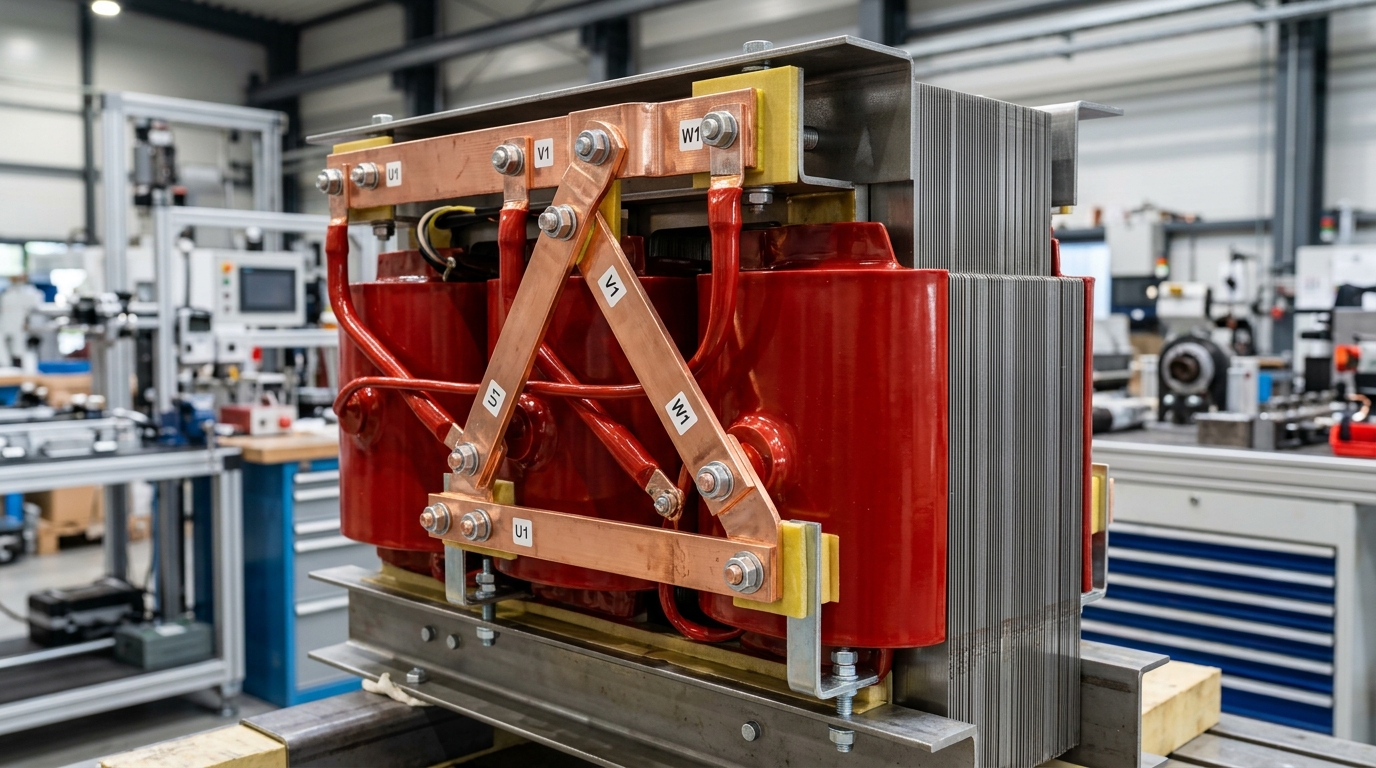
Direct Engineering Answer: Cast Resin (CRT) transformers encapsulate windings in solid fiberglass-reinforced epoxy resin under vacuum, providing superior moisture, dust, and short-circuit resistance (Class E2/C2) ideal for humid Pakistani basements. Vacuum Pressure Impregnated (VPI) units use open windings coated with varnish, offering higher temperature ratings (Class H 220°C) and lower cost for clean, climate-controlled environments.
1. The Two Dominant Dry-Type Technologies in Modern Electrical Design
In the transition away from combustible mineral oil, electrical consulting engineers and MEP designers encounter two primary manufacturing methodologies for dry-type distribution transformers: Cast Resin Transformers (CRT) and Vacuum Pressure Impregnated Transformers (VPI). While both technologies eliminate flammable dielectric fluids, their mechanical construction, environmental resilience, insulation chemistry, and moisture absorption characteristics differ substantially.
Understanding these differences is crucial for installations in Pakistan, where high ambient humidity during the summer monsoon, airborne textile fluff, cement dust, and corrosive coastal atmosphere in Karachi can compromise open-wound electrical equipment. Explore our full range of cast resin dry-type transformers.
2. Cast Resin (CRT) Manufacturing Process & Vacuum Epoxy Encapsulation
In a Cast Resin transformer, the high-voltage (HV) windings—wound with pure electrolytic copper foil or round conductor—are placed inside high-precision steel molds and completely encapsulated in a thick matrix of liquid epoxy resin mixed with silica quartz filler under high vacuum (typically < 1 mbar):
- Void-Free Monolith: Vacuum casting eliminates all air bubbles and micro-voids, reducing internal partial discharge (PD) to negligible levels (≤ 10 pico-Coulombs at 1.3 times rated voltage).
- Impermeable Solid Barrier: The cured epoxy forms a solid, rock-hard cylindrical barrier that completely isolates the copper conductors from ambient moisture, corrosive chemical gases, and conductive airborne dust.
- Extreme Mechanical Strength: The fiberglass-reinforced epoxy provides exceptional tensile and compressive strength, preventing any winding movement during severe downstream short-circuit faults.
3. Vacuum Pressure Impregnated (VPI) Construction & Open-Wound Architecture
VPI transformers utilize open-wound coils separated by high-temperature solid insulation barriers (such as DuPont Nomex® aramid paper). The completed core and coil assembly is placed inside a pressure chamber where high-temperature polyester or silicone varnish is introduced under alternating vacuum and high pressure (up to 6 bar):
While the varnish penetrates deep into the paper layers, the windings remain fundamentally open-wound. VPI units boast superior thermal endurance—often utilizing Class H (180°C) or Class C (220°C) materials—making them capable of withstanding extreme thermal overloads. However, because the coils are not sealed in solid resin, the varnish surface can absorb atmospheric moisture if left un-energized in humid environments.
4. Moisture, Humidity & Monsoon Performance in Pakistan (Class E2 Standards)
In Pakistan's monsoon season (July to September), relative humidity frequently exceeds 90% in cities like Lahore, Sialkot, and Karachi. If a VPI transformer stands de-energized during a scheduled plant maintenance shutdown, moisture can condense on the open windings, lowering insulation resistance (Megger values) and necessitating 24 to 48 hours of hot-air oven drying before safe energization.
Cast Resin CRT transformers are certified to Class E2 (Frequent Condensation / Heavy Pollution) per IEC 60076-11. The solid epoxy encapsulation prevents any moisture absorption, allowing a CRT transformer to be energized instantly with 100% safety even after months of un-energized storage in high-humidity basement environments.
5. Mechanical Short-Circuit Withstand & Electromagnetic Ruggedness
During heavy external short-circuit faults, radial bursting forces attempt to expand the high-voltage winding outwards, while axial forces attempt to compress the coils. The monolithic epoxy structure of a Cast Resin transformer acts as an impenetrable mechanical clamp, providing dynamic short-circuit withstand capabilities up to twice that of standard VPI units.
6. Thermal Insulation Classes: Class F (155°C) vs Class H (180°C/220°C)
Most commercial Cast Resin transformers are engineered with Class F insulation (155°C maximum, 100°C temperature rise) or Class H insulation (180°C maximum, 125°C rise). High-performance VPI transformers can be built with Class C materials (220°C). However, for commercial high-rises and standard industrial distribution, Class F/H Cast Resin units deliver more than adequate thermal margins.
7. Partial Discharge (PD) Performance & Dielectric Life Expectancy
Partial discharge (PD) is the microscopic breakdown of air trapped in voids under high electric fields. In VPI transformers, small voids between varnish layers can exhibit PD levels of 50 to 200 pC. In contrast, TransfoLine vacuum-cast resin transformers maintain guaranteed PD levels of ≤ 10 pC, ensuring a design lifespan of 30+ years with zero insulation degradation.
8. Detailed Engineering Comparison Matrix (CRT vs VPI)
| Engineering Parameter | Cast Resin Dry-Type (CRT) | Vacuum Pressure Impregnated (VPI) |
|---|---|---|
| Winding Encapsulation | Solid Epoxy Resin with Silica (Vacuum Cast) | Open Coils Impregnated with Varnish |
| Moisture & Humidity Resistance | Superior (Class E2 - Zero Penetration) | Moderate (Vulnerable to long-term condensation) |
| Dust & Chemical Immunity | Complete (Class C2 - Washable surface) | Dust can accumulate in open coil crevices |
| Partial Discharge Level | Extremely Low (≤ 10 pC) | Higher (Typically 50–200 pC) |
| Short-Circuit Mechanical Rigidity | Exceptional Monolithic Armor | Moderate Mechanical Clamping |
| Thermal Overload Rating | Class F (155°C) / Class H (180°C) | Class H (180°C) / Class C (220°C) |
| Initial Purchase Cost | Slightly Higher (+10% to +15% vs VPI) | Slightly Lower |
9. Selection Guidelines for Consultants & Procurement Engineers
- Choose Cast Resin (CRT) For: Commercial plazas, underground basements, shopping malls, hospitals, food processing facilities, and coastal industrial plants in Karachi.
- Choose VPI For: Dry, clean, air-conditioned indoor switchgear rooms, high-ambient thermal testing facilities, and dedicated clean-room data centers.
10. Manufacturing Quality Control: Vacuum Casting vs Dip Impregnation
The manufacturing process of Cast Resin Transformers requires strict environmental and atmospheric control. At the manufacturing plant, the copper foil windings and insulating Nomex spacers are dried inside a hot-air dehydration chamber at 120°C for 8 hours to eliminate all surface moisture. The winding assembly is then transferred into a high-vacuum autoclave chamber where pure epoxy resin mixed with silica filler is degassed and poured under a continuous vacuum of < 1 mbar.
In contrast, standard VPI manufacturing relies on dipping assembled open-frame coils into an atmospheric varnish tank followed by pressure cycling. While VPI provides adequate dielectric coating for clean, dry environments, it cannot match the monolithic, void-free solidity and moisture imperviousness of vacuum-cast epoxy resin.
11. Dielectric Stress Analysis & Finite Element Coil Modeling
TransfoLine's cast resin transformers are engineered using 3D electrostatic finite element method (FEM) software. By calculating electric field gradient contours (ΔV/mm) across coil edges, transition steps, and insulation interfaces, our engineers ensure that maximum voltage stress remains below 35% of the breakdown threshold of solid epoxy resin (20 kV/mm). This prevents localized partial discharge and guarantees a 30+ year operating life under continuous commercial load.
Frequently Asked Questions
FAQ Can a Cast Resin transformer be washed or cleaned with water?
The outer epoxy resin surface can be wiped clean with a damp cloth or vacuumed during maintenance, as moisture cannot penetrate the cured solid resin.
FAQ What causes partial discharge in dry-type transformers?
Microscopic air voids trapped inside the insulation barrier ionize under high electrical voltage stress; vacuum casting eliminates these voids to keep PD below 10 pC.
FAQ Is VPI transformer cheaper than Cast Resin?
VPI transformers are typically 10% to 15% cheaper upfront due to less complex tooling and resin casting machinery.
FAQ How does TransfoLine test Cast Resin transformers before dispatch?
Every unit undergoes partial discharge measurement, high-voltage dielectric proof testing, turns ratio verification, and temperature rise tests.
FAQ What kVA sizes of CRT transformers are available from TransfoLine?
TransfoLine supplies cast resin units from 50 kVA up to 5,000 kVA (5 MVA) across 11kV, 22kV, and 33kV primary voltages.
Need Direct Technical Assistance or a Factory-Direct Quote?
TransfoLine supplies, installs, overhauls, and repairs heavy industrial transformers across Pakistan with nationwide 48-hour delivery, genuine WAPDA P-10 compliance, and 12-month full warranty.