Metallurgical Physics: Copper vs. Aluminium Electrical Properties
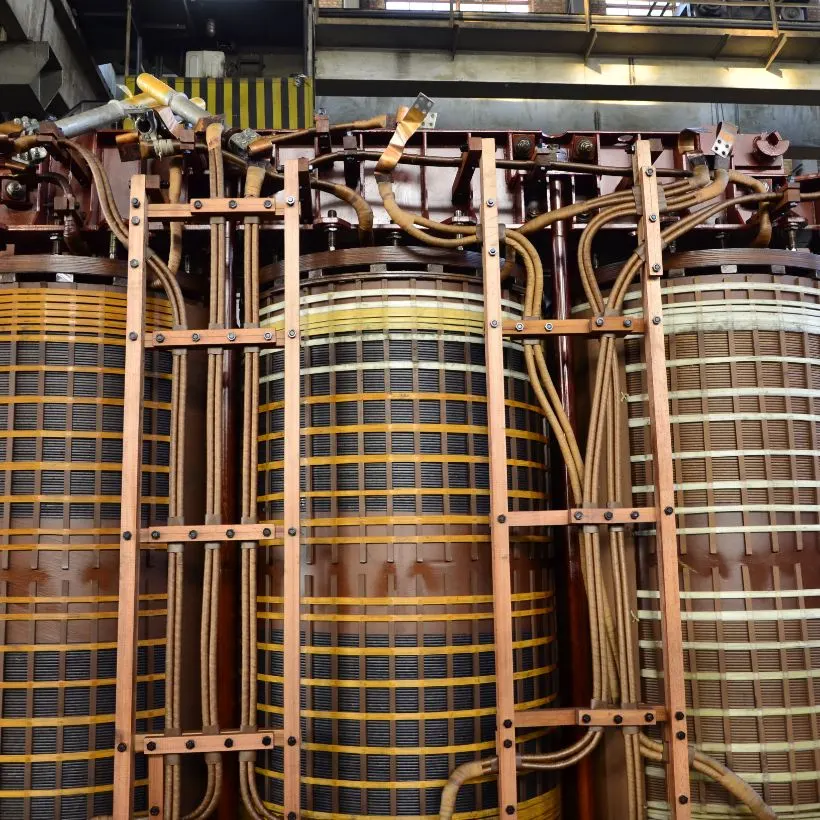
In electrical power transformer engineering, the choice of winding conductor material governs every critical operating parameter: electrical resistance, operating temperature rise, cooling oil volume, mechanical dimensions, and resilience against external short circuits.
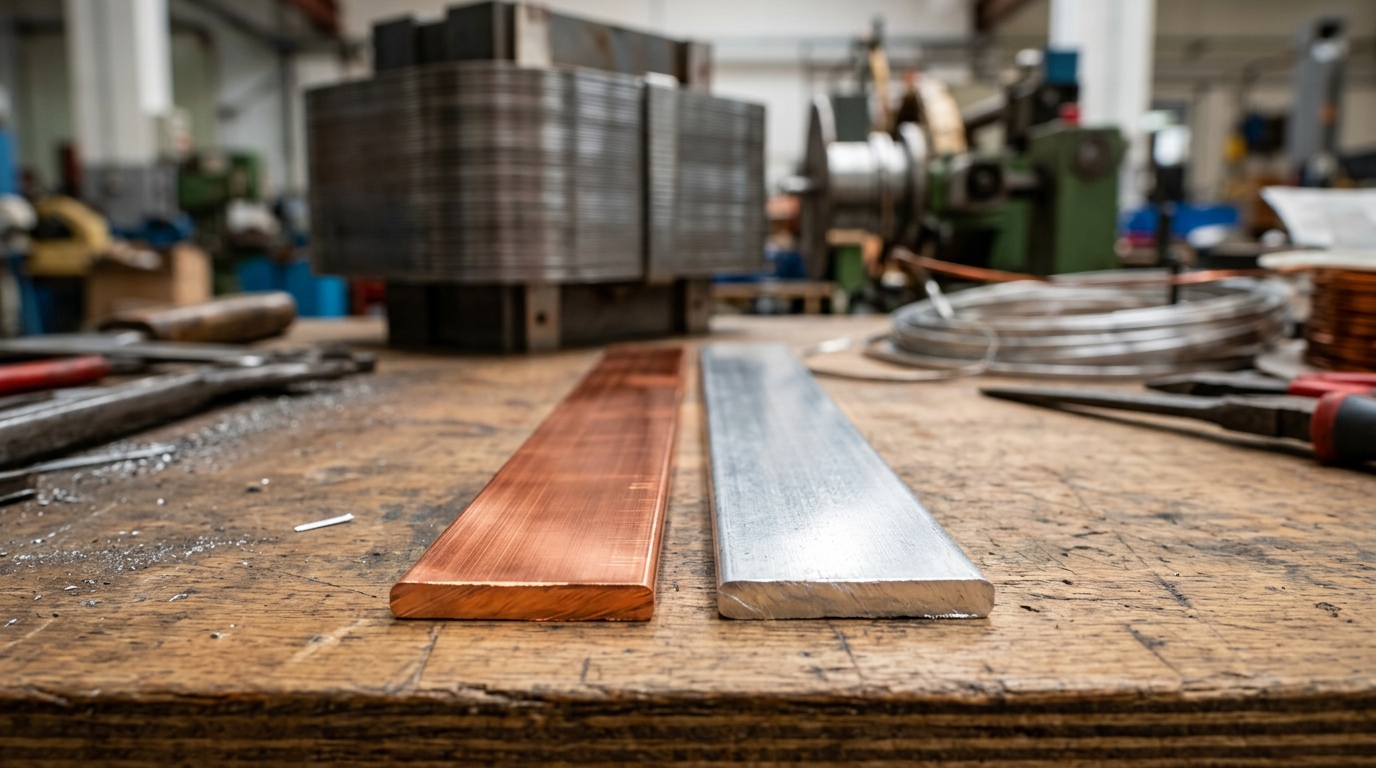
The table below summarizes the fundamental physical properties of Oxygen-Free High-Conductivity (OFHC) Electrolytic Copper (Electrolytic Tough Pitch, ETP) versus Electrical Grade Aluminium (EC Grade 1350):
| Physical / Electrical Property | 99.99% Pure Copper (ETP) | EC Grade Aluminium (1350) | Engineering Impact |
|---|---|---|---|
| Electrical Conductivity (% IACS) | 100.0% – 101.5% | 61.0% | Aluminium requires 64% larger cross-sectional area for same current |
| Electrical Resistivity at 20°C ($ ho$) | $1.724 imes 10^{-8} \ \Omega\cdot ext{m}$ | $2.826 imes 10^{-8} \ \Omega\cdot ext{m}$ | Aluminium has 64% higher internal resistance per unit volume |
| Thermal Conductivity | $386 \ ext{W/(m}\cdot ext{K)}$ | $222 \ ext{W/(m}\cdot ext{K)}$ | Copper conducts heat away from winding hot spots 74% faster |
| Coefficient of Thermal Expansion | $16.5 imes 10^{-6} \ / ext{K}$ | $23.1 imes 10^{-6} \ / ext{K}$ | Aluminium expands 40% more, loosening terminal bolted joints |
| Tensile Yield Strength | $200 – 240 \ ext{MPa}$ | $70 – 90 \ ext{MPa}$ | Copper is nearly 3x stronger against short-circuit mechanical burst |
| Melting Point | $1,085^\circ ext{C}$ | $660^\circ ext{C}$ | Aluminium melts during severe high-current fault arcs |
The I²R Heat Loss Penalty & Lifetime Electricity Bills
The most immediate operational consequence of using aluminium wire instead of electrolytic copper inside an existing transformer core is the massive surge in internal $I^2R$ load losses.
Because an existing transformer core has fixed window dimensions ($W_w imes H_w$), an informal rewinder cannot increase the conductor cross-sectional area by 64% to compensate for aluminium's inferior conductivity. Consequently, they wind aluminium wire of similar or only slightly larger gauge into the existing slot.
The direct physical penalty is severe:
- Internal winding resistance ($R$) increases by approximately 50% to 60%.
- Load loss ($P_{cu} = 3 I^2 R$) escalates proportionally. On a 630 kVA transformer running at full load (875 Amperes per phase on the LT 415V side), copper windings generate approximately 6,800 Watts of heat loss. An aluminium replacement in the same core generates over 10,500 Watts of continuous heat!
- That extra 3,700 Watts of pure waste heat must be absorbed by the transformer oil, elevating operating temperatures by 15°C to 20°C and driving the unit into chronic summer overheating.
- Over 8,000 annual operating hours, that extra 3.7 kW wastes $3.7 imes 8,000 = \mathbf{29,600 ext{ kWh (units)}}$ of electricity. At PKR 45/unit, operating an aluminium rewound transformer costs your business an extra PKR 1,332,000 in wasted electricity every year!
Mechanical Yield Strength & Short-Circuit Withstand Capability
When an external short circuit occurs on an 11kV feeder (such as a cable dig-in or overhead line flashover in Lahore), the fault current flowing through the transformer surges to 20 to 25 times the rated full-load current for several electrical cycles before the upstream circuit breaker clears the fault.
According to Ampere’s Force Law ($F \propto I^2$), the radial bursting forces pushing outward on the secondary coils and axial crushing forces compressing the primary coils multiply by a staggering 400x to 600x normal operating levels!
- Copper Conductors (Tensile Yield Strength ~220 MPa): Electrolytic copper maintains high mechanical rigidity under extreme magnetic forces. When supported by dense pressboard radial spacers and oven-baked varnish, copper coils resist deformation, retaining their exact circular shape.
- Aluminium Conductors (Tensile Yield Strength ~80 MPa): Aluminium is soft, malleable, and prone to plastic elongation. Under violent 20x short-circuit fault currents, aluminium coils physically crush, stretch, and deform. The paper insulation between layers shears under the sliding friction of soft aluminium, causing instantaneous turn-to-turn dead shorts. Over 70% of aluminium-rewound transformers in Pakistan fail during their very first external line short circuit!
Thermal Expansion Rates & Galvanic Creep at Bushing Terminals
A persistent failure mode in cheap aluminium-rewound transformers is terminal joint burnout. Aluminium has a thermal expansion coefficient ($23.1 imes 10^{-6} / ext{K}$) that is 40% higher than copper ($16.5 imes 10^{-6} / ext{K}$) and bronze bushing stems.
During daily temperature cycles between night shutdowns (25°C) and peak daytime load (90°C):
- The aluminium winding leads expand aggressively against the brass/bronze bushing connecting studs.
- Because aluminium has low yield strength, the soft metal undergoes "mechanical creep"—it permanently deforms and flows under the clamping bolt pressure.
- When the transformer cools at night, the aluminium contracts back, leaving a microscopic loose gap between the terminal lug and the stud.
- This loose gap introduces high contact resistance, creating localized terminal hot spots exceeding 300°C that burn through the oil, oxidize the connection into non-conductive aluminium oxide ($Al_2O_3$), and trigger catastrophic bushing flashover.
Unscrupulous Workshop Tactics: How Aluminium is Disguised as Copper
Informal repair workshops around Bund Road and Badami Bagh employ deceptive practices that factory managers must be vigilant against:
- Copper-Clad Aluminium (CCA) Wire: Utilizing CCA wire—which features a thin, 10% electroplated skin of copper over a cheap aluminium core. To an untrained visual glance or quick scratch test, the wire appears to be solid copper, but it carries all the thermal and mechanical weaknesses of soft aluminium.
- Hybrid "Copper-Aluminium" Winding: Rewinding the visible top layers of the coils with copper wire, while hiding cheaper aluminium wire in the deep inner layers adjacent to the core where the client cannot see it.
- Recycled Scrap Re-Drawn Wire: Buying old, brittle burnt copper wire from scrap yards, running it through crude hand-straighteners, and wrapping it in cheap non-electrical cotton tape without annealing. The wire contains microscopic stress fractures and impurities that cause immediate hot spots.
How TransfoLine Verifies 99.99% Electrolytic Copper Purity
TransfoLine operates with complete material transparency. At our Raiwind Road overhaul workshop, every batch of winding wire undergoes verified quality assurance:
- Micro-Ohmmeter Conductivity Testing: We measure the exact DC resistance of a calibrated 1.00-metre wire sample at 20°C using digital Kelvin double bridges to verify electrical conductivity $\ge 100.0\% ext{ IACS}$.
- Open Client Witnessing: Factory technical representatives are invited to our workshop floor to witness the de-spooling of virgin, brand-new magnet wire from certified manufacturers (Pakistan Cables, Newage, or Golden).
- Chemical Spark Spectrometry Certification: Metallurgical certification confirming oxygen content < 10 ppm and minimum 99.99% elemental copper purity ($Cu \ge 99.99\%$).
Aluminium-to-Copper Substation Conversion: The 24-Month Payback
Many legacy distribution transformers supplied under old rural utility tenders were originally manufactured with aluminium windings to minimize initial capital procurement costs. When such a unit burns out, converting it to 99.99% pure copper during rewinding yields immense operational returns:
- Operating temperature drops by 12°C to 18°C under identical factory load.
- Transformer kVA capacity effectively increases by 15% to 20% without changing plinth dimensions.
- Annual electricity losses drop by thousands of kWh.
- The capital cost difference between an aluminium and copper rebuild (typically PKR 180,000 to PKR 300,000 on a 400 kVA unit) is fully recouped in lower electricity bills and zero downtime within 18 to 24 months!
Frequently Asked Questions
FAQ Why is copper winding superior to aluminium for industrial transformers in Pakistan?
99.99% pure electrolytic copper has 64% higher electrical conductivity, 74% higher thermal conductivity, and nearly 3 times the mechanical tensile strength of aluminium. In Lahore's extreme 45°C summer heat, copper operates much cooler, wastes significantly less electricity in I²R losses, and easily survives violent 20x short-circuit fault currents that shatter soft aluminium coils.
FAQ Can you convert an aluminium-wound transformer to copper during rewinding?
Yes, absolutely. TransfoLine routinely converts legacy aluminium transformers to pure electrolytic copper at our Raiwind Road workshop. We recalculate turns ratios and wire gauges to optimize the core window, lowering operating temperatures by up to 15°C and increasing continuous overload resilience.
FAQ How can I verify that a repair workshop actually used 100% pure copper?
Always demand to inspect the bare conductor before it is assembled into the tank. Check for virgin factory manufacturer spools (e.g., Pakistan Cables), verify DC resistance with a micro-ohmmeter to ensure 100% IACS conductivity, and ensure the workshop provides a certified material test report. TransfoLine invites clients to inspect their coils on our workshop floor at any stage.
FAQ Is Copper-Clad Aluminium (CCA) wire safe for transformer rewinding?
No. CCA wire is intended for light high-frequency telecommunications cables, never for heavy power transformers. Under heavy 50Hz power currents, CCA wire suffers extreme internal I²R heating, severe thermal expansion, and catastrophic insulation burnout within months.
FAQ What is the warranty provided on TransfoLine copper rewinding?
Every transformer rewound with 99.99% pure electrolytic copper at TransfoLine is backed by a 12-Month Comprehensive Service Warranty covering all winding coils and insulation against electrical failure under rated operating load.

TransfoLine Electrical Engineering Team
Specialized in industrial high-voltage substations, transformer rewinding, and power quality diagnostics across Pakistan. Based on Raiwind Road, Lahore with 18+ years of field experience and 10,000+ energized installations.
Urgent Transformer Breakdown in Lahore?
Our emergency mobile testing team arrives on-site in Sundar, Kot Lakhpat, Multan Road, or Sheikhupura within 2 to 4 hours. Standby loaner transformers available.