
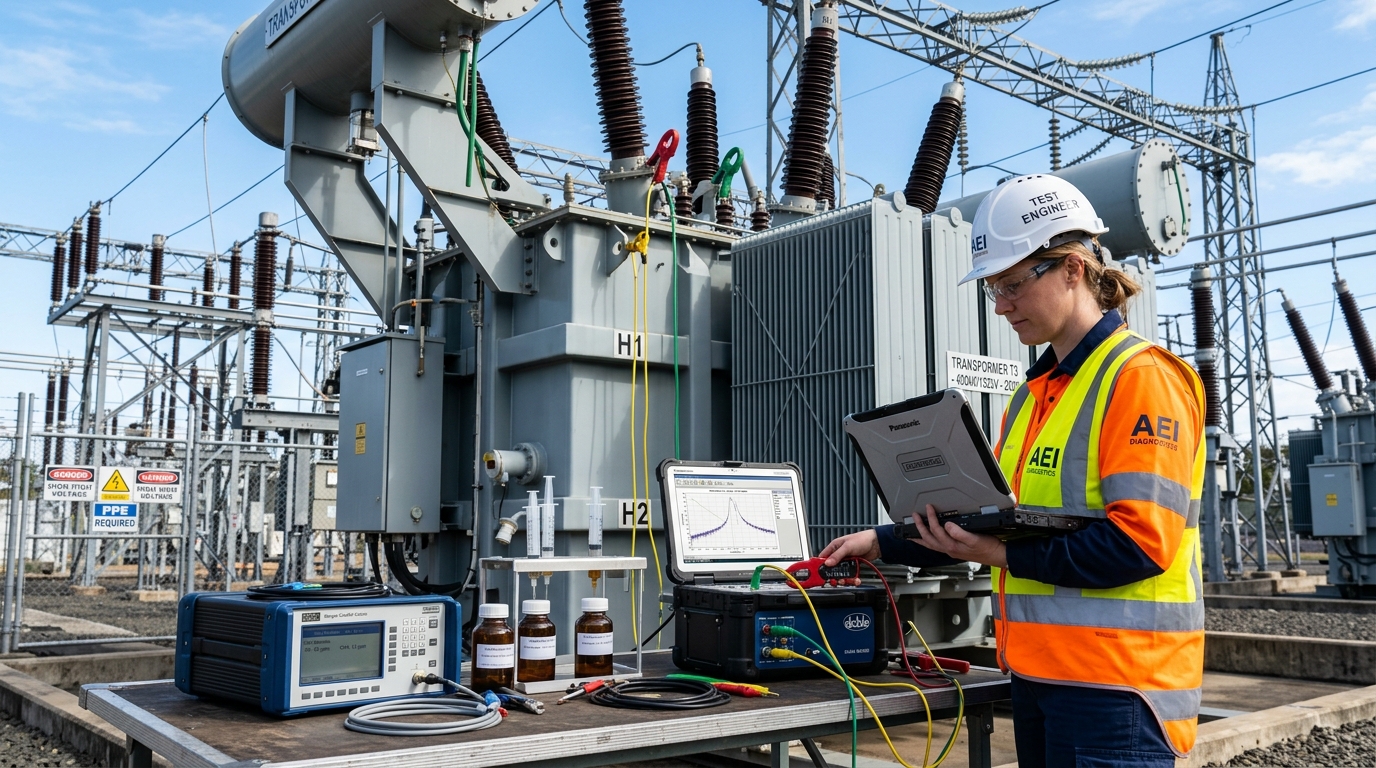
Direct Engineering Answer: Dissolved Gas Analysis (DGA) interprets fault gases (Acetylene C2H2 for arcing, Ethylene C2H4 for high-temperature thermal faults >700°C) dissolved in transformer oil using Duval Triangle ratios. Sweep Frequency Response Analysis (SFRA) injects 20Hz–2MHz frequency sweeps to detect sub-millimeter mechanical winding deformation without un-tanking the transformer.
1. The High Stakes of High-Voltage Transformer Asset Management
In Pakistan's power generation, transmission, and heavy manufacturing sectors—including IPPs, 132kV grid stations, composite textile complexes in Faisalabad, and chemical refineries in Port Qasim—power transformers rated between 2.5 MVA and 40 MVA are the most critical and expensive capital assets in the entire electrical distribution network. A single catastrophic internal failure can result in equipment replacement costs exceeding 30 to 60 Million PKR, hazardous fire hazards, and weeks of catastrophic factory production downtime.
Traditional time-based preventative maintenance—such as periodic insulation resistance (Megger) checks and basic oil breakdown voltage (BDV) tests—is reactive and incapable of detecting early-stage incipient thermal faults, low-energy dielectric tracking, or sub-millimeter mechanical winding distortion. To safeguard critical assets, modern industrial plants deploy advanced Condition-Based Predictive Maintenance powered by Dissolved Gas Analysis (DGA) and Sweep Frequency Response Analysis (SFRA). Explore our complete high-voltage power transformers catalog and diagnostic capabilities.
2. Chemical Physics of Transformer Oil Degradation & Gas Generation
Transformer mineral insulating oil is composed of a complex mixture of hydrocarbon molecules (paraffinic, naphthenic, and aromatic ring structures). Under normal operating conditions, these chemical bonds are highly stable. However, when abnormal electrical or thermal stresses occur inside the transformer tank—such as partial discharge corona, localized hotspots, or high-energy power arcs—the hydrocarbon bonds break apart via homolytic thermal and electrical cracking.
As the free radical fragments recombine, specific combustible fault gases dissolve directly into the liquid dielectric oil. Similarly, thermal breakdown of solid kraft paper and pressboard insulation releases carbon oxides ($CO$ and $CO_2$) and furanic compounds. By capturing oil samples in gastight glass syringes and analyzing gas concentrations down to parts-per-million (ppm) using Gas Chromatography (GC), electrical engineers can accurately diagnose the exact nature, severity, and development rate of internal faults.
3. Key Diagnostic Fault Gases: Hydrogen, Hydrocarbons & Carbon Oxides
Different fault mechanisms produce distinct gas fingerprints depending on the energy density and temperature of the fault zone:
| Fault Gas Molecule | Chemical Symbol | Generation Mechanism & Fault Type | Typical Alert Limit (ppm) |
|---|---|---|---|
| Hydrogen | H2 | Corona partial discharge; low-energy electrical tracking; electrolytic reactions | > 100 ppm |
| Methane | CH4 | Low-temperature thermal overheating in oil (< 300°C) | > 120 ppm |
| Ethane | C2H6 | Medium-temperature thermal oil fault (300°C – 700°C) | > 65 ppm |
| Ethylene | C2H4 | Severe high-temperature thermal fault (> 700°C) in core or winding copper | > 50 ppm |
| Acetylene | C2H2 | High-energy electrical arcing, flashover, or OLTC leakage (CRITICAL) | > 2 ppm |
| Carbon Monoxide | CO | Thermal degradation of solid cellulose paper insulation | > 350 ppm |
| Carbon Dioxide | CO2 | Normal paper aging; CO2/CO ratio < 3 indicates severe paper burning | > 2,500 ppm |
4. International Gas Concentration Action Limits (IEEE C57.104 & IEC 60599)
International standard IEEE C57.104-2019 categorizes transformer condition into four distinct risk status levels based on Total Dissolved Combustible Gas (TDCG) volume and 90th percentile gas generation rates:
- Condition 1 (Normal): TDCG ≤ 720 ppm. Transformer is operating satisfactorily; continue routine annual sampling.
- Condition 2 (Warning): TDCG 721 – 1,920 ppm. Elevated combustible gas levels present; increase sampling frequency to quarterly and conduct acoustic partial discharge mapping.
- Condition 3 (High Risk): TDCG 1,921 – 4,630 ppm. Significant incipient fault active; schedule immediate thermal imaging, power factor testing, and plan for load reduction.
- Condition 4 (Extreme Hazard): TDCG > 4,630 ppm or Acetylene > 35 ppm. Imminent transformer failure; de-energize unit immediately for inspection and internal overhaul.
5. Advanced Graphical Diagnostics: Duval Triangle 1, 4 & 5 Methods
Gas concentration values alone do not reveal the exact fault type. Michel Duval developed the Duval Triangle Graphical Method (IEC 60599), which plots the relative percentage concentrations of three key hydrocarbon gases (%CH4, %C2H4, %C2H2) on a triangular coordinate plane:
- Zone PD (Partial Discharge): High Hydrogen/Methane ratio; cold electrical breakdown in gas bubbles or void voids.
- Zone T1 (<300°C): Thermal fault in oil; loose connections, core circulating currents.
- Zone T2 (300°C–700°C): Medium thermal fault; eddy currents in structural steel clamps, magnetic flux shunts.
- Zone T3 (>700°C): Severe thermal hotspot; melting of copper conductors or magnetic core laminations.
- Zone D1 (Low Energy Discharge): Dielectric sparking, tracking in pressboard barriers.
- Zone D2 (High Energy Discharge): Sustained power arcing, winding turn-to-turn short-circuit flashover.
6. Sweep Frequency Response Analysis (SFRA): Principles & Physics
While DGA evaluates chemical degradation, Sweep Frequency Response Analysis (SFRA per IEC 60076-18) is the most sensitive non-destructive electrical test for detecting physical mechanical deformation of transformer cores and windings. An assembled transformer winding represents a distributed electrical network of series resistances ($R$), self and mutual inductances ($L$), and ground-to-turn capacitances ($C$).
During an SFRA test, a precision frequency generator injects a low-voltage sinusoidal test signal (typically 0.2V to 10V RMS) across the winding terminals while sweeping across a wide frequency range from 20 Hz to 2 MHz. A high-speed digital receiver measures the output amplitude and phase angle, generating a unique transfer function magnitude response curve ($20 \log_{10}(V_{ ext{out}} / V_{ ext{in}}) ext{ in dB}$ vs frequency).
7. Interpreting SFRA Frequency Bands (Core, Windings & Bushing Leads)
The resulting SFRA Bode plot is divided into distinct frequency sub-bands, each sensitive to specific physical components inside the transformer:
| Frequency Sub-Band | Dominant Electrical Component | Physical Fault Types Detected |
|---|---|---|
| Low Frequency (< 2 kHz) | Core Magnetizing Inductance ($L_m$) | Core lamination short-circuits, shifted core limbs, multiple core earthing defects. |
| Medium-Low (2 kHz – 20 kHz) | Mutual Inductances between Coils | Radial hoop stress winding deformation, bulk axial winding displacement. |
| Medium-High (20 kHz – 400 kHz) | Inter-Turn & Inter-Disk Capacitances | Local winding buckling, disk tilting, spacer collapse, turn-to-turn insulation shifts. |
| High Frequency (> 400 kHz) | Lead & Bushing Stray Capacitances | High-voltage lead shifting, internal tap lead movement, bushing shield defects. |
8. Dielectric Frequency Response (DFR) & Insulation Moisture Mapping
In addition to DGA and SFRA, TransfoLine performs advanced Dielectric Frequency Response (DFR / FDS) using OMICRON DIRANA test sets. DFR accurately quantifies the exact percentage of moisture trapped inside the solid cellulose insulation pressboard (e.g. 1.2% dry vs 3.8% saturated) independent of oil temperature, allowing plant managers to schedule targeted vacuum drying before insulation aging becomes irreversible. Discover our on-site oil dehydration services.
9. Case Study: Early Fault Detection in a 10 MVA Textile Substation
During a routine predictive maintenance audit at a 10 MVA 132/11kV substation in Faisalabad, TransfoLine engineers identified a sudden spike in Acetylene ($C_2H_2 = 14 ext{ ppm}$) and Ethylene ($C_2H_4 = 85 ext{ ppm}$). SFRA testing revealed a significant resonance shift in the medium-frequency band (65 kHz) on Phase W.
Immediate endoscopic tank inspection revealed that a mechanical clamping bolt had worked loose during an external transmission line fault, allowing the Phase W high-voltage coil to vibrate and arc against the core frame. Catching the defect prevented a full coil blowout, saving the mill over 45 Million PKR in catastrophic replacement costs.
10. TransfoLine Certified Mobile Testing Laboratory Services
TransfoLine operates specialized mobile diagnostic vans equipped with calibrated OMICRON FRANEO 800, DIRANA, and BAUR precision testing instruments. We provide on-site DGA, SFRA, Tan Delta, and dielectric recovery services across all industrial corridors in Pakistan. Learn more about our comprehensive 16 certified electrical testing procedures.
Frequently Asked Questions
FAQ What is the most critical fault gas in transformer oil DGA?
Acetylene (C2H2) is the most critical gas; any concentration above 2 to 5 ppm proves active, high-energy electrical arcing inside the transformer tank.
FAQ How does SFRA detect mechanical winding damage?
SFRA injects high-frequency sweeps (20Hz–2MHz) to map the winding's electrical transfer function; shifts in resonant peak frequencies prove physical coil displacement or core deformation.
FAQ How often should DGA testing be conducted in industrial facilities?
For critical industrial transformers, DGA should be conducted every 6 months, or immediately following an upstream short-circuit fault trip.
FAQ What is an acceptable Tan Delta value for a power transformer?
For new oil-immersed power transformers at 20°C, Tan Delta should be ≤ 0.5%; values exceeding 1.0% indicate moisture contamination or aging.
FAQ Can TransfoLine perform DGA testing without taking the transformer off-line?
Yes, oil sampling for DGA is performed safely via hermetic syringes while the transformer is energized and delivering full load current.
Need Direct Technical Assistance or a Factory-Direct Quote?
TransfoLine supplies, installs, overhauls, and repairs heavy industrial transformers across Pakistan with nationwide 48-hour delivery, genuine WAPDA P-10 compliance, and 12-month full warranty.