
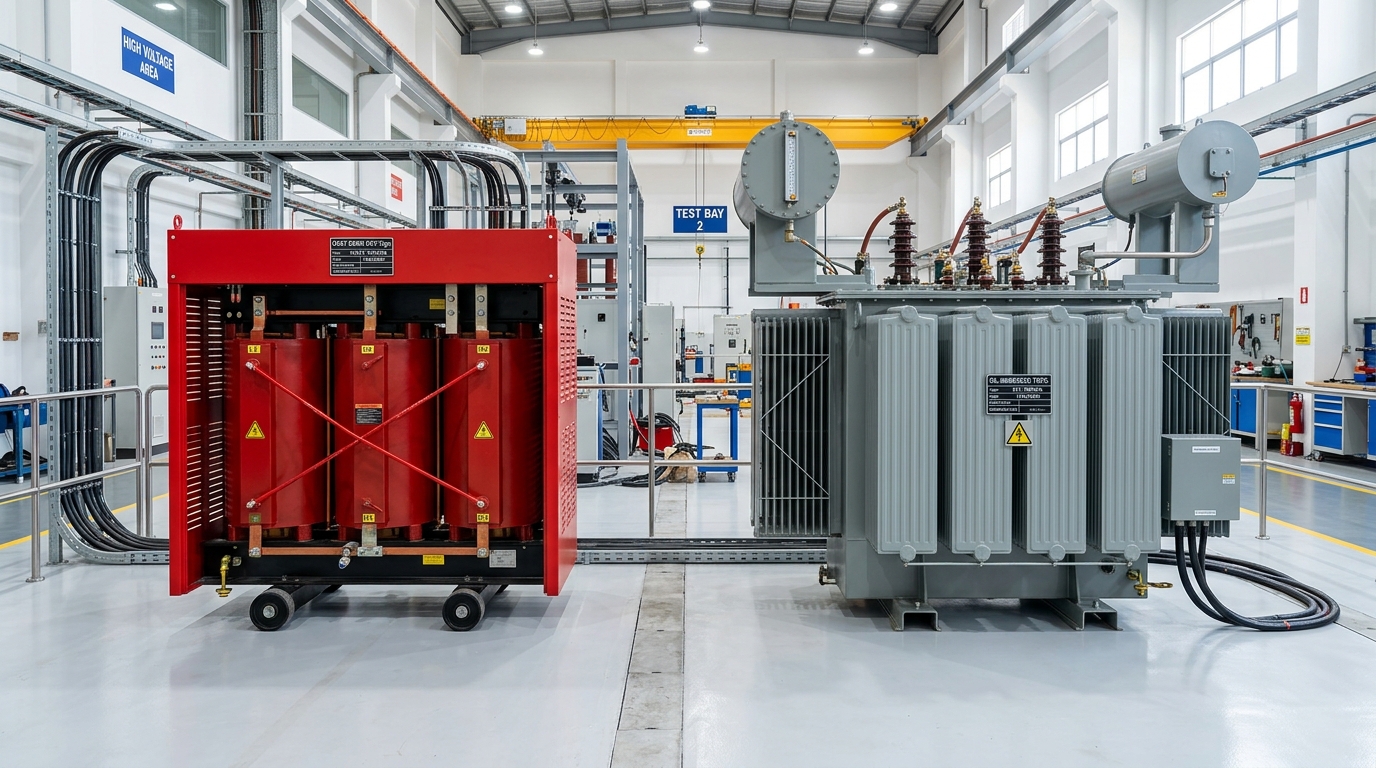
Direct Engineering Answer: Oil-immersed transformers have lower upfront capital costs (-25% to -35%) and excel in outdoor utility yards, but require ongoing dielectric BDV testing, oil dehydration, and fire containment infrastructure. Cast resin dry-type transformers have zero oil hazard, minimal maintenance, self-extinguishing fire safety, and are required for indoor basements, high-rises, and hospitals.
1. Strategic Overview: Selecting the Right Transformer Architecture
When engineering an electrical distribution substation for an industrial plant, commercial facility, or institutional campus in Pakistan, the foundational design decision revolves around specifying either an Oil-Immersed (Liquid-Filled) Transformer or a Cast Resin Dry-Type (CRT) Transformer. Both technologies have evolved significantly over decades of electrical engineering, and each possesses distinct operational advantages depending on ambient environmental conditions, installation location, fire codes, and total lifecycle budget.
Making the wrong selection can result in either excessive upfront capital expenditure or long-term operational headaches, fire hazards, and high maintenance costs. Explore our comprehensive catalogs of dry-type cast resin transformers and oil-immersed distribution transformers for full technical specifications.
2. Core Construction & Dielectric Cooling Mechanisms
The primary engineering distinction between the two architectures lies in how internal core and coil losses ($I^2R$ and hysteresis) are dissipated into the surrounding atmosphere:
- Oil-Immersed Transformers: The magnetic core and copper windings are submerged completely in refined hydrocarbon mineral insulating oil (or synthetic ester fluid). Heat is transferred from the active parts to the oil via conduction, which then circulates through external cooling radiator fins via natural thermosiphon convection (ONAN) or forced oil pumps (OFAF/OFWF).
- Cast Resin Dry-Type Transformers: The high-voltage windings are vacuum-cast in solid epoxy resin containing quartz silica fillers, while low-voltage windings are vacuum-pressure impregnated. Heat is dissipated directly to ambient air through vertical cooling channels via natural air convection (AN) or cross-flow booster fans (AF).
3. Side-by-Side Comprehensive Engineering Comparison Table
| Comparison Factor | Cast Resin Dry-Type (CRT) | Oil-Immersed (Mineral Oil) |
|---|---|---|
| Fire Safety & Flammability | 100% Non-Flammable / Self-Extinguishing (F1) | Combustible liquid; flashpoint ≈ 140°C |
| Initial Purchase Price (CapEx) | Higher (+25% to +40% premium) | Lower (Standard industrial baseline) |
| Routine Maintenance | Zero fluid testing (Dust vacuuming only) | Regular BDV testing, DGA, oil filtration, gaskets |
| Installation Location | Indoor basements, high-rises, hospitals | Outdoor yards, pole mounts, substation bays |
| Civil Infrastructure Needs | Simple flat plinth (Zero oil pit needed) | Requires concrete oil soak pit & fire barriers |
| Environmental Pollution Risk | Zero soil or groundwater contamination | Risk of catastrophic oil leaks and ground spills |
| Overload Capability | Up to +40% with automated AF cooling fans | High thermal inertia from large oil mass |
| Moisture & Dust Ingress | Class E2/C2 certified; solid epoxy barrier | Fully sealed hermetic tank |
4. Capital Cost (CapEx) vs 30-Year Operating Cost (OpEx) Analysis
While an oil-immersed transformer has a lower purchase invoice price, plant managers must evaluate the Total Cost of Ownership (TCO) across a 30-year lifecycle:
- Civil Construction Costs: Building an underground oil retention pit, fire barrier walls, and deluge sprinkler piping for a 1,000 kVA oil transformer adds Rs. 800,000 to Rs. 1,500,000 in civil CapEx.
- Maintenance OpEx: Over 20 years, semi-annual dielectric oil BDV testing, mobile vacuum dehydration, nitrogen purging, and bushing gasket replacements average Rs. 120,000 annually (Rs. 2.4 Million total).
- Insurance Premium Savings: Commercial facilities powered by cast resin units enjoy 15% to 25% lower property fire insurance premiums.
When evaluated over 15 to 20 years in an indoor commercial facility, the total cost of ownership of Cast Resin Dry-Type transformers is frequently 10% to 15% lower than oil-filled units.
5. Fire Safety, Environmental Impact & Civil Footprint Requirements
In environmentally sensitive zones, water catchment areas, and crowded commercial plazas across Lahore, Karachi, and Islamabad, the risk of mineral oil leakage poses severe environmental liabilities. A single cracked radiator fin can discharge 1,500 liters of dielectric oil into municipal stormwater drains. Cast resin dry-type transformers contain zero liquids, providing complete environmental peace of mind and full compliance with EPA standards.
6. Maintenance Requirements: Periodic Testing vs Zero-Fluid Care
Maintaining an oil-immersed fleet requires scheduled physical shutdowns for oil sampling, breakdown voltage (BDV) measurement per IEC 60156, moisture content Karl Fischer titration, and Dissolved Gas Analysis (DGA). In contrast, cast resin dry-type transformers require only an annual visual inspection and vacuuming of superficial atmospheric dust from cooling ducts using compressed air during routine plant turnarounds. Explore our oil dehydration services and preventive AMC programs.
7. Overload Capacity & Forced Air (AF) Dynamic Sizing
One of the major advantages of modern Cast Resin transformers is dynamic forced-air overload capability. By integrating cross-flow tangential cooling blowers at the base of the coil ducts, a dry-type transformer rated at 1,000 kVA AN (Air Natural) can continuously deliver 1,400 kVA AF (Air Forced)—a massive 40% capacity boost—allowing facilities to handle unexpected peak loads without tripping or investing in larger transformers.
8. Acoustic Noise & Sound Attenuation Differences
In oil transformers, the surrounding oil and steel tank naturally dampen core vibration hum. Cast resin units emit sound directly into the surrounding room. However, by utilizing precision step-lap mitered core joints and anti-vibration neoprene elastomer isolation pads, TransfoLine dry-type transformers achieve sound levels below 50 dB, ensuring quiet operation near occupied offices.
9. Climate Resistance: Monsoon Humidity & Desert Heat in Pakistan
Cast resin units certified to Class E2 (IEC 60076-11) are immune to condensation and high humidity during Pakistan's monsoon season. Even after prolonged shutdowns, they require no pre-drying and can be energized immediately with 100% reliability.
10. Application Decision Framework: Where to Deploy Each Type
- Specify Cast Resin Dry-Type For: Commercial shopping malls, multi-story office basements, hospitals, clean rooms, data centers, airport terminals, and indoor textile weaving halls.
- Specify Oil-Immersed Transformers For: Outdoor utility distribution networks, housing society pole-mounted grids, dedicated industrial switchyards, steel induction melting furnaces (OFWF), and remote rural agricultural tube wells.
11. Real-World Case Study: Plaza Substation Retrofit in Gulberg, Lahore
A premier multi-tenant commercial tower in Gulberg III, Lahore, was instructed by the local civil defense and building development authority to replace its aging 1,250 kVA oil-filled basement transformer following updated municipal fire safety audits. The building management faced severe space constraints, as constructing an outdoor substation yard would eliminate 6 prime ground-floor parking slots valued at over Rs. 18 Million in commercial rental utility.
TransfoLine engineered a complete turnkey indoor retrofit: decommissioning and rigging out the old oil transformer, preparing the basement floor without requiring an oil catch pit, and installing a modern 1,250 kVA Class F Cast Resin Dry-Type Transformer with IP21 enclosure and automated cross-flow cooling fans. The entire changeover was executed over a 36-hour weekend window, maintaining full building power through temporary generator synchronization. The project saved valuable parking real estate, met 100% of municipal fire codes, and reduced the building's annual electrical maintenance budget by 70%.
Frequently Asked Questions
FAQ Why is dry-type transformer initial cost higher than oil-filled?
Dry-type transformers require specialized vacuum epoxy casting machinery, premium Class F/H resin insulation compounds, and laser-cut prime CRGO core steel, resulting in higher manufacturing costs.
FAQ Can oil-immersed transformers be legally installed in commercial basements in Pakistan?
Only if equipped with blast-proof fire separation walls, 100% volume oil soak pits, automatic deluge fire suppression, and municipal building authority NOC approvals.
FAQ What is the efficiency difference between dry and oil transformers?
Both architectures achieve 98.5% to 99.2% electrical efficiency; modern low-loss CRGO dry-type units match high-efficiency WAPDA DDS-84 oil units.
FAQ How does ambient humidity affect cast resin transformers in monsoon?
Cast resin CRT units are Class E2 certified, meaning solid epoxy resin completely blocks moisture penetration, allowing immediate energization even in 95% humidity.
FAQ Can TransfoLine convert an existing oil substation to a dry-type unit?
Yes, TransfoLine executes complete turnkey substation retrofits, removing old oil transformers and installing compact cast resin units with new busbar links.
Need Direct Technical Assistance or a Factory-Direct Quote?
TransfoLine supplies, installs, overhauls, and repairs heavy industrial transformers across Pakistan with nationwide 48-hour delivery, genuine WAPDA P-10 compliance, and 12-month full warranty.