
First 15 Minutes: Critical Substation Safety & Isolation Protocol
When an industrial transformer fails under full load in a Lahore manufacturing facility, the immediate environment changes from an orderly production floor into a severe high-voltage life-safety hazard. The catastrophic failure of dielectric insulation or an internal short-circuit fault generates explosive acoustic shockwaves, rapid thermal vaporisation of transformer mineral oil, and potential arc flash blasts exceeding 15,000°C.
Before calling maintenance technicians or worrying about production delivery deadlines, the factory electrical engineer or shift supervisor must enforce this non-negotiable 4-step safety lockdown:
1. Complete High-Voltage (HT) and Low-Voltage (LT) Electrical Isolation
Never rely on automatic trip indications alone. Manually trip the upstream 11kV Vacuum Circuit Breaker (VCB) or drop the pole-mounted gang-operated disconnector (GOD) switch on your dedicated industrial feeder. Immediately rack out the LT Air Circuit Breakers (ACB) or main low-tension incoming motorized switchgear on the secondary side. This prevents dangerous back-feeding from standby diesel generator sets (gensets) or commercial solar rooftop grid-tied inverters.
2. Substation Evacuation & 15-Metre Perimeter Exclusion
Evacuate all operators, helpers, and maintenance personnel from the indoor transformer vault or outdoor pad-mounted bay. Establish a rigid 15-metre safety cordon. If the transformer tank is bulging, boiling, or hissing, the internal pressure relief valve (PRV) may discharge superheated combustible hydrocarbon gases. Under no circumstances should non-certified personnel approach the enclosure.
3. Visual Inspection from Safe Distance & Oil Spill Containment
Assess the transformer from outside the exclusion line with safety glasses and flame-retardant PPE. Look for visible arcing marks on the 11kV porcelain or silicon rubber bushings, ruptured explosion vents, or oil overflowing into the gravel soak pit. If mineral oil is spreading towards factory storm drains or cable trenches, deploy dry sand barriers or absorbent bunding pillows immediately. Warning: Never use water hoses on a transformer fire. If flames ignite, call Rescue 1122 and employ Class B dry chemical powder (DCP) or carbon dioxide (CO2) wheeled trolleys.
4. Lock-Out / Tag-Out (LOTO) Verification
Apply physical padlock hasps and high-visibility warning tags to both the HT breaker operating handle and the LT main bus coupler. In Lahore industrial estates, catastrophic secondary electrocutions frequently occur when uncoordinated shift teams attempt to reset a tripped LESCO breaker without verifying transformer internal isolation.
The True Cost of Transformer Downtime in Lahore Factories
In manufacturing corridors such as Sundar Industrial Estate, Quaid-e-Azam Industrial Estate (Kot Lakhpat), Multan Road, and Sheikhupura Road, the direct cost of rewinding a burnt transformer is merely a fraction of the total economic loss suffered during an unmanaged outage.
The table below breaks down the typical hourly and daily revenue losses experienced across major industrial sectors in Lahore when a primary substation transformer suffers an unpredicted burnout:
| Industry Sector in Lahore | Typical Substation kVA | Hourly Production Loss (PKR) | Raw Material / Batch Loss | 48-Hr Unplanned Outage Total |
|---|---|---|---|---|
| Textile Spinning & Weaving (Kot Lakhpat / Manga) | 1,500 kVA to 2,500 kVA | PKR 450,000 – 850,000 | Broken yarn spools, machine recalibration | PKR 22,000,000+ |
| Pharmaceutical Formulations (Sundar IE) | 630 kVA to 1,250 kVA | PKR 600,000 – 1,200,000 | Spoiled sterile batches, HVAC cleanroom failure | PKR 35,000,000+ |
| Plastics & Polymer Injection (Multan Road) | 400 kVA to 800 kVA | PKR 250,000 – 500,000 | Hardened polymer inside extruders/screws | PKR 14,000,000+ |
| Steel Re-Rolling & Foundries (Badami Bagh / Muridke) | 2,000 kVA to 6,300 kVA | PKR 800,000 – 1,800,000 | Frozen furnace melts, refractory lining cracking | PKR 50,000,000+ |
| Food Processing & Cold Storage (Ferozepur Rd) | 500 kVA to 1,000 kVA | PKR 300,000 – 600,000 | Perishable inventory thaw & spoilage | PKR 18,000,000+ |
When financial losses accumulate at this velocity, waiting 5 to 7 days for a conventional rewinding workshop or attempting to negotiate bureaucratic utility channels will cripple annual operational margins. Rapid on-site triage and temporary standby loaner transformers are essential.
Immediate Diagnostic Triage: What Protection Relays Are Telling You
Before an emergency repair team arrives on-site from Raiwind Road, factory electrical engineers should inspect the control panel protection flags. Modern industrial substations in Lahore utilize numerical or electromechanical protection relays that capture the exact operating parameters at the millisecond of tripping.
1. Buchholz Relay Trip (Gas Collection vs. Surge Valve)
On conservator-type oil-immersed transformers, the double-float Buchholz relay is the most informative diagnostic device. Inspect the inspection sight glass on the relay chamber:
- Gas Accumulation (Alarm Stage): If pale grey or yellowish gas is trapped in the chamber, low-energy internal partial discharges or localized overheating of paper insulation is taking place. Take an immediate oil sample for Dissolved Gas Analysis (DGA).
- Surge Trip (Contact Stage): If the lower mercury/reed switch has tripped, a violent high-energy internal arc occurred, displacing a wave of insulating oil toward the conservator. Never re-energize a transformer that has suffered a Buchholz surge trip without internal tank de-tanking and high-voltage bay testing.
2. Instantaneous Overcurrent (50) vs. Time-Overcurrent (51)
An instantaneous trip (50) indicates a direct low-impedance short circuit—either a phase-to-phase flashover on the 11kV busbars or an internal primary winding inter-turn dead short. A time-delayed overcurrent trip (51) suggests sustained plant overloading, low power factor, or un-cleared downstream motor stall currents that heated the windings beyond thermal boundaries.
3. Restricted Earth Fault (64R / REF) and Residual Earth Fault (51N)
An earth fault trip signifies insulation breakdown between an energized phase conductor and the grounded core or tank wall. In Lahore's humid monsoon months (July–August), moisture ingress through cracked silica gel breathers or hardened cork gaskets frequently causes LT star-point neutral insulation to flash over to ground.
4. Winding & Top-Oil Temperature Indicators (OTI / WTI)
Check the reset needles on the dial thermometers. If the top oil exceeded 85°C or winding temperature exceeded 105°C (under standard 40°C Lahore ambient design), the core-and-coil assembly has experienced severe thermal degradation, requiring immediate oil breakdown voltage testing and insulation resistance measurement.
Mobilizing 24/7 Mobile Testing Vans in Lahore Industrial Estates
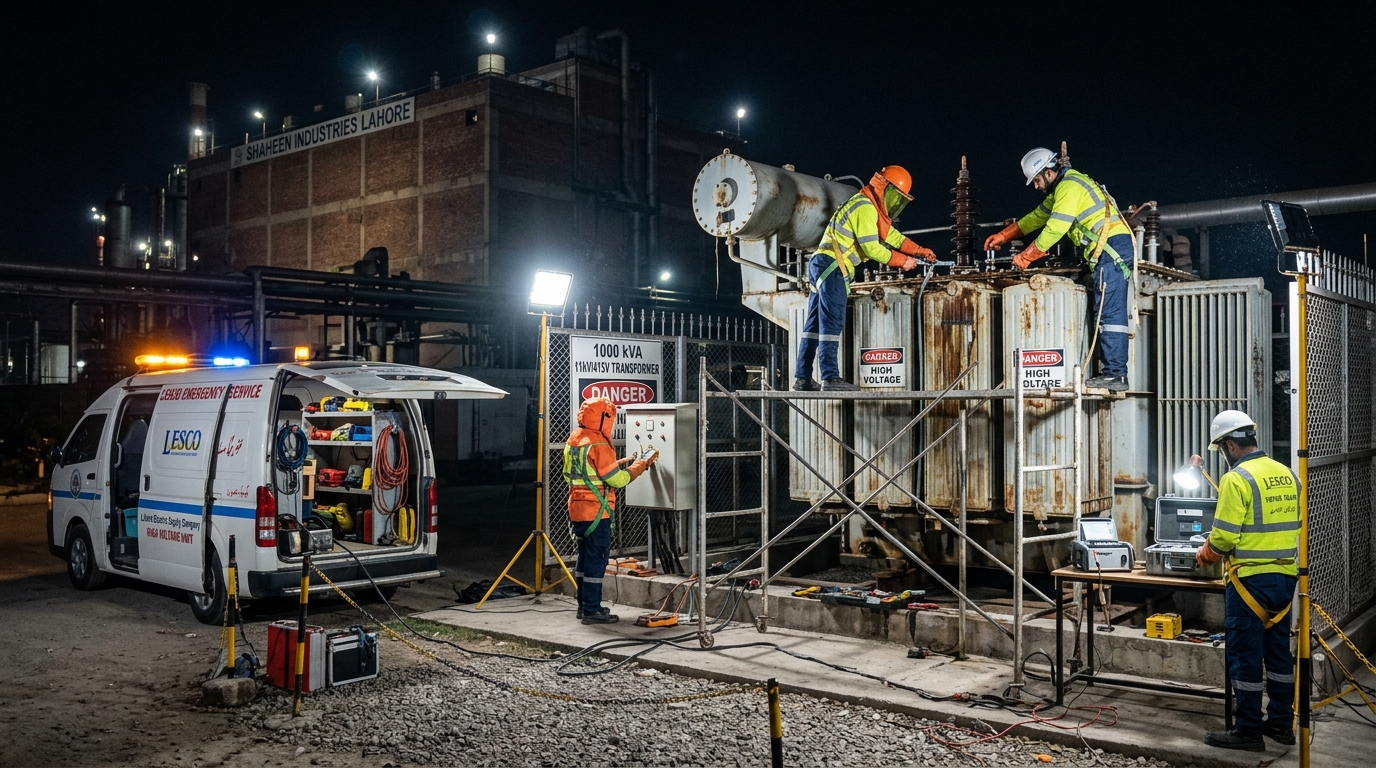
TransfoLine operates a dedicated 24-hour rapid response emergency engineering fleet stationed on Raiwind Road, Lahore. When you contact our emergency helpline (0300 6919113), our high-voltage field crew mobilizes within 15 minutes with precision diagnostic equipment.
Our on-site testing protocol executed inside your substation encompasses five calibrated checks:
- Insulation Resistance (Megger Test) at 2.5kV / 5kV DC: Measures primary-to-secondary (HT-LT), primary-to-earth (HT-E), and secondary-to-earth (LT-E) resistance in megaohms/gigaohms. A healthy 11kV transformer at 30°C must exhibit > 500 MΩ. Readings below 20 MΩ indicate catastrophic moisture absorption or carbon tracking.
- Transformer Turns Ratio (TTR) & Phase Displacement: Verifies voltage ratios across all tap changer positions (Taps 1 through 5). Any ratio deviation > 0.5% compared to nameplate ratings pinpoints an internal inter-turn coil short circuit.
- DC Winding Resistance (Micro-Ohmmeter): Measures electrical resistance of all three phases (U-V, V-W, W-U) to 0.001 mΩ precision. Resistance unbalance exceeding 2% proves loose internal crimping, broken copper strands, or burned tap changer contacts.
- Oil Dielectric Breakdown Voltage (BDV Test): A fresh 500ml oil sample is drawn from the bottom drain valve and tested in our van's automated 80 kV test vessel across spherical electrodes. WAPDA DDS-84 requires > 40 kV. In failed transformers, BDV often drops below 18 kV due to suspended carbon and dissolved water.
- Magnetic Balance Test at Low AC Voltage (230V): Injects low-voltage single-phase AC into one winding and measures induced voltage across the remaining phases to detect core mechanical displacement or crushed lamination limbs.
On-Site Repair vs. Workshop Transit: Making the Call in 60 Minutes
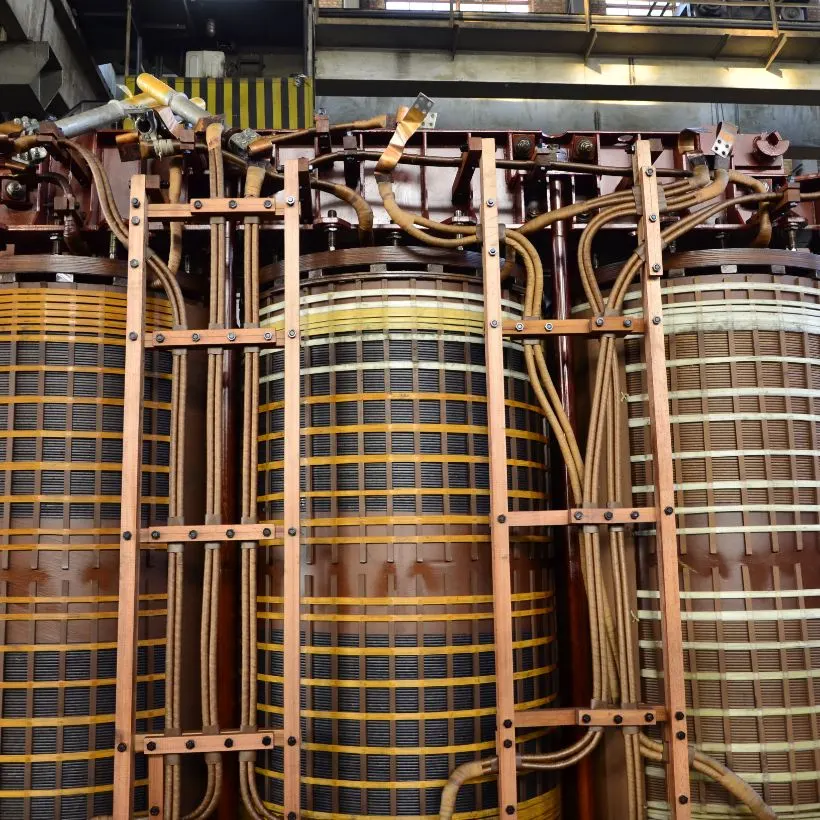
One of the most critical decisions during an emergency is determining whether the fault can be resolved directly inside your factory substation or if the transformer must be decoupled, rigged onto a hydraulic crane truck, and transported to our Raiwind Road workshop facility.
Here is our engineering triage decision matrix:
| Fault Classification | Diagnostic Indicators | Execution Path | Expected Turnaround |
|---|---|---|---|
| External Bushing Flashover | Cracked porcelain, carbon tracks, Megger HT-E low | On-Site Repair | 3 to 6 Hours |
| Severe Oil Degradation / Moisture | BDV < 25 kV, water > 35 ppm, coils intact | On-Site Vacuum Filtration | 8 to 14 Hours |
| Perimeter Gasket Oil Leaks | Seeping oil around tank flange, conservator, valve | On-Site Gasket Overhaul | 4 to 8 Hours |
| Inter-Turn Winding Short Circuit | TTR error > 2%, burnt smell, DGA acetylene > 50 ppm | Workshop Rewinding Transit | 48 to 72 Hours |
| Core Flashover / Lamination Melting | High no-load excitation current, severe buzzing noise | Workshop Re-Coring Transit | 3 to 5 Days |
The Zero-Downtime Secret: Deploying Emergency Standby Loaners
When diagnostic testing confirms that internal winding replacement is required, conventional workshops inform factory owners that production must remain halted for 4 to 6 days while copper is stripped, re-wound, varnished, and baked. For a continuous manufacturing plant, a 5-day blackout translates to dozens of millions of rupees in lost contracts.
TransfoLine eliminates this downtime entirely through our Standby Loaner Program.
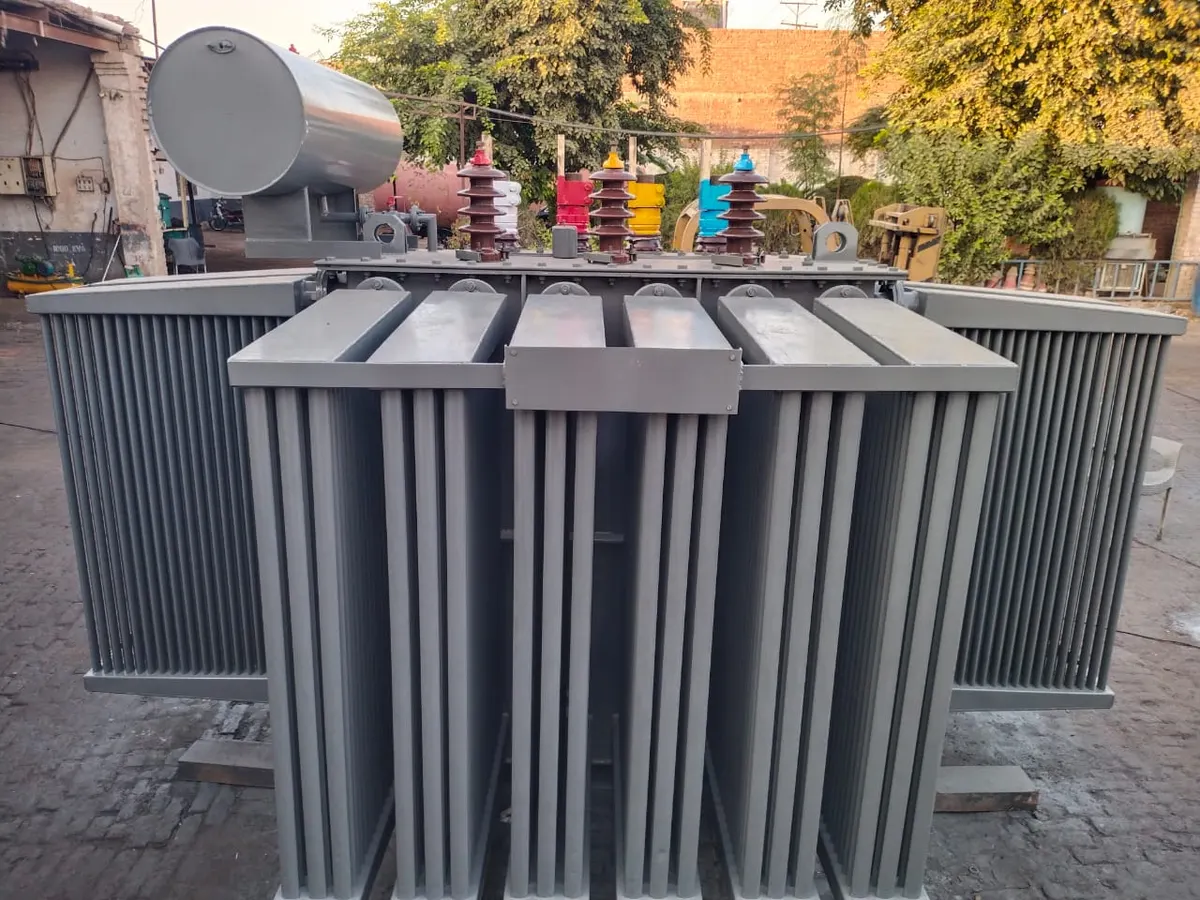
At our central Raiwind Road yard, we maintain an emergency inventory of over 50 fully certified, tested, and WAPDA P-10 compliant distribution transformers ranging from 50 kVA up to 2,500 kVA. When a major overhaul is confirmed, our logistics team executes a synchronized two-way deployment:
- Our heavy boom crane truck arrives at your factory carrying a calibrated standby loaner unit matched to your exact primary (11kV) and secondary (400V/415V) substation voltage taps.
- While your burnt transformer is being disconnected and unbolted from the plinth, our rigging crew offloads the loaner transformer onto adjacent staging pads.
- We connect temporary HT drop cables and LT busbars, calibrate protection relays to match the loaner impedance, conduct a baseline insulation test, and re-energize your plant within hours.
- Your damaged transformer is securely transported to our workshop for precision winding reconstruction without production pressure compromising quality standards.
Coordinating with LESCO for Feeder Isolation & Re-Energization
Executing high-voltage transformer repair in Lahore requires seamless coordination with the Lahore Electric Supply Company (LESCO). Whether your factory is fed from the Sundar 132kV Grid Station, Kot Lakhpat Grid, Manga Mandi Grid, or Bund Road Grid, touching the 11kV incoming terminal without an authorized LESCO Permit to Work (PTW) is illegal and lethal.
TransfoLine's licensed engineers manage the complete utility interface on your behalf:
- Sub-Divisional Officer (SDO) & Line Superintendent (LS) Coordination: We contact the relevant LESCO sub-division to submit urgent shutdown requests, verify feeder tripping logs, and obtain written PTW clearance.
- Line Earthing & Disconnection: Our certified high-voltage electricians verify feeder dead-line status, apply portable grounding clamps across all three 11kV phases, and open the gang-operated disconnector (GOD) switch.
- Testing Clearance & Re-Energization: Once repair work or loaner connection is completed, we submit an official signed and stamped high-voltage insulation test certificate to LESCO operating engineers to authorize immediate feeder breaker closing.
Post-Emergency Recovery & Long-Term Failure Prevention
After emergency repair or rewinding is completed and your facility is safely running, the priority shifts to ensuring that the same failure never reoccurs. TransfoLine implements a 4-point post-recovery hardening protocol:
- Digital Power Quality & Harmonic Logging: We install a 3-phase power quality analyzer on your main switchgear for 48 hours to identify unbalance, voltage sags, and harmonic resonance generated by variable frequency drives (VFDs) or induction furnaces.
- Thermographic Infrared Inspection: Within 48 hours of energization under 80% to 100% full production load, our Level II thermographers scan all cable terminations, bushing lugs, and radiator fins using calibrated FLIR thermal imagers to identify latent hot spots.
- Annual Maintenance Contract (AMC): Scheduled bi-monthly oil dielectric BDV sampling, silica gel recharging, and contact resistance measurement to guarantee 100% uptime year-round.
Frequently Asked Questions
FAQ How fast can TransfoLine's emergency repair team reach our factory in Lahore?
For all major industrial estates in Lahore—including Sundar Industrial Estate, Kot Lakhpat (Quaid-e-Azam Industrial Estate), Multan Road corridor, and Sheikhupura Road—our mobile diagnostic testing van arrives on-site within 2 to 4 hours of your emergency call. For facilities located along Raiwind Road or Manga Mandi, response time is under 90 minutes.
FAQ Can you provide a temporary loaner transformer while our unit is being rewound?
Yes. TransfoLine maintains an emergency inventory of over 50 ready-to-dispatch certified transformers at our Raiwind Road yard from 50 kVA to 2,500 kVA. We deliver and connect a temporary loaner transformer so your factory production continues without downtime while your damaged unit is undergoing workshop rewinding.
FAQ Do you handle the official LESCO shutdown and energization permissions?
Yes. Our licensed high-voltage electrical engineers coordinate directly with the relevant LESCO grid station, SDO, and line superintendents to obtain the official Permit to Work (PTW), execute safe feeder earthing, and provide stamped test certificates for immediate re-energization.
FAQ What is the cost of emergency transformer repair in Lahore?
On-site emergency repairs such as bushing replacements, gasket sealing, tap changer cleaning, or vacuum oil filtration typically range from PKR 45,000 to PKR 160,000 depending on kVA size. Complete workshop rewinding of a burnt 200 kVA to 1000 kVA transformer ranges from PKR 180,000 to PKR 950,000 with 99.99% pure electrolytic copper wire and a 1-year warranty.
FAQ What happens if a transformer fails in the middle of the night or on Sunday?
Our emergency hotline (0300 6919113) is operational 24 hours a day, 7 days a week, 365 days a year. We maintain an on-duty standby crew, mobile testing vehicle, and crane truck ready for immediate dispatch at 2 AM on a Sunday or during public holidays.

TransfoLine Electrical Engineering Team
Specialized in industrial high-voltage substations, transformer rewinding, and power quality diagnostics across Pakistan. Based on Raiwind Road, Lahore with 18+ years of field experience and 10,000+ energized installations.
Urgent Transformer Breakdown in Lahore?
Our emergency mobile testing team arrives on-site in Sundar, Kot Lakhpat, Multan Road, or Sheikhupura within 2 to 4 hours. Standby loaner transformers available.