
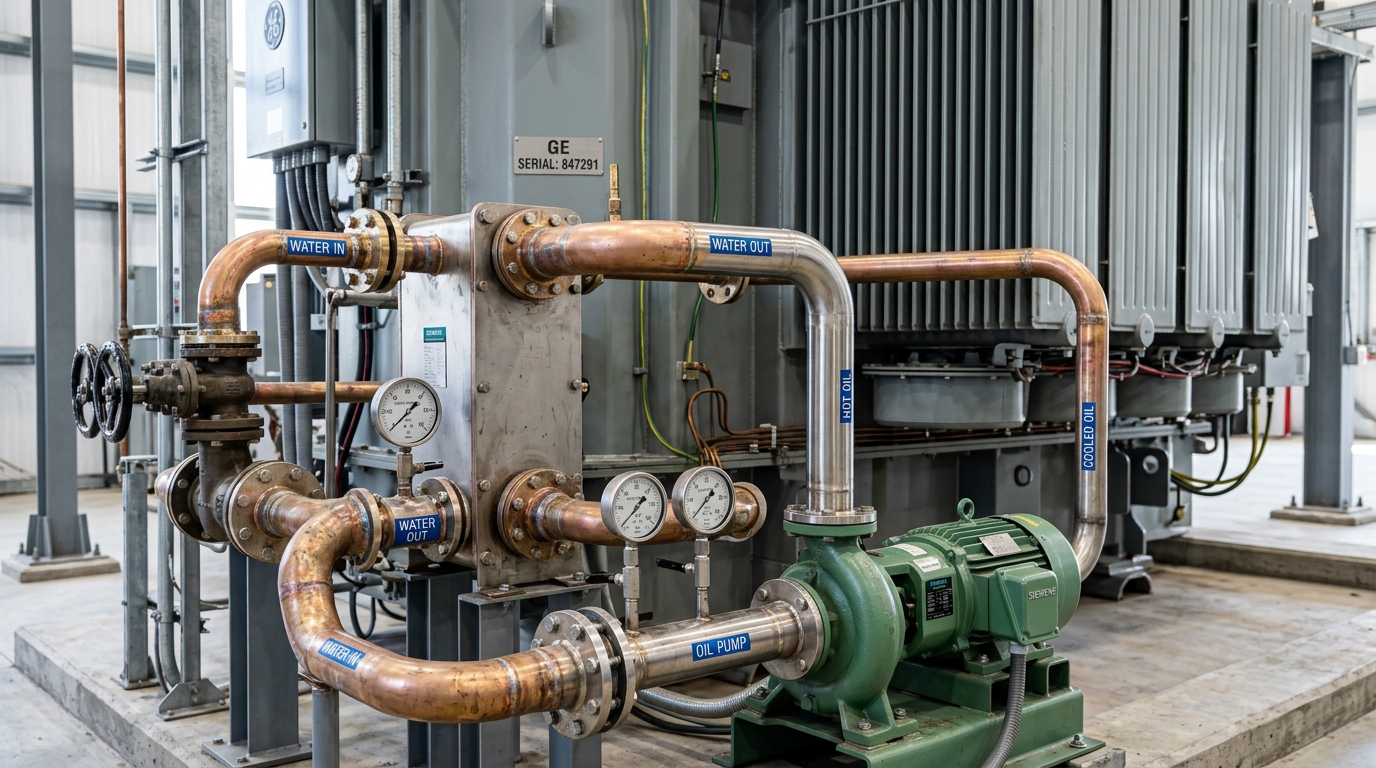
Direct Engineering Answer: In furnace transformers, Oil Forced Water Forced (OFWF) cooling is mandatory to dissipate high heat loads. Scaling in raw bore water tubes reduces cooling by over 40%, causing oil temperatures to spike past 90°C. Maintaining higher oil pressure than water pressure prevents catastrophic water contamination, while quarterly acid descaling and DGA testing prevent winding burnouts.
1. Thermal Overheating: The #1 Cause of Furnace Transformer Failure
In Pakistan's intense summer climate, ambient temperatures in steel foundry zones regularly exceed 45°C. When combined with continuous 100% melting loads, furnace transformers rely entirely on their Oil Forced Water Forced (OFWF) cooling systems to dissipate massive core and coil heat.
If raw bore water or unconditioned cooling tower water is circulated through the copper heat exchanger tubes, mineral scale (calcium and magnesium carbonate) deposits rapidly inside the tubes. A 1mm scale layer reduces thermal heat transfer efficiency by over 40%, causing oil temperatures to spike past 90°C and degrading insulation paper. Discover our complete furnace transformer solutions and maintenance protocols.
2. Anatomy & Operating Principles of OFWF Heat Exchangers
An OFWF cooling module consists of a heavy shell-and-tube heat exchanger mounted directly to the transformer tank side. Mineral insulating oil is drawn from the top of the transformer tank by a centrifugal oil pump, forced through the outer shell around a bundle of seamless copper or cupro-nickel tubes, and returned cooled to the bottom of the core assembly. Chilled water from the factory cooling tower circulates inside the tubes in a counter-flow direction to maximize the logarithmic mean temperature difference (LMTD).
3. Maintaining Positive Oil-to-Water Differential Pressure
The cardinal rule of OFWF heat exchanger operation is positive oil differential pressure. The oil pressure inside the shell must always exceed the circulating water pressure by at least 0.5 bar to 1.0 bar (7 to 15 PSI). In the event that a copper tube develops pinhole corrosion or mechanical fretting wear, transformer oil will leak outward into the cooling water drain rather than allowing high-conductivity cooling water into the transformer oil tank, which would cause an instant phase-to-earth dielectric flashover.
4. Chemical Descaling Protocols for Cupro-Nickel Tubes
When scale accumulates, heat transfer drops sharply. TransfoLine field teams execute specialized on-site chemical descaling without un-mounting the heat exchanger:
- Isolation & Fresh Water Flush: Isolate the water inlet/outlet valves and flush with low-pressure water to remove loose silt.
- Inhibited Acid Circulation: Circulate a 5% to 8% solution of inhibited sulfamic acid with copper corrosion inhibitors for 2 to 4 hours using an external acid-proof diaphragm pump.
- Neutralization: Flush with a mild 1% sodium carbonate neutralizing solution until pH stabilizes at 7.0–7.5.
- Hydrostatic Pressure Testing: Pressure test the tube bundle at 6.0 bar for 30 minutes to verify zero tube leakage before re-commissioning.
5. Dual-Pump Redundancy & Flow Sensor Automation
To prevent instant overheating during pump failure, modern furnace substations feature dual 100% capacity oil pumps and water differential pressure switches connected to the main control panel. If pump #1 trips on overload or flow drops below 150 liters/min, the control PLC triggers pump #2 within 1.5 seconds and alerts operators.
6. Dissolved Gas Analysis (DGA) for Overheating Detection
Even minor localized overheating of transformer windings generates characteristic thermal decomposition gases in the oil. TransfoLine performs bi-monthly Dissolved Gas Analysis (DGA) via gas chromatography. Elevated levels of Ethylene (C2H4) and Methane (CH4) indicate thermal faults between 300°C and 700°C, allowing corrective action before catastrophic insulation breakdown.
7. High-Vacuum Mobile Oil Dehydration & Dielectric Recovery
If moisture or thermal sludge accumulates in your furnace transformer oil, TransfoLine dispatches high-flow mobile oil dehydration trailers directly to your factory in Lahore, Faisalabad, Gujranwala, or Karachi. Our multi-stage high-vacuum filtration restores oil Breakdown Voltage (BDV) to >65 kV while keeping factory downtime to an absolute minimum.
8. Preventive AMC Schedules for Steel Foundries in Pakistan
Under our Annual Maintenance Contracts (AMC), TransfoLine engineers conduct monthly infrared thermography scans of busbar connections, quarterly oil BDV/moisture tests, and semi-annual heat exchanger descaling to ensure 100% plant uptime.
10. Complete Step-by-Step Oil Dehydration & Vacuum Degassing Workflow
When transformer dielectric oil suffers moisture contamination (water content > 30 ppm) or dielectric breakdown voltage drops below 40 kV, TransfoLine executes a standardized 6-stage high-vacuum oil treatment process:
- Initial Laboratory Oil Sampling: Syringe sampling from top and bottom drain valves for baseline Karl Fischer moisture titration, acidity (TAN), interfacial tension (IFT), and Dissolved Gas Analysis (DGA).
- Closed-Loop Hose Hookup: Heavy-duty oil-resistant stainless steel braided hoses are coupled to the transformer bottom drain valve (suction) and top conservator/tank inlet (discharge).
- Thermostatic Stage Heating: Oil is heated progressively to 60°C–65°C using low-watt-density ceramic heating elements to release bound moisture from cellulose fibers without thermal cracking.
- Multi-Stage Vacuum Degassing: Inside the two-stage vacuum chamber operating at < 0.05 mbar absolute pressure, the heated oil is sprayed through helical atomizing nozzles, creating micro-droplets that flash off dissolved water and trapped combustible gases.
- Sub-Micron Coalescence Filtration: Three-stage particulate filters (10-micron primary, 3-micron secondary, and 0.5-micron fine tertiary) remove carbon soot, metal wear particles, and suspended fibers.
- Final Proof Testing: Continuous online dielectric testing until Breakdown Voltage (BDV) exceeds 65 kV / 2.5 mm and moisture content drops below 10 ppm.
11. Water Conditioning & Cooling Tower Maintenance Schedule
To prevent mineral scale formation inside cupro-nickel heat exchanger tubes, plant operators must implement a strict daily and weekly water treatment routine: maintain blowdown cycles to keep Total Dissolved Solids (TDS) under 1,000 ppm, dose organic scale inhibitors (polyacrylates) and non-oxidizing biocides to prevent algae buildup, and inspect differential pressure gauges across oil and water lines daily. An increase in differential pressure of > 0.4 bar indicates tube fouling requiring immediate mechanical cleaning.
12. Dissolved Moisture Dynamics: Oil-Paper Equilibrium (Piper & Fabre Chart)
In high-temperature furnace transformers, moisture partitions dynamically between the liquid mineral oil and the solid kraft insulation paper according to thermodynamic equilibrium (described by the Fabre-Pichon curves). As oil temperature increases during a melting heat cycle, water molecules migrate from the hot paper into the oil, lowering oil dielectric BDV. During night shutdowns when the transformer cools down, moisture is reabsorbed into the paper, accelerating paper aging.
TransfoLine's vacuum dehydration processes extract moisture directly from both the circulating oil and the solid cellulose insulation structure, ensuring long-term insulation health and high operational reliability.
Frequently Asked Questions
FAQ Why must transformer oil pressure be higher than water pressure?
Maintaining oil pressure higher than water pressure ensures that in the event of an internal copper tube puncture, oil leaks outward into the water rather than water entering the high-voltage transformer tank.
FAQ What is the maximum safe operating oil temperature for a furnace transformer?
Top oil temperature should never exceed 75°C to 80°C under continuous full melting load; alarms should trigger at 85°C and emergency trips at 95°C.
FAQ How often should furnace heat exchangers be chemically descaled in Punjab?
Due to high mineral hardness in underground bore water across Punjab, heat exchangers should be descaled every 3 to 4 months.
FAQ What oil breakdown voltage (BDV) is required for furnace transformers?
In-service furnace transformer oil must maintain a BDV of at least 45 kV to 50 kV across a standard 2.5 mm electrode gap.
FAQ Can TransfoLine test transformer oil on site at our factory?
Yes, our mobile laboratory vans perform on-site oil BDV, moisture, and acidity testing with immediate certified results.
Need Direct Technical Assistance or a Factory-Direct Quote?
TransfoLine supplies, installs, overhauls, and repairs heavy industrial transformers across Pakistan with nationwide 48-hour delivery, genuine WAPDA P-10 compliance, and 12-month full warranty.