
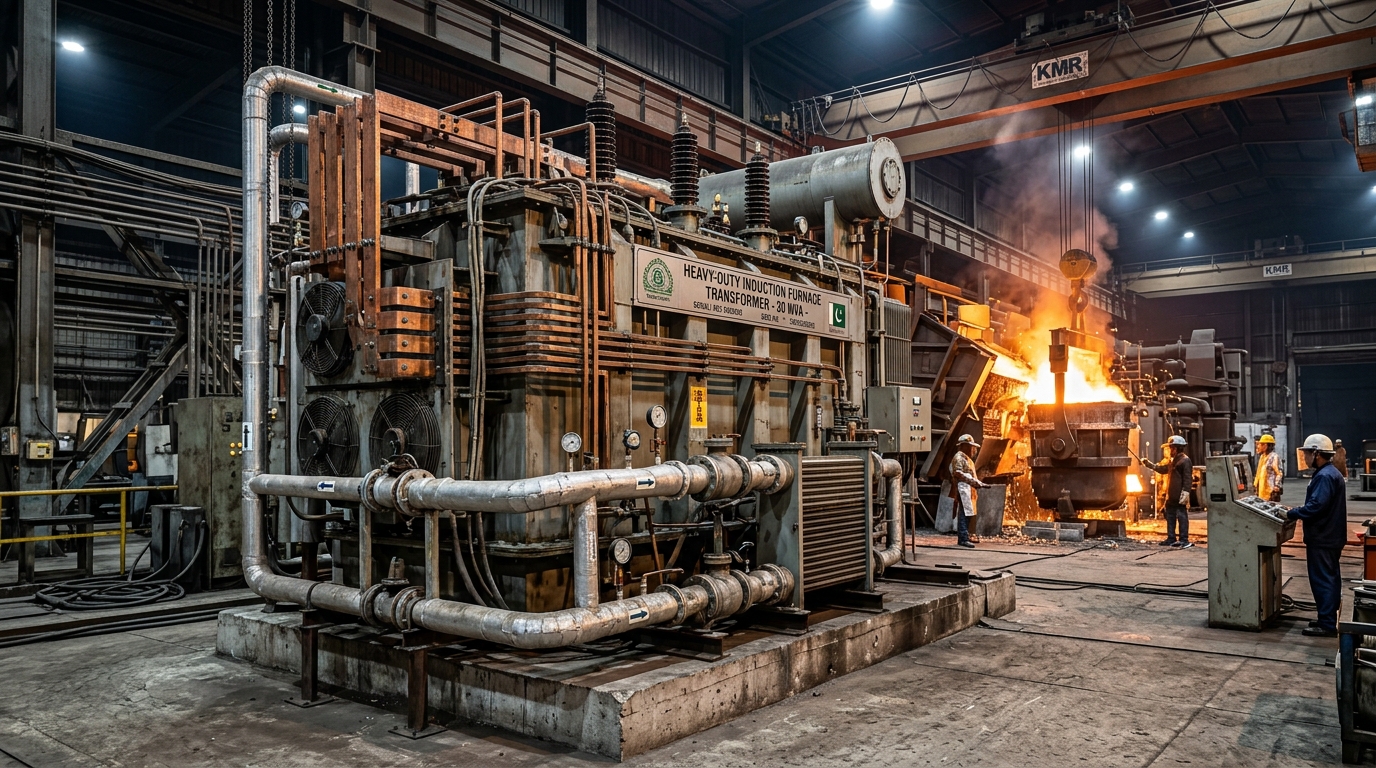
Direct Engineering Answer: Sizing an induction furnace transformer requires calculating the net crucible melting power in kW (based on specific energy consumption of 550 to 620 kWh per metric ton of steel scrap), adjusting for power supply inverter efficiency (96–97%), applying an operating displacement power factor (cos phi = 0.90 to 0.95), and incorporating a 20% to 25% harmonic safety derating buffer. A 1-ton crucible typically requires a 1,000 kVA to 1,250 kVA water-cooled unit; a 5-ton crucible requires 5,000 kVA to 5,500 kVA (5.5 MVA).
1. The Economics & Risks of Furnace Transformer Sizing in Pakistan
In the heavy industrial foundry corridors of Pakistan—including Badami Bagh and Bund Road in Lahore, the G.T. Road industrial belt in Gujranwala, Sheikhupura Road, and the SITE and Korangi industrial zones in Karachi—induction melting furnaces represent the single largest electrical power consumers in any manufacturing plant. Operating around the clock, these installations melt scrap metal into high-tensile billets and foundry ingots under extreme cyclical electrical loads.
Unlike standard distribution transformers supplying continuous motor loads, an induction furnace swings from zero to 100% full-load capacity within seconds as raw scrap bridges the induction coil. Undersizing the primary transformer leads to continuous thermal tripping of 11kV vacuum circuit breakers (VCB), core saturation, and accelerated degradation of cellulose paper insulation, triggering catastrophic winding burnout within months. Conversely, over-sizing without proper harmonic filtering and reactive power management results in severe monthly kVARh low-power-factor penalties from utility distribution companies like LESCO, GEPCO, and K-Electric. For detailed ratings and unit availability, explore our dedicated steel furnace transformers engineering center.
To establish a high-yield, uninterrupted melting operation, plant directors and chief electrical engineers must master the relationship between crucible volume, inverter frequency, power factor correction, and transformer winding thermal ratings. Sizing mistakes in multi-MVA industrial projects carry multi-million-rupee consequences, both in equipment capital costs and in devastating daily factory downtime.
2. Thermodynamics of Induction Steel Melting (kWh/Ton Standards)
To accurately calculate the required electrical capacity, electrical consulting engineers begin with the fundamental thermodynamics of melting carbon steel and scrap alloy. The theoretical thermodynamic energy required to raise the temperature of 1 metric ton (1,000 kg) of steel scrap from ambient room temperature (30°C) to the standard pouring tapping temperature (1,600°C–1,650°C), including the latent heat of fusion (approx. 270 kJ/kg), is approximately 380 kWh per ton.
However, practical industrial efficiency in Pakistani foundries is significantly lower due to inevitable energy dissipation channels:
- Crucible Radiation Losses: Radiant heat escaping through open lids during charging and slag skimming accounts for 8% to 12% of total thermal energy.
- Coil Water Cooling Losses: High-frequency current circulating in copper induction coils generates I2R resistance heat, transferred directly to the coil cooling tower (15% to 18% energy loss).
- Inverter Switching & Snubber Losses: Solid-state silicon SCR and IGBT rectifiers/inverters incur 3% to 4% electrical switching dissipation.
- Thermal Conduction to Refractory Lining: Heat absorbed by the rammed silica or alumina crucible lining during initial cold starts.
Consequently, modern medium-frequency solid-state induction melting power supplies (typically 250 Hz to 1,000 Hz) achieve an overall specific energy consumption of 550 kWh to 620 kWh per metric ton of liquid steel for a standard 60-minute heat cycle from cold charge to tap.
3. Step-by-Step Mathematical Sizing Formula & Worked Example
The total electrical power in Kilowatts (kW) delivered by the solid-state inverter to melt a specific batch capacity within a target heat cycle time (t) in hours is derived as follows:
Once the active power demand in kW is established, the required transformer apparent power in kVA is calculated by factoring in the power supply inverter efficiency (η ≈ 0.96), operating displacement power factor (cos φ ≈ 0.92), and a mandatory 20% harmonic derating safety buffer:
Worked Engineering Example: 2.0-Ton Melting Crucible (60-Minute Cycle)
Consider a steel re-rolling mill in Gujranwala operating a 2.0-ton coreless induction furnace targeting a 60-minute (1.0 hour) melt cycle with specific energy consumption of 580 kWh/ton:
- Active Melting Power: $P = (2.0 ext{ Tons} imes 580 ext{ kWh/Ton}) / 1.0 ext{ hr} = 1,160 ext{ kW}$
- Inverter DC Link & Coil Losses: Adjusted power input = $1,160 ext{ kW} / 0.96 = 1,208 ext{ kW}$
- Base Apparent Power: $S_{ ext{base}} = 1,208 ext{ kW} / 0.92 = 1,313 ext{ kVA}$
- Applying Harmonic & Overload Margin (1.25): Required Transformer Capacity = $1,313 imes 1.25 = \mathbf{1,641 ext{ kVA}}$
In standard manufacturing practice, the facility would specify a standard 2,000 kVA (2.0 MVA) OFWF water-cooled furnace transformer to provide head-room for cold-scrap bridging and future auxiliary ladling loads.
4. Crucible Tonnage to Transformer kVA/MVA Engineering Matrix
The following engineering matrix outlines recommended transformer capacities, primary voltage levels, cooling configurations, and secondary current handling for standard induction crucible sizes in Pakistan:
| Crucible Capacity | Melt Power (kW) | Standard Transformer Rating | Primary Voltage | Secondary Voltage (LV) | Cooling Class |
|---|---|---|---|---|---|
| 500 kg (0.5 Ton) | 350 kW – 450 kW | 500 kVA – 630 kVA | 11 kV | 415 V / 575 V | ONAN / OFWF |
| 1.0 Ton | 750 kW – 900 kW | 1,000 kVA – 1,250 kVA (1.25 MVA) | 11 kV | 575 V / 660 V | OFWF (Forced Water) |
| 2.0 Ton | 1,500 kW – 1,800 kW | 2,000 kVA – 2,500 kVA (2.5 MVA) | 11 kV / 33 kV | 660 V / 850 V | OFWF (Forced Water) |
| 3.0 Ton | 2,200 kW – 2,600 kW | 3,000 kVA – 3,150 kVA (3.15 MVA) | 11 kV / 33 kV | 850 V / 1,000 V | OFWF Dual Cooler |
| 5.0 Ton | 3,500 kW – 4,200 kW | 4,500 kVA – 5,500 kVA (5.5 MVA) | 11 kV / 33 kV | 1,000 V / 1,200 V | OFWF Dual Cooler |
| 10.0 Ton | 7,000 kW – 8,500 kW | 9,000 kVA – 11,000 kVA (11 MVA) | 33 kV / 132 kV | 1,200 V / 1,500 V | OFWF Quad Cooler |
5. Managing Extreme High Secondary Current & Heavy Copper Busbars
One of the most defining characteristics of an induction furnace transformer is the magnitude of the secondary low-voltage current. While primary 11kV current is relatively modest (e.g. approx. 105 Amperes for a 2,000 kVA unit), the secondary winding must continuously carry 2,000 to 15,000 Amperes depending on voltage configuration.
Standard flexible cable leads cannot withstand these high current densities. TransfoLine custom-fabricates secondary terminations using heavy electrolytic tough-pitch (ETP) 99.99% pure copper flat busbars with silver-plated contact faces. Furthermore, secondary busbars are interleaved in a non-inductive configuration to minimize stray eddy current losses and electrodynamic repulsion forces during short-circuit transients.
6. Harmonic Distortion (THD-I) & Transformer K-Factor Selection
Modern solid-state induction furnace inverters generate substantial non-sinusoidal currents rich in 5th, 7th, 11th, and 13th harmonic orders. In un-mitigated 6-pulse rectifier circuits, Total Harmonic Current Distortion (THD-I) can exceed 28% to 35%. Harmonic currents cause severe stray load losses in core clamps and winding conductors via skin and proximity effects.
TransfoLine furnace transformers are designed with a minimum rating of K-Factor = 13 to K-Factor = 20. By utilizing step-lap mitered prime CRGO magnetic cores, electrostatic copper Faraday shielding between primary and secondary windings, and transposed multi-strand conductors, our transformers operate with low thermal rise even under extreme harmonic spectrums. For comprehensive substation panel integration, see our HT/LT panel installations.
7. Oil Forced Water Forced (OFWF) Cooling & Heat Dissipation Sizing
Under continuous melting in Pakistani summer ambient temperatures exceeding 45°C, natural air radiators (ONAN) are physically incapable of dissipating the 40 kW to 120 kW of heat generated by multi-MVA furnace transformers without massive footprint expansion. TransfoLine incorporates compact Oil Forced Water Forced (OFWF) tubular heat exchangers:
- Positive Pressure Differential: Transformer dielectric oil is maintained at 0.5 to 1.0 bar higher pressure than circulating cooling water, ensuring zero water ingress in the event of tube rupture.
- Corrosion-Resistant Cupro-Nickel Tubes: Heat exchanger tubes are manufactured from 90/10 Cupro-Nickel or heavy-gauge copper to resist raw bore water scaling.
- Automatic Redundancy: Dual 100% rated oil circulation pumps and water valves feature automatic PLC changeover upon flow failure.
8. 11kV/33kV Substation Protection & VCB Switchgear Coordination
A furnace substation requires specialized protective relay coordination. TransfoLine integrates comprehensive primary protection including instantaneous overcurrent (50), inverse-time overcurrent (51), sensitive earth fault (50N/51N), transformer differential protection (87T), dual-float Buchholz gas surge detection, and winding temperature trip micro-switches. Discover our complete range of turnkey substation EPC capabilities.
9. TransfoLine Fast-Track Delivery & 50+ In-Stock Units
When a primary furnace transformer suffers an unpredicted blowout, production halts immediately, costing millions of rupees per shift. TransfoLine maintains an inventory of over 50 certified new and rebuilt transformers (500 kVA to 10 MVA) in Lahore, ready for dispatch within 24 to 48 hours with full WAPDA/IEC test dossiers and a 12-month comprehensive warranty.
Frequently Asked Questions
FAQ What size transformer is needed for a 1-ton induction furnace in Pakistan?
A 1-ton crucible typically requires a 1,000 kVA to 1,250 kVA OFWF water-cooled transformer connected to an 11kV primary distribution feeder.
FAQ What is the typical electricity consumption per ton of liquid steel?
Modern medium-frequency solid-state induction furnaces consume between 550 kWh to 620 kWh per metric ton of melted steel scrap.
FAQ Why is OFWF water cooling preferred over standard radiator air cooling for furnaces?
OFWF cooling dissipates massive continuous heat loads in a compact footprint and maintains safe operating oil temperatures (<75°C) even during 48°C Pakistani summer heatwaves.
FAQ What happens if an induction furnace operates with an undersized transformer?
The transformer core will saturate and windings will overheat, causing frequent 11kV VCB breaker trips, extended heat melting times, and rapid cellulose paper degradation leading to coil blowout.
FAQ Can TransfoLine deliver emergency replacement furnace transformers in Pakistan?
Yes, TransfoLine maintains 50+ tested units in stock and dispatches emergency replacement transformers across Punjab and Sindh within 24 to 48 hours.
Need Direct Technical Assistance or a Factory-Direct Quote?
TransfoLine supplies, installs, overhauls, and repairs heavy industrial transformers across Pakistan with nationwide 48-hour delivery, genuine WAPDA P-10 compliance, and 12-month full warranty.