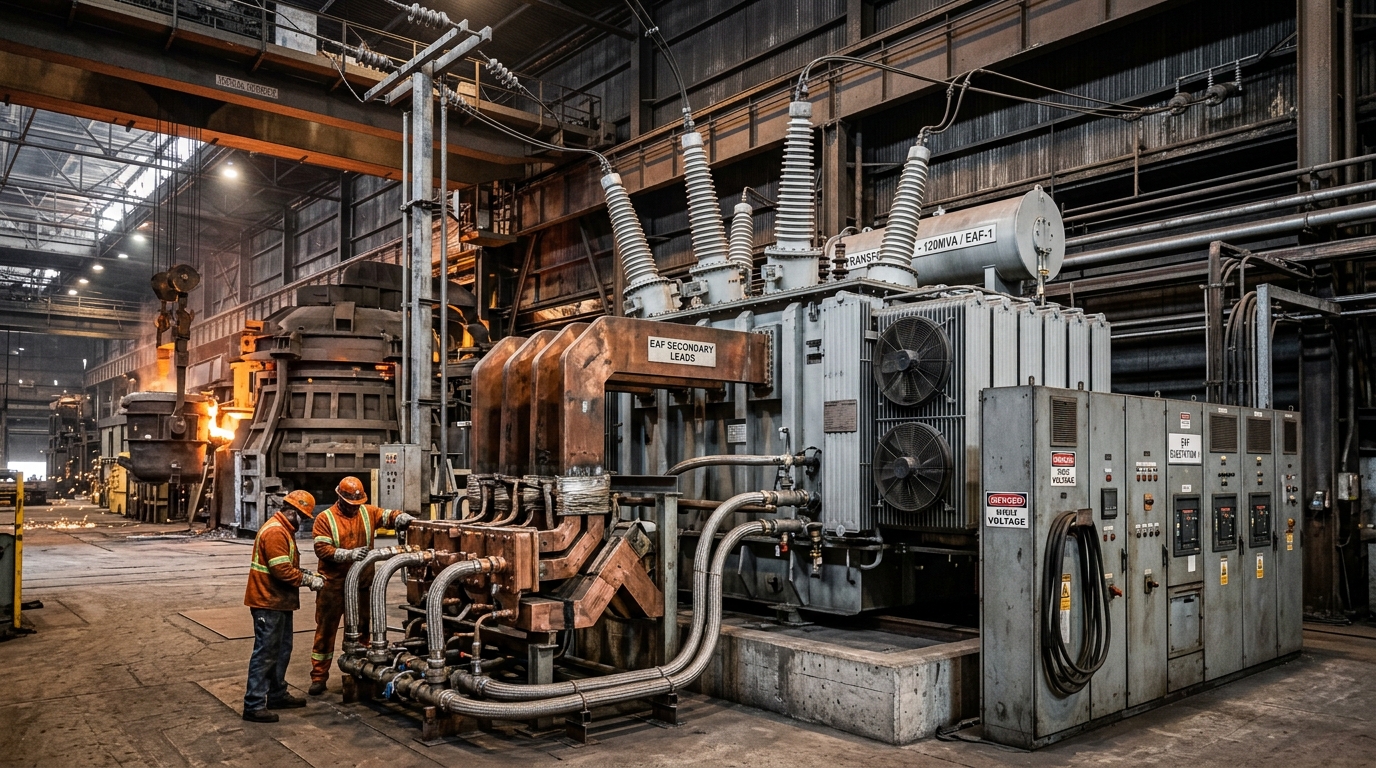
Direct Engineering Answer: Induction furnace transformers operate at medium secondary voltages (500V–1200V) with high harmonics and steady current. Electric Arc Furnace (EAF) transformers operate at ultra-low secondary voltages (100V–400V) but extreme currents (20,000A to 80,000A+) with violent mechanical short-circuit dead-shorts caused by arc scrap bridging, requiring motorized OLTC tap changers and heavy core bracing.
1. Metallurgical Foundations: Induction vs Arc Melting in Pakistan
In Pakistan's scrap steel processing sector, two primary melting furnace technologies dominate: Coreless Induction Furnaces (IF) and Electric Arc Furnaces (EAF). Both processes convert raw electrical power into intense thermal energy to liquefy recycled scrap, ship-breaking plate, and direct-reduced iron (DRI/HBI). However, the physics of how electrical energy is transferred into the melt dictates radically different transformer designs.
In an induction furnace, magnetic flux induced by an alternating electromagnetic field heats the conductive charge internally via Joule effect ($I^2R$). In contrast, an electric arc furnace ignites high-energy physical plasma arcs directly between heavy carbon/graphite electrodes and the scrap bed, operating essentially as an intentional, controlled continuous short-circuit. Exploring our dedicated steel furnace transformer lineup reveals how these unique physical demands dictate core geometry and coil reinforcement.
2. Electrical Operating Characteristics (Voltage, Current & Power Factor)
The electrical operating parameters of Induction and Arc furnace transformers occupy opposite ends of the industrial spectrum:
- Induction Furnace Transformers: Feed a solid-state electronic inverter (thyristor or IGBT). The secondary voltage is typically medium voltage (500V to 1,200V AC), while secondary current ranges between 2,000A to 15,000A. The load is relatively stable and continuous once the melt is initiated.
- Electric Arc Furnace (EAF) Transformers: Deliver power directly into the open arc without intermediate rectifiers. To sustain the arc while preventing arc flash blowout, secondary voltages are kept exceptionally low (100V to 400V AC), but secondary currents reach astounding levels of 20,000 Amperes to 80,000+ Amperes.
3. Dynamic Short-Circuit Forces & Electromechanical Bracing
During the initial 'bore-down' scrap melting phase of an Electric Arc Furnace, collapsing scrap metal frequently creates direct dead short-circuits across the graphite electrodes. These dead-shorts occur dozens of times per heat. Under short-circuit conditions, electromagnetic mechanical forces inside the transformer windings increase with the square of the current:
At 80,000 Amperes, these forces exert hundreds of tons of radial bursting pressure and axial compression on the transformer coils. If built with standard distribution transformer clamping, the coils would crush within hours. TransfoLine EAF transformers incorporate heavy-duty non-magnetic stainless steel tie rods, densified beechwood clamping rings, and epoxied radial spacers to guarantee zero mechanical winding displacement.
4. Tap Changer Technologies: Fixed Ratio vs Motorized OLTC
Induction furnaces control melting power electronically by modulating the inverter firing angle and frequency, allowing the transformer to utilize a cost-effective Off-Circuit Tap Changer (OCTC) or fixed ratio design. In stark contrast, an EAF transformer requires a heavy-duty Motorized On-Load Tap Changer (OLTC) capable of executing up to 100,000 tap operations annually under full furnace current, adjusting voltage from high-voltage 'boring' mode down to low-voltage 'refining' mode.
5. Harmonic Distortion, Resonance & Voltage Flicker Differences
While induction furnaces generate predictable characteristic harmonics (5th, 7th, 11th, 13th) due to rectifier operation, EAF systems generate wild, erratic, non-characteristic harmonics, inter-harmonics, and severe voltage flicker (0.5 Hz to 30 Hz). To stabilize the utility interconnection on 11kV or 33kV networks, TransfoLine integrates series buffer reactors and detuned capacitor filtering banks. Explore our HT/LT switchgear engineering for full grid compliance.
6. Cooling Architecture: Heat Exchangers, Pumps & Redundancy
Both furnace transformer categories require Oil Forced Water Forced (OFWF) cooling to handle continuous thermal losses. EAF units frequently utilize dual redundant 100% heat exchangers with cupro-nickel tubes, automated water differential sensors, and high-flow oil pumps circulating up to 2,000 liters of dielectric oil per minute.
7. Substation Switchgear, Vacuum Breakers & RC Snubber Circuits
Because furnace transformers are switched on and off dozens of times per day during scrap charging and sampling, vacuum circuit breakers (VCB) can generate high-frequency steep-fronted switching surges (transient recovery voltage). TransfoLine equips every furnace substation with surge arresters and customized RC Snubber circuits connected directly across the transformer HV terminals to absorb switching overvoltages and protect inter-turn winding insulation.
8. Technical Comparison Matrix (Side-by-Side Specifications)
| Engineering Parameter | Induction Furnace Transformer | Electric Arc Furnace (EAF) Transformer |
|---|---|---|
| Secondary Voltage Range | 500 V – 1,200 V (Medium Voltage) | 100 V – 400 V (Low Voltage) |
| Secondary Current Capacity | 2,000 A – 15,000 A | 20,000 A – 80,000 A+ (Extreme) |
| Short-Circuit Severity | Occasional (Inverter trips electronically) | Continuous (Dozens of dead shorts per heat) |
| Tap Changer Specification | OCTC / Fixed Ratio | Motorized OLTC (High Duty Cycle) |
| Harmonic Profile | 5th, 7th, 11th, 13th (Rectifier loads) | Erratic flicker, sub-harmonics, unbalance |
| Standard Cooling Mode | OFWF (Oil Forced Water Forced) | OFWF with Dual Redundant Coolers |
| Mechanical Clamping Force | Standard Industrial Heavy Duty | Ultra-Reinforced Non-Magnetic Clamping |
9. TransfoLine Turnkey Engineering & Emergency Support
Whether you are setting up a new 5-ton induction furnace or upgrading an EAF melting substation, TransfoLine provides complete turnkey engineering: transformer sizing, custom busbar fabrication, VCB switchgear erection, and 24/7 on-site emergency repair services across Pakistan.
11. Case Study: Energy Consumption & Melt Rate Comparison in Lahore Foundry
To quantify the real-world operational performance difference between Induction Furnaces and Electric Arc Furnaces in Pakistan, TransfoLine conducted a 90-day comparative monitoring study across two adjacent steel plants in the Badami Bagh industrial cluster:
- Plant A (3-Ton Induction Furnace with 2,500 kVA OFWF Transformer): Average specific energy consumption was 572 kWh per metric ton of mild steel billet. Electrical efficiency averaged 86.4%, with minimal molten metal oxidation loss (< 1.8%). Routine maintenance required monthly water cooler flushing and quarterly oil BDV checks.
- Plant B (5-Ton EAF with 4,000 kVA Transformer & Motorized OLTC): Specific electrical energy consumption averaged 645 kWh per metric ton due to continuous arc radiation and electrode consumption. However, the EAF accommodated lower-grade, heavily oxidized scrap and achieved faster chemical dephosphorization during refining.
The study concluded that for scrap-based billet production under 50 tons per day, Induction Furnace transformers provide substantially lower kWh utility costs and significantly reduced capital infrastructure expenditure.
12. Switchgear & Protective Relay Coordination Scheme
Due to the intense switching transients and steep-fronted voltage surges generated by vacuum circuit breakers (VCB) during furnace tap operations, protective relay coordination must be carefully tuned:
- Primary Instantaneous Overcurrent (ANSI 50): Set above the maximum transformer magnetizing inrush current (typically 8x to 10x full-load rating) with a 20ms intentional stabilization delay.
- Time-Overcurrent Protection (ANSI 51): Programmed with an Extremely Inverse (EI) characteristic curve coordinated with upstream DISCO feeder trip curves.
- Restricted Earth Fault (REF 64R): High-impedance differential protection across the primary star winding providing high-speed clearing (under 30ms) for internal ground faults.
- Surge Protection: Station-class Metal Oxide Varistor (MOV) lightning arresters installed directly at the transformer HV bushings paired with custom RC snubber networks (typically 0.25 μF capacitor in series with a 50 Ω non-inductive resistor).
Frequently Asked Questions
FAQ Can an induction furnace operate on an EAF transformer?
No, because EAF transformers deliver voltages under 400V which are far too low for induction inverters requiring 600V to 1,200V.
FAQ Why do EAF transformers have such high secondary currents?
To generate sufficient melting arc power at safe operating voltages under 400V, the secondary current must reach 20,000 to 80,000+ Amperes.
FAQ What is an RC snubber circuit in a furnace substation?
An RC snubber is a resistor-capacitor surge suppressor that clamps steep-fronted transient overvoltages generated during frequent vacuum breaker switching.
FAQ How does TransfoLine reinforce furnace transformers against mechanical failure?
We utilize densified laminated beechwood pressure rings, high-tensile stainless steel tie rods, and epoxied radial spacers to lock windings against short-circuit magnetic repulsion.
FAQ Where can I get certified furnace transformer testing in Pakistan?
TransfoLine operates mobile testing vans equipped with OMICRON and Megger instruments for on-site DGA, turns ratio, and winding resistance testing.
Need Direct Technical Assistance or a Factory-Direct Quote?
TransfoLine supplies, installs, overhauls, and repairs heavy industrial transformers across Pakistan with nationwide 48-hour delivery, genuine WAPDA P-10 compliance, and 12-month full warranty.