
The Ageing Substation Challenge in Kot Lakhpat & Quaid-e-Azam
Established decades ago, Quaid-e-Azam Industrial Estate (widely known as Kot Lakhpat Industrial Area) and the surrounding Ferozepur Road manufacturing belt represent the foundational core of Lahore's industrial economy. However, because many factories here were established between the 1990s and early 2000s, a substantial proportion of primary 11kV/415V distribution transformers (ranging from 400 kVA to 2,000 kVA) have now exceeded their nominal design lifespan of 20 to 25 years.
Operating an ageing transformer under heavy industrial duty in Kot Lakhpat introduces distinct vulnerabilities:
- Severe Paper Insulation Brittleness (Low DP Value): The mechanical strength of electrical Kraft paper depends on the Degree of Polymerization (DP). While virgin insulation paper exhibits a DP value between 1,000 and 1,200, transformers operating in hot, unventilated Kot Lakhpat substations for 20 years frequently drop below 200 DP—the internationally recognized threshold of terminal mechanical fragility. At this stage, even a minor external downstream short circuit produces electromagnetic forces that shatter the brittle paper, causing catastrophic inter-turn flashover.
- Acidic Sludge Accumulation: Decades of oil oxidation generate organic acids and colloidal sludge that settle into cooling ducts between the windings, choking natural convective oil flow and causing localized core hot spots exceeding 120°C.
- Hardened, Leaking Perimeter Gaskets: Old natural rubber gaskets have calcified into rigid, cracked rock-like material, leading to chronic oil seepage around conservator flanges, inspection covers, and lower drain valves.
5 Warning Signs of Terminal Insulation Ageing in 15+ Year Transformers
Plant engineers in Kot Lakhpat should monitor these five critical diagnostic indicators during routine monthly walk-throughs to schedule planned overhauls before an explosive in-service burnout halts production:
1. Dissolved Gas Analysis (DGA) Showing High Carbon Oxides
When cellulose paper insulation degrades under prolonged thermal stress, it decomposes into carbon monoxide ($CO$) and carbon dioxide ($CO_2$). A ratio of $CO_2 / CO < 3.0$ combined with absolute $CO$ levels exceeding 500 ppm proves that paper insulation is actively charring deep within the winding pack.
2. Dark, Pungent Insulating Oil (High Neutralization Acid Number)
Healthy transformer oil has a clear, pale yellow appearance with an acidity value below $0.03 ext{ mg KOH/g}$. In aged Kot Lakhpat transformers, oil frequently turns dark brown or reddish-black with a strong pungent, burnt odor and acid numbers exceeding $0.4 ext{ mg KOH/g}$. Acidic oil aggressively corrodes internal copper and accelerates paper decay by a factor of four.
3. Low Polarization Index (PI) on Megger Testing
The Polarization Index ($PI = R_{10 ext{min}} / R_{1 ext{min}}$) measured using a calibrated 5kV DC Megger indicates the cleanliness and moisture level of the solid insulation. A healthy transformer exhibits a PI > 2.0. If the 10-minute to 1-minute insulation resistance ratio drops below 1.25, the winding insulation is critically saturated with conductive moisture and aging sludge.
4. Elevated No-Load Losses and Loud Acoustic Humming
Over decades of magnetic vibration (at 100Hz twice the 50Hz fundamental), the clamping bolts securing the cold-rolled grain-oriented (CRGO) silicon steel laminations slacken. This allows individual steel sheets to vibrate against each other, increasing no-load iron losses ($P_{fe}$) by 20% to 40% and generating a distinctive, deafening metallic buzz throughout the substation room.
5. Bushing Oil Level Depletion & Surface Tracking
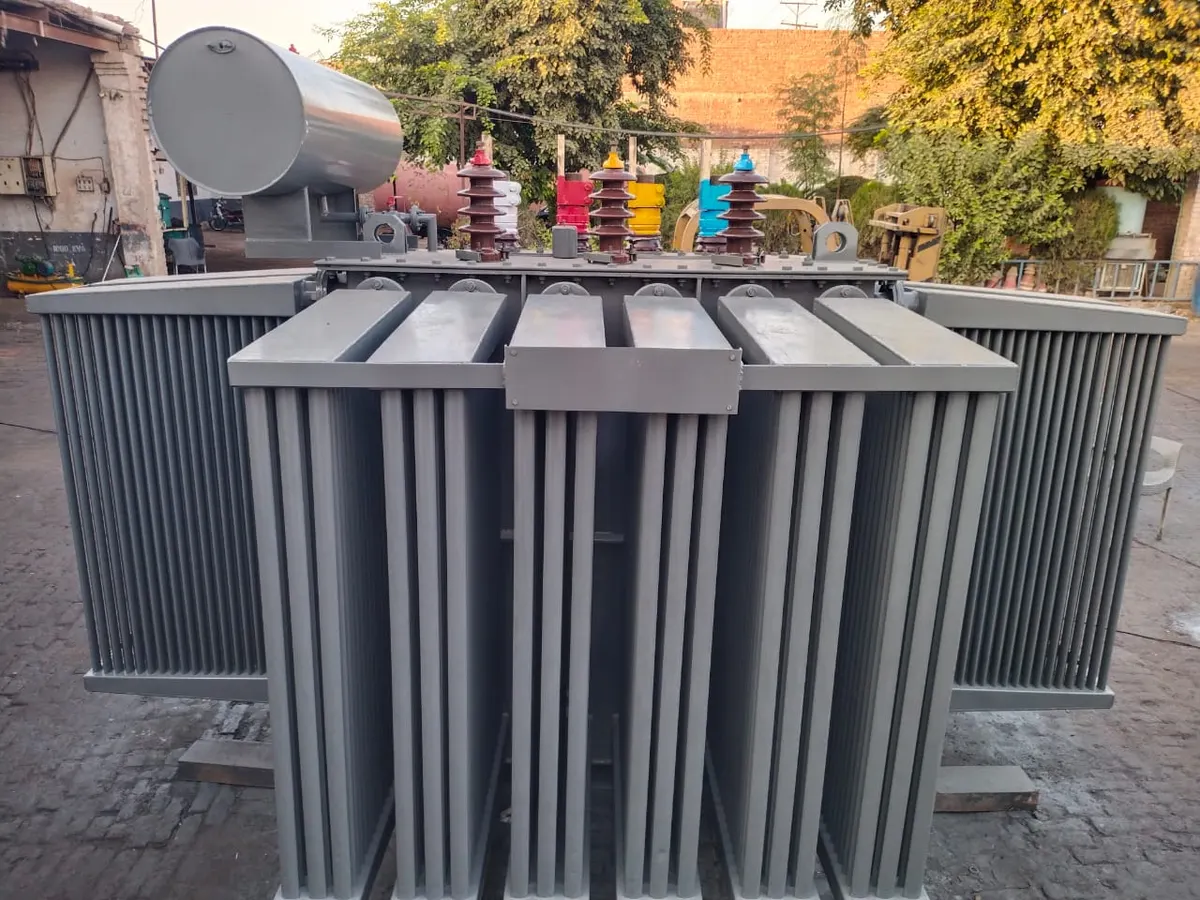
Oil-filled HT bushings on vintage transformers frequently show weeping seals around the brass terminal stem. Lowered oil inside the bushing creates an internal air gap that ignites corona partial discharges, eventually leading to porcelain shattering.
Core De-Stacking & Silicon Steel Lamination Restoration
When an aged transformer from Kot Lakhpat arrives at our Raiwind Road workshop for a complete overhaul, we don't just rewind the coils—we restore the foundational magnetic core.
Our core refurbishment protocol encompasses:
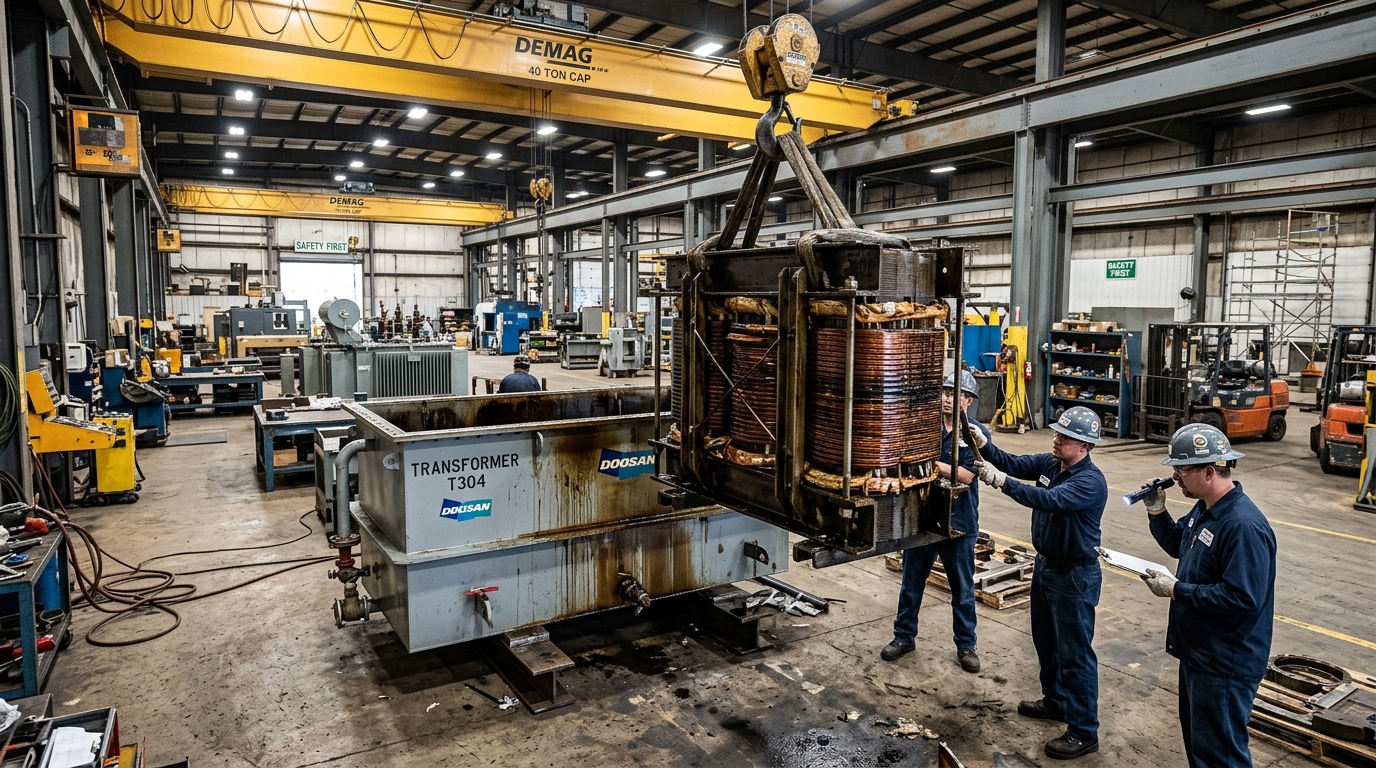
- De-Tanking & Sludge Washing: The core-coil assembly is unbolted and extracted using our 20-ton overhead gantry crane. Burnt oil sludge is thoroughly washed down using heated, high-pressure dielectric flushing fluid.
- Careful Core De-Stacking: The top yoke laminations are removed sheet by sheet. Damaged or pitted CRGO steel laminations are deburred, chemically cleaned, and re-insulated with a fresh micro-thin layer of high-temperature core-plate varnish (Carlite coating).
- Re-Stacking Under Calibrated Torque: The laminations are reassembled into step-lap mitred joints to minimize magnetic reluctance. Heavy channel-iron core clamps and insulated tie-rods are tightened using digital torque wrenches to exact manufacturer specifications, eliminating lamination chatter and restoring baseline no-load losses.
HT/LT Electrolytic Copper Coil Rewinding Standards (Class H)
At TransfoLine, we strictly enforce virgin materials for all coil rewinding:
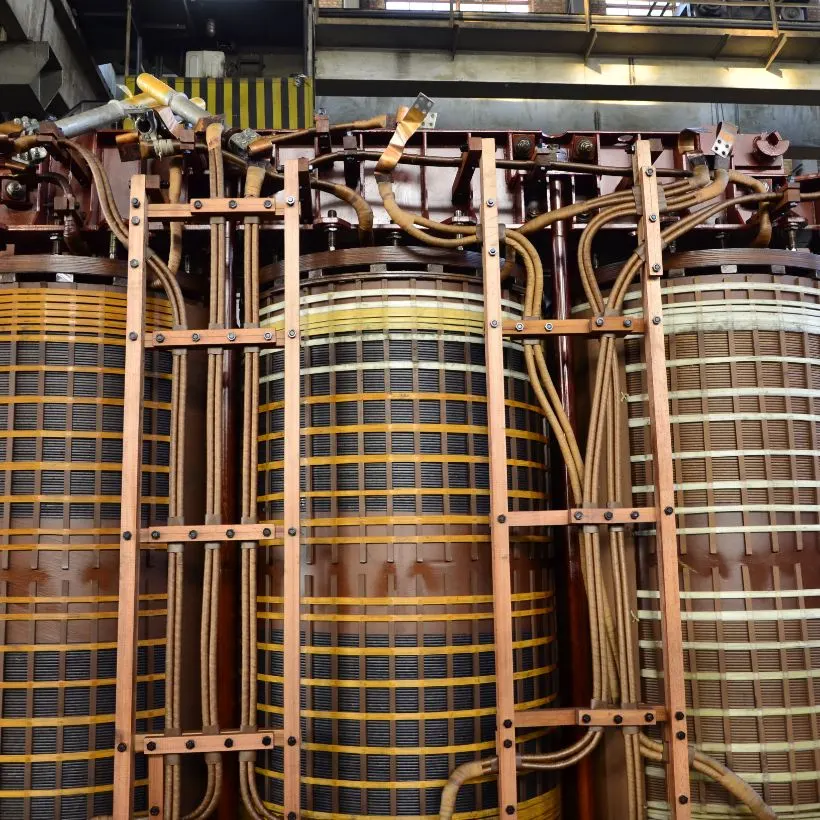
- 99.99% Pure Electrolytic Grade Copper: We use oxygen-free copper flat conductors for low-voltage (LT) coils and double-paper covered enameled copper wire for high-voltage (HT 11kV) coils. We maintain zero tolerance for recycled scrap wire or aluminium substitutes.
- Nomex & Thermally Upgraded Kraft Insulation: Coils are interleaved with DuPont Nomex aramid paper (Class H, 180°C thermal endurance) between layers and heavy pressboard cylinders between HT and LT windings.
- Double-Dip Vacuum Pressure Impregnation (VPI): Completed coil assemblies undergo vacuum varnish impregnation followed by 16 to 24 hours of computerized oven baking at 105°C, ensuring that moisture is driven out and the winding solidifies into a rock-hard monolithic mass capable of withstanding 25x short-circuit mechanical forces.
In high-throughput manufacturing environments like Sundar Industrial Estate, electrical loads are characterized by rapid duty-cycle shifts and continuous thermal dissipation. For instance, in automated blow-molding and pharmaceutical bottle-forming plants, hydraulic clamping motors and electric heating bands switch on and off cyclically hundreds of times per hour. This cyclic pulse-loading induces severe electromagnetic mechanical vibrations inside the transformer windings, causing micro-frictional wear against the interlayer paper insulation.
Furthermore, because many manufacturing units in Sundar operate dedicated 11kV rooftop solar grid-tied systems alongside LESCO utility supply, reverse power flow during midday low-production hours frequently drives local substation voltages upward. When utility line voltage surges coincide with peak solar generation, the transformer core operates near saturation, accelerating internal gas generation and thermal degradation.
Transformer Oil Sludge Removal & Acid Neutralization
Re-installing rewound coils into a tank contaminated with old acidic oil guarantees premature failure. For overhauls in Kot Lakhpat, we execute complete fluid regeneration:
- Tank Internal Sandblasting & Epoxy Coating: Old oil sludge and internal rust are cleaned from tank walls, sandblasted to white metal, and coated with oil-resistant, heat-tolerant polyurethane internal varnish.
- Fresh Uninhibited Mineral Insulating Oil: We fill the tank with brand-new virgin naphthenic or paraffinic transformer oil conforming to IEC 60296.
- Vacuum Degassing & Dehydration: The filled unit is subjected to deep vacuum (< 0.1 mbar) to extract all microscopic air bubbles trapped in the paper windings, elevating dielectric breakdown voltage to > 65 kV.
Economic Audit: Rewinding vs. Purchasing a Certified-Used Unit
For factory owners in Kot Lakhpat, deciding whether to rewind an existing 25-year-old transformer or replace it with a certified-used WAPDA P-10 compliant unit from TransfoLine's stock depends on financial and operational metrics:
| Decision Factor | Workshop Rewinding Existing Unit | Purchasing Certified-Used Unit |
|---|---|---|
| Capital Cost (e.g., 630 kVA) | PKR 620,000 – 780,000 (Lower) | PKR 1,400,000 – 1,800,000 |
| Deployment Turnaround | 48 to 72 Hours (or loaner unit) | Same-Day Delivery (12–24 Hours) |
| Core Energy Efficiency | Original older core loss (higher no-load W) | Modern low-loss CRGO silicon core |
| Warranty Protection | 12-Month Service Warranty | 12-Month Full Replacement Warranty |
| Best Recommendation For | Transformers with healthy cores and intact tanks | Catastrophically burnt or cracked tank units |
Comprehensive Maintenance Schedule for Heavy Engineering Substations
To ensure 20+ years of additional operational life after an overhaul, TransfoLine recommends the following structured maintenance program for Kot Lakhpat plants:
- Monthly: Check oil level sight gauges on tank and bushings; inspect silica gel color (replace when 50% turns pink); record ambient and top-oil thermometer readings under peak shift load.
- Quarterly: Perform on-site oil dielectric BDV breakdown test (must remain > 40 kV); clean radiator banks and bushing insulators to remove conductive industrial soot and textile lint.
- Annually: Measure 5kV Megger insulation resistance; perform micro-ohmmeter winding resistance balance check; conduct full infrared FLIR thermographic audit of all busbar connections.
Frequently Asked Questions
FAQ How long does a complete transformer overhaul take for a factory in Kot Lakhpat?
For standard industrial ratings (200 kVA to 630 kVA), complete workshop de-tanking, core de-stacking, coil rewinding, oven baking, and testing requires 48 to 72 hours. For 1000 kVA to 2000 kVA units, turnaround is 3 to 5 days. We provide temporary standby loaner transformers during the overhaul period to prevent factory downtime.
FAQ Can you pick up our heavy 1000 kVA transformer from Kot Lakhpat?
Yes. TransfoLine operates heavy-duty hydraulic boom crane trucks and low-bed transport trailers capable of rigging, lifting, and transporting transformers up to 20 tons directly from your Kot Lakhpat substation vault to our Raiwind Road workshop.
FAQ Is it worth rewinding a 20-year-old transformer in Kot Lakhpat?
Yes, provided the magnetic CRGO silicon steel core is intact and has not melted during the fault. Rewinding costs roughly 40% to 50% of the price of a certified-used transformer and 25% of a brand-new unit, while restoring winding insulation to like-new condition with a 12-month warranty.
FAQ Do you replace old gaskets and bushings during an overhaul?
Yes. Every complete overhaul includes 100% gasket replacement using oil-resistant Nitrile-bonded cork (RC-70 grade), replacement of cracked porcelain bushings, renewal of terminal brass stems, and installation of fresh silica gel breathers.
FAQ What test documentation is provided upon completion of overhaul?
You receive an official stamped TransfoLine High-Voltage Test Certificate documenting turns ratio, winding resistance, insulation Megger readings, short-circuit impedance, no-load excitation losses, and oil dielectric BDV breakdown voltage conforming to WAPDA DDS-84 standards.

TransfoLine Electrical Engineering Team
Specialized in industrial high-voltage substations, transformer rewinding, and power quality diagnostics across Pakistan. Based on Raiwind Road, Lahore with 18+ years of field experience and 10,000+ energized installations.
Urgent Transformer Breakdown in Lahore?
Our emergency mobile testing team arrives on-site in Sundar, Kot Lakhpat, Multan Road, or Sheikhupura within 2 to 4 hours. Standby loaner transformers available.