Understanding LESCO 11kV Grid Dynamics & Voltage Swings
The Lahore Electric Supply Company (LESCO) operates one of the most heavily loaded power distribution networks in South Asia. Supplying over 5 million consumers across Lahore, Kasur, Okara, and Sheikhupura districts, LESCO's 132kV/11kV substations face immense demand fluctuations, particularly during peak summer cooling months (May to September).
Industrial consumers fed via dedicated 11kV radial feeders or shared mixed industrial-commercial feeders frequently experience severe supply abnormalities that directly impact substation distribution transformers:
- Sustained High Voltage (Over-Voltage): During night shifts and Sunday shutdowns, 11kV feeder voltage regularly surges to 12.2kV or even 12.6kV. This over-excites the transformer's magnetic core, driving the silicon steel past its saturation knee-point into deep saturation, generating severe eddy current heating and loud acoustic humming.
- Severe Under-Voltage & Voltage Sags: During peak afternoon hours (2 PM to 6 PM), grid voltage often plunges to 9.8kV. Because industrial induction motors require constant power ($P = \sqrt{3} V I \cos heta$), a 12% drop in voltage forces motors to draw 14% higher current to maintain shaft torque, rapidly overloading the transformer windings and triggering thermal overcurrent trips.
- Feeder Auto-Reclosing & Switching Surges: LESCO grid breakers execute rapid auto-reclosing sequences during transient overhead line faults (tree touches, kite flying strings). The resulting high-frequency switching transients inject steep $dV/dt$ voltage surges into the transformer's first winding layers, causing inter-turn insulation degradation.
The Top 5 Causes of Transformer Tripping in Lahore Factories
When an industrial transformer breaker opens in a Lahore factory, field maintenance teams often jump to the incorrect conclusion that the unit has burnt out. In our 18 years of field diagnostic experience across Lahore, more than 60% of tripping events are caused by external grid or switchgear coordination factors rather than irreversible winding burnouts.
Here are the five primary root causes we uncover during on-site forensic testing:
1. Overcurrent & Thermal Overload Tripping (Device 51)
Factory expansions without corresponding transformer upgrades are rampant in Lahore. Facilities add injection molding machines, air compressors, or packaging lines without calculating total connected kVA load and diversity factors. When ambient temperatures in Lahore reach 45°C in June, a transformer operating at 95% rated load has zero thermal margin, causing the oil and winding temperature protection switches (OTI/WTI) to trip the breaker.
2. Nuisance Buchholz Relay Tripping (Gas vs. Surge)
On oil-filled transformers with conservator tanks, Buchholz relays frequently trip due to trapped air or false gas accumulation. In older transformers where oil levels have dropped below the conservator bottom line due to slow valve leaks, rapid temperature drops during night rainstorms cause oil contraction, sucking air bubbles through the pipe and tripping the top float.
3. Sensitive Earth Fault (51N / 50N) from Damp Cable Boxes
During the monsoon season, high humidity and rainwater leakage into 11kV cable termination end-boxes or LT busbar trunks cause surface moisture condensation across porcelain insulators. This triggers micro-milliamp leakage currents to ground that trip sensitive digital numerical earth fault relays set below 10% of rated nominal current.
4. Miscoordinated Upstream/Downstream Breaker Protection
In many Lahore industrial switchboards, downstream LT air circuit breakers (ACBs) for individual factory sections have their time-delay curves set higher than the incoming 11kV vacuum circuit breaker (VCB) overcurrent relay. Consequently, when a small 50 HP motor shorts out in a weaving shed, the main 11kV transformer breaker trips instead of the localized LT breaker, blacking out the entire industrial complex.
5. Internal Turn-to-Turn Flashover
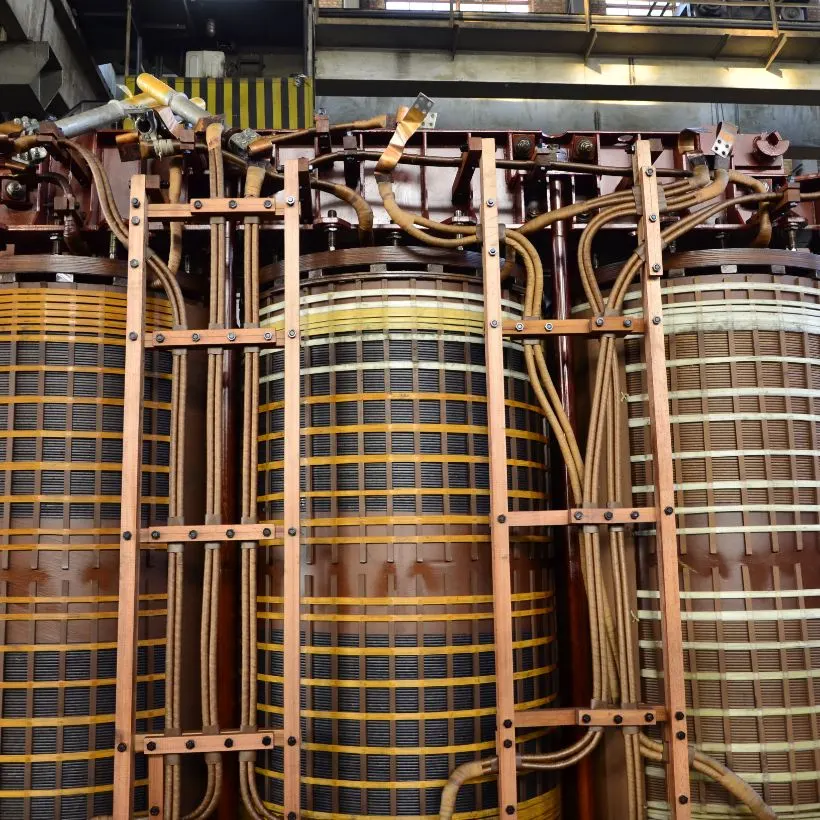
The only truly catastrophic failure cause: dielectric paper puncture between adjacent copper turns. Once an inter-turn arc ignites, localized boiling of transformer oil produces heavy hydrocarbon gas (acetylene, hydrogen) that activates the Buchholz trip contact within 100 milliseconds.
Differential Diagnosis: Grid-Side Fault vs. Internal Transformer Failure
When a trip occurs, follow this systematic electrical diagnostic checklist before attempting to reset the circuit breaker:
| Diagnostic Step | External / Grid Fault Indication | Internal Transformer Defect Indication |
|---|---|---|
| Breaker Flag Check | Overcurrent (51) or Under-Voltage (27) flag | Buchholz trip, Differential (87), REF (64) |
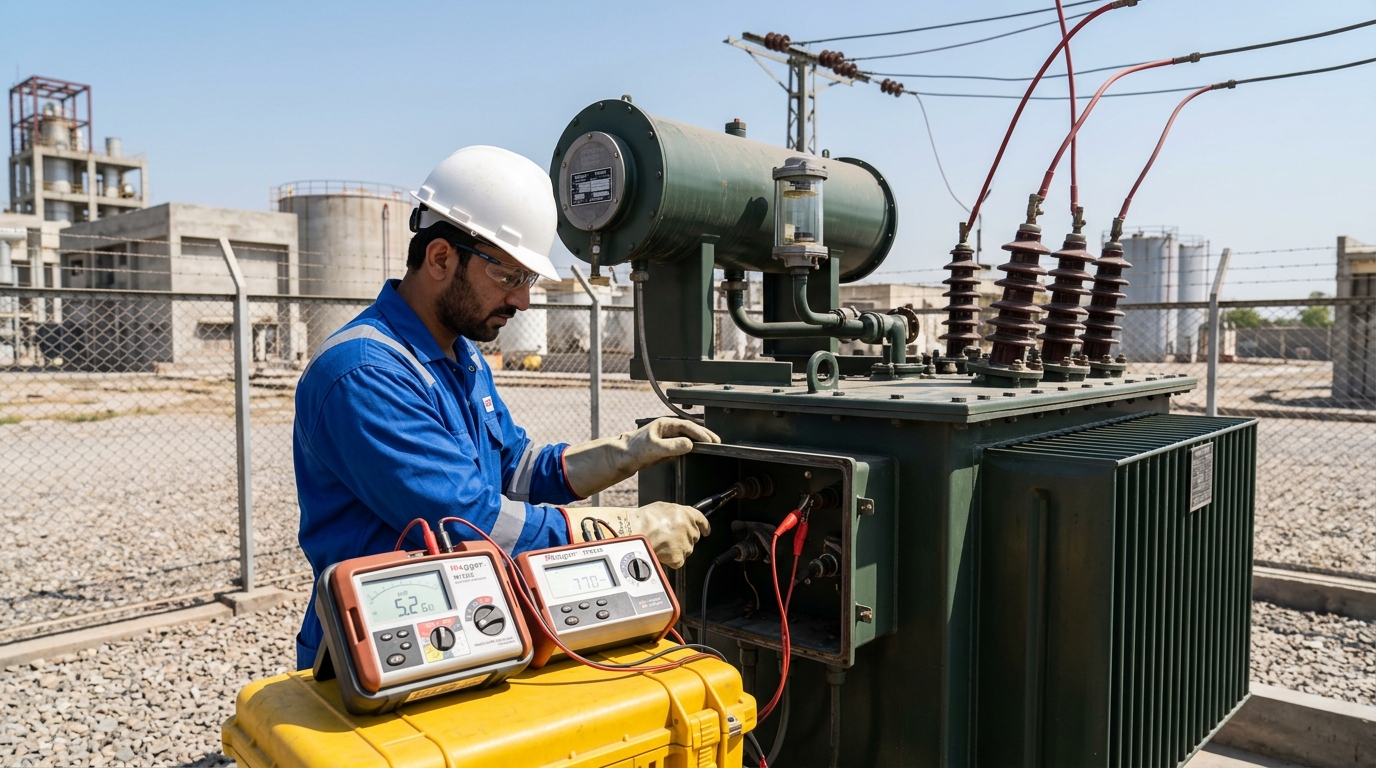
| Insulation Megger (5kV DC) | HT-E > 500 MΩ, LT-E > 100 MΩ (Healthy) | HT-E < 20 MΩ or LT-E < 5 MΩ (Burnt) |
| Winding Resistance Balance | Phase balance deviation < 1.0% across all phases | One phase resistance deviates > 3.0% |
| Buchholz Sight Glass Gas | Clear air, non-combustible (snuffed match) | Yellow/grey gas, flammable (hydrocarbon arc) |
| Oil BDV Breakdown Test | > 35 kV across spherical test gap | < 20 kV with suspended black carbon particles |
Neutral Voltage Shift & Severe Phase Unbalance Troubles
In mixed manufacturing and commercial complexes in Lahore, single-phase lighting and office air-conditioning loads are frequently loaded onto only one phase (e.g., Phase U). When phase currents are heavily unbalanced (e.g., U=650A, V=380A, W=410A on a 400 kVA transformer), magnetic flux equilibrium in the three-limb core is broken.
This triggers two dangerous operational hazards:
- Neutral Inversion / Neutral Shift: The star neutral point floats away from zero potential, causing phase-to-neutral voltages to become wildly uneven (e.g., 265V on Phase W and 185V on Phase U). Single-phase sensitive electronics, PLCs, and servo drives burnout instantly.
- Excessive Tank Stray Eddy Losses: The unbalanced zero-sequence flux cannot circulate inside the closed core limbs and is forced out through the transformer mineral oil and structural steel tank walls, causing severe tank overheating even when total kVA load is below nameplate rating.
Non-Linear Loads & Harmonic-Induced Nuisance Tripping
Modern factories in Sundar and Kot Lakhpat rely heavily on variable speed motor drives (VFDs), UPS systems, LED lighting driver power supplies, and induction melting furnaces. These non-linear loads draw current in sharp pulses rather than smooth sinusoidal curves, generating rich 5th (250Hz), 7th (350Hz), and 11th (550Hz) harmonic currents.
Standard distribution transformers built to WAPDA DDS-84 specifications are designed strictly for pure 50Hz linear loads with a harmonic K-factor of 1. When subjected to total harmonic distortion ($THD_i$) exceeding 15%:
- Winding eddy current losses increase with the square of the harmonic frequency ($P_{ec} \propto f^2$).
- Standard power factor improvement (PFI) capacitor banks enter parallel harmonic resonance with the transformer leakage reactance, multiplying harmonic currents by 300% to 500% and causing instantaneous overcurrent breaker tripping or capacitor explosion.
Calibrating Protection Relay Coordination with LESCO Overcurrent Curves
To eliminate unnecessary whole-plant shutdowns caused by minor downstream machine faults, protection relays must be systematically coordinated according to IEC 60255 standard inverse time curves:
- LESCO Grid Incomer Interface: Obtain the upstream grid substation feeder protection settings from LESCO engineers. Ensure your factory 11kV VCB relay time multiplier setting (TMS) is at least 0.25 to 0.30 seconds faster than LESCO's incoming relay to ensure discrimination.
- Transformer Thermal Overload Setting: Configure thermal overload pickup ($I_{ heta}$) at $105\%$ to $110\%$ of full-load nominal current with an appropriate cooling thermal time constant ($t$) matching the transformer oil time curve.
- Instantaneous High-Set Pickup ($I>>$): Set the instantaneous overcurrent trip at $600\%$ to $800\%$ of transformer rated current with zero intentional delay (0 ms). This ensures the breaker trips instantaneously during a dead short circuit while riding through standard transformer inrush magnetizing currents (which peak at 6x to 8x rated current for 100 milliseconds upon energization).
Permanent Engineering Remedies to Eliminate Nuisance Tripping
TransfoLine engineers provide complete turnkey remediation packages for industrial substations in Lahore experiencing recurring tripping events:
- On-Site Harmonic & Power Quality Audits: We deploy class-A Fluke power quality loggers to capture true RMS currents, crest factors, and individual harmonic spectrums up to the 50th order.
- Detuned Reactor PFI Panel Upgrades: We replace standard un-protected capacitor banks with 7% or 14% detuned iron-core copper filter reactors that prevent harmonic resonance and eliminate voltage spikes.
- Neutral Re-Balancing & Deep Substation Grounding: We install dedicated low-resistance chemical earthing pits to achieve < 1.0 Ω ground resistance, anchoring the neutral point securely against phase load shifts.
Frequently Asked Questions
FAQ Why does my transformer trip even though total factory kW load is low?
Tripping under low active load is commonly caused by severe phase unbalance (one phase drawing 90% while others draw 30%), high reactive power demand causing low power factor, high harmonic distortion from VFDs/welding machines, or an over-voltage surge on the LESCO 11kV feeder driving the core into magnetic saturation.
FAQ Is it safe to re-close an 11kV breaker immediately after a transformer trip?
No, absolutely not. Re-closing a breaker onto an internal transformer fault can cause catastrophic tank explosion and oil fire. Always inspect relay trip flags first. If the trip was caused by Buchholz relay gas, differential protection, or earth fault, the transformer must undergo insulation resistance (Megger) and turns-ratio testing before re-energization.
FAQ Can high ambient summer temperatures in Lahore cause transformer tripping?
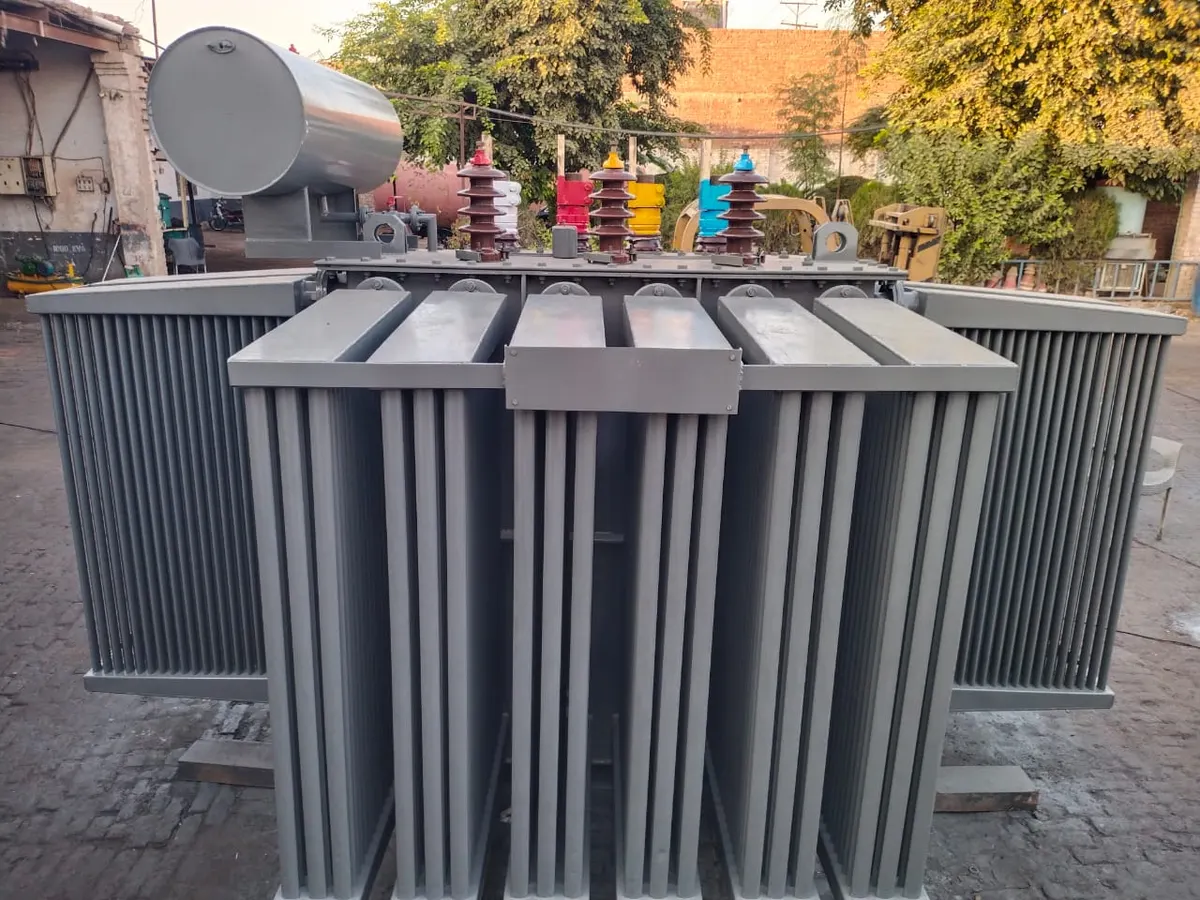
Yes. Distribution transformers in Pakistan are typically designed for a maximum ambient temperature of 40°C or 45°C. When Lahore ambient temperatures exceed 44°C in May/June and radiator fins are clogged with industrial dust or direct sunlight, the transformer cannot dissipate heat, triggering winding temperature indicator (WTI) trips even at 80% load.
FAQ How does LESCO 11kV feeder voltage variation damage transformer windings?
When LESCO feeder voltage surges above 12 kV during low-demand night hours, the core over-saturates, generating extreme heat and harmonic flux that burns winding paper insulation. Conversely, severe under-voltage (below 10 kV) forces industrial motors to draw higher current to maintain power, causing thermal overload tripping.
FAQ What services does TransfoLine provide to stop recurring transformer tripping in Lahore?
We provide comprehensive on-site electrical diagnostic audits: power quality and harmonic logging, relay protection curve coordination, tap changer optimization, high-vacuum oil filtration, and detuned capacitor bank installation across all Lahore industrial estates.

TransfoLine Electrical Engineering Team
Specialized in industrial high-voltage substations, transformer rewinding, and power quality diagnostics across Pakistan. Based on Raiwind Road, Lahore with 18+ years of field experience and 10,000+ energized installations.
Urgent Transformer Breakdown in Lahore?
Our emergency mobile testing team arrives on-site in Sundar, Kot Lakhpat, Multan Road, or Sheikhupura within 2 to 4 hours. Standby loaner transformers available.