
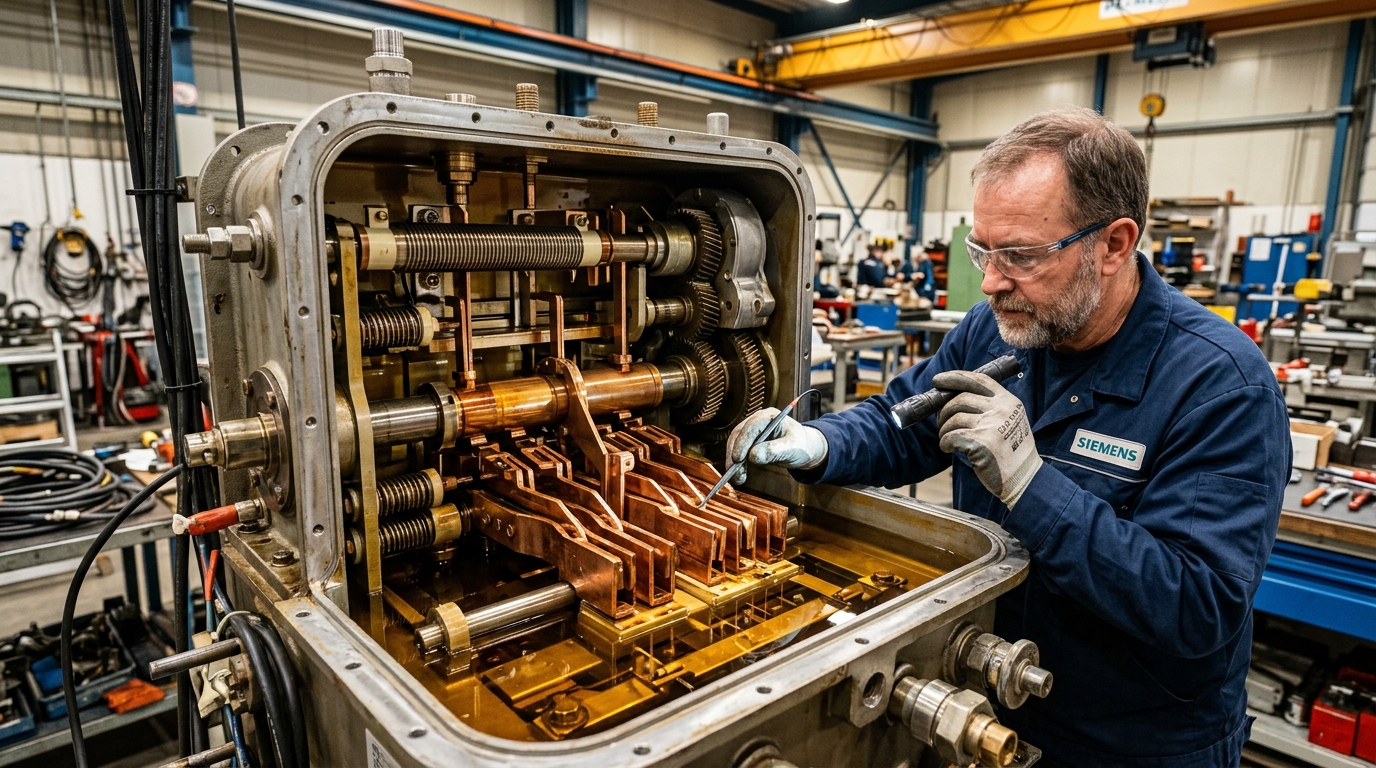
Direct Engineering Answer: On-Load Tap Changers (OLTC) mechanically adjust transformer winding turn ratios under full load current to counteract severe utility grid voltage drops (from 11kV down to 9.5kV). Routine diverter switch contact resistance testing, motor drive timing inspection, and dielectric oil filtration inside the diverter chamber prevent catastrophic tap selector flashovers.
1. Grid Voltage Instability & The Critical Role of OLTCs in Pakistan
Across major industrial and manufacturing hubs in Pakistan—ranging from the dense industrial zones of Lahore (Sundar, Kot Lakhpat, Multan Road) and Faisalabad to Hattar (KPK), Hub (Balochistan), and Karachi's SITE area—electrical grid voltage delivered by public utility distribution companies (LESCO, FESCO, GEPCO, MEPCO, IESCO, PESCO, HESCO, and K-Electric) is subject to extreme, unpredictable fluctuations.
During evening peak demand hours (6:00 PM to 10:00 PM), heavy residential air conditioning and heating loads frequently pull primary 11kV distribution line voltage down to 9,400V (a drop of over 15%). Conversely, during off-peak midnight hours, line voltages surge above 11,800V. For industrial facilities operating sensitive automation, variable frequency drives (VFDs), electronic spinning controls, and heavy electric arc or induction furnaces, unmitigated voltage swings cause severe motor overheating, false under-voltage trips, ruined product batches, and premature dielectric breakdown of auxiliary equipment.
An On-Load Tap Changer (OLTC) is the primary active electromechanical subsystem that solves this challenge. Integrated into high-voltage power transformers, it automatically varies the effective number of high-voltage winding turns under full load current, maintaining constant secondary output voltage (415V or 11kV) regardless of upstream grid volatility. Explore our complete range of power transformers with motorized OLTC.
2. Fundamental Differences: On-Load (OLTC) vs Off-Circuit (OCTC) Tap Changers
Distribution transformers are commonly equipped with a simple Off-Circuit Tap Changer (OCTC), also known as a de-energized tap changer (DETC). An OCTC can only be operated when the transformer is completely disconnected from the electrical grid and de-energized. Attempting to switch an OCTC under load creates a catastrophic phase-to-phase explosive arc flash.
In contrast, an On-Load Tap Changer (OLTC) is designed to switch transformer winding taps while carrying full load current (hundreds of amperes) at high voltages without interrupting electrical power to the plant for even a fraction of a millisecond. This continuous power availability makes OLTCs mandatory for 24/7 continuous process industries such as textiles, steel melting, cement manufacturing, chemical synthesis, and commercial high-rises.
3. Mechanical Anatomy: Tap Selector, Diverter Switch & Transition Resistors
A heavy-duty industrial OLTC consists of two synchronized, compartmentalized sub-assemblies:
- Tap Selector: Located inside the main transformer oil tank, the tap selector pre-selects the physical regulating winding tap off-load. It consists of rotating contact arms that move silently between tap pins without making or breaking electrical load current.
- Diverter Switch (Archar): Located inside a separate, oil-tight insulating cylinder isolated from the main transformer tank. The diverter switch contains high-speed, spring-loaded tungsten-copper contacts that transfer the load current from the active tap to the pre-selected tap in less than 40 to 50 milliseconds.
- Transition Resistors: Precision wound non-inductive nickel-chromium (NiCr) resistor elements that momentarily bridge the adjacent taps during the switching interval, limiting circulating circulating reactive current to safe levels and preventing dead short-circuits between transformer winding turns.
4. The Switching Sequence: Fast Spring-Energy Storage & High-Speed Diverters
The operational sequence of an OLTC requires mechanical precision. When the external motor drive mechanism rotates, it slowly winds up a heavy helical spring energy storage mechanism. Once the spring reaches full tension, a mechanical trip latch releases the stored kinetic energy instantly, snapping the diverter contacts across in a fraction of a cycle. This rapid snap action prevents prolonged electrical arcing across contact tips and minimizes contact erosion.
5. Oil Degradation, Carbon Soot & Dielectric Breakdown in Diverter Tanks
Because traditional oil-break diverter switches extinguish high-energy electrical arcs directly in dielectric mineral oil, every single tap change operation creates intense localized thermal cracking ($> 2,000^\circ ext{C}$) of the oil molecules. This process produces microscopic black carbon soot particles, dissolved combustible gases (primarily Acetylene $C_2H_2$ and Hydrogen $H_2$), and organic acidic sludge.
Over thousands of operations, carbon soot settles onto the fiberglass-epoxy insulating barrier cylinder separating the diverter switch from the main transformer core. If the dielectric breakdown voltage (BDV) of the diverter oil drops below 25 kV / 2.5 mm, an explosive inter-tap flashover occurs, rupturing the diverter head and causing severe mechanical damage to the transformer tank. TransfoLine installs online centrifugal diverter oil filtration systems that continuously strip carbon and moisture, extending diverter service intervals by over 300%.
6. Motor Drive Mechanism (MDM) Overhaul, Microswitches & Gearboxes
The external Motor Drive Mechanism (MDM) enclosure mounted on the transformer tank side houses the 3-phase electric drive motor, reduction bevel gears, position indicator potentiometers, step-by-step Geneva gear linkages, and mechanical limit switches. Routine maintenance by TransfoLine field engineers includes:
- Inspection and lubrication of precision worm gears and drive shafts.
- Contact resistance verification and contact cleaning of electrical step-limit microswitches.
- Verification of mechanical emergency hand-crank interlocks to prevent motorized accidental operation during manual servicing.
- Timing calibration of the motor run cycle (standard 5.0 to 6.0 seconds per tap step).
7. Automatic Voltage Regulators (AVR) & Digital Closed-Loop Feedback Control
In modern industrial substations, the motorized OLTC is controlled by a digital Automatic Voltage Regulator (AVR) relay installed in the control room panel (such as MR TAPCON or TransfoLine AVR-300). The AVR samples incoming and outgoing busbar voltages through high-precision Potential Transformers (PTs):
- Dead-Band Setting (±1.0% to ±2.0%): Prevents unnecessary hunting and mechanical wear when grid voltage fluctuates within acceptable tolerances.
- Time-Delay Integral (30 to 60 seconds): Ensures the tap changer does not react to momentary voltage sags caused by large motor starting inrush currents.
- Line Drop Compensation (LDC): Automatically raises transformer secondary voltage during peak load hours to compensate for impedance voltage drops across long factory cable runs.
8. Advanced Non-Destructive Testing: Dynamic Resistance Measurement (DRM)
TransfoLine's field diagnostic division utilizes state-of-the-art Dynamic Resistance Measurement (DRM) instruments (OMICRON / DV-Power) to assess tap changer health without un-tanking the unit. By injecting a constant DC current into the transformer windings and recording current ripples during tap transitions at high sampling rates (10 kHz), DRM produces a detailed waveform signature:
- Detects fractured or open-circuit transition resistors.
- Measures exact diverter contact transit time and contact bounce duration.
- Identifies pitted, eroded, or misaligned main and arcing contact tips.
9. Vacuum Type vs Traditional Oil-Break OLTC Comparison
| Engineering Parameter | Traditional Oil-Break OLTC | Modern Vacuum-Bottle OLTC |
|---|---|---|
| Arc Extinguishment Medium | Mineral Insulating Oil (In Chamber) | Hermetically Sealed Vacuum Interrupters |
| Diverter Oil Carbonization | Heavy (Requires regular filtration) | Zero Oil Carbonization |
| Maintenance Inspection Interval | Every 50,000 operations (or 3-4 years) | Every 300,000 operations (or 10 years) |
| Contact Replacement Lifespan | 100,000 – 150,000 operations | 600,000+ operations |
| Initial Capital Cost | Standard Cost Baseline | Higher (+20% to +30% premium) |
10. TransfoLine 24/7 Field Service, Genuine Spare Parts & Overhaul AMC
TransfoLine is Pakistan's leading specialist in power transformer tap changer servicing. We stock genuine replacement contacts, transition resistors, motorized drive assemblies, and AVR controllers for all major brands (Maschinenfabrik Reinhausen - MR, Huaming, ABB, Siemens, and indigenous units). Our field engineers execute complete on-site tap changer inspections, DRM testing, and emergency overhauls across Pakistan with 24/7 dispatch readiness. Explore our 16 certified diagnostic testing services or schedule an on-site tap changer health audit today.
Frequently Asked Questions
FAQ How often should an OLTC diverter switch be inspected in Pakistan?
Traditional oil-break diverter switches should undergo oil dielectric testing every 6 months and a full mechanical contact overhaul every 50,000 operations or 3 to 4 years.
FAQ What causes tap changer flashover in power transformers?
Excessive carbon soot accumulation in the diverter oil, moisture ingress through breathers, or fractured transition resistors create a conductive flashover path across adjacent taps, destroying the diverter cylinder.
FAQ What is Dynamic Resistance Measurement (DRM)?
DRM is an advanced non-destructive diagnostic test that captures millisecond current ripple signatures during tap transitions to pinpoint contact wear and resistor damage without opening the tank.
FAQ Can TransfoLine convert an old manual tap changer transformer to motorized OLTC?
Yes, TransfoLine executes complete turnkey engineering retrofits, adding regulating windings, external motorized drive mechanisms, and digital AVR panels to existing transformers.
FAQ What is the typical voltage regulation range of an OLTC in Pakistan?
Standard high-voltage industrial OLTCs provide a regulation range of ±10% to ±15% in 16 to 17 symmetrical steps (typically 1.25% voltage adjustment per step).
Need Direct Technical Assistance or a Factory-Direct Quote?
TransfoLine supplies, installs, overhauls, and repairs heavy industrial transformers across Pakistan with nationwide 48-hour delivery, genuine WAPDA P-10 compliance, and 12-month full warranty.