
Why Insulating Oil Degrades Rapidly in Lahore Substations
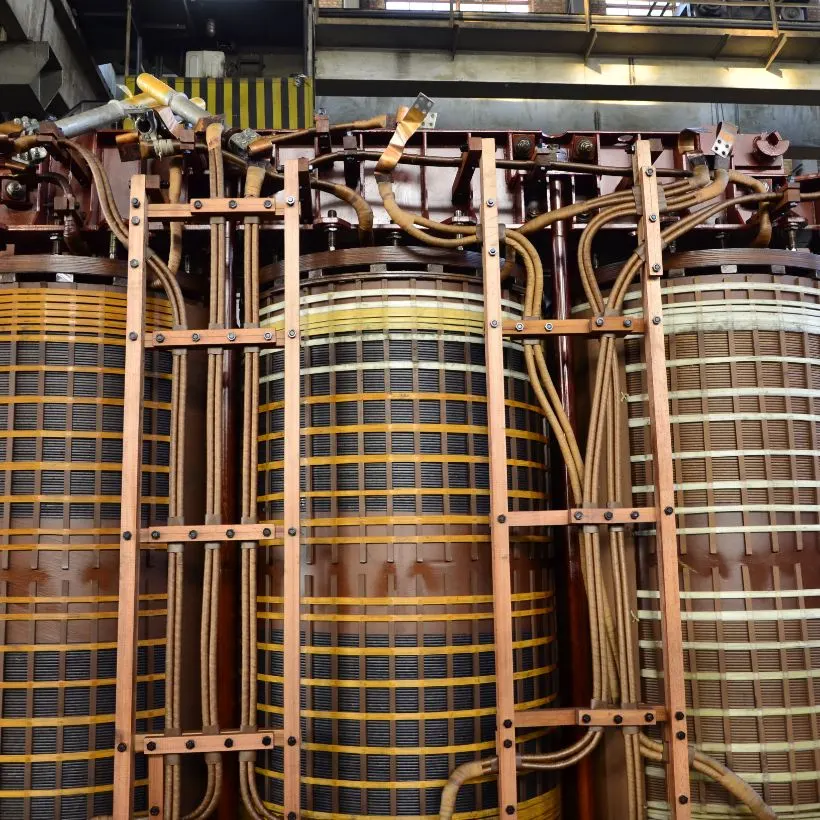
In power and distribution transformers operating across Lahore (Sundar, Kot Lakhpat, Multan Road, Sheikhupura), uninhibited naphthenic mineral oil is subjected to extreme physical and chemical degradation forces. Three local atmospheric and operational conditions accelerate this breakdown:
- Extreme Monsoonal Humidity (July–August): Lahore's monsoon brings relative humidity exceeding 85% coupled with intense ambient heat. When transformers undergo daily thermal load cycles, the air inside the conservator tank contracts during cooling cycles, drawing humid ambient air past worn-out, saturated silica gel breathers directly into the oil reservoir.
- Thermal Oxidation & Acidity: Under sustained summer temperatures (45°C ambient), oxygen dissolved in the oil reacts with hydrocarbons at winding hot spots, forming organic acids, peroxides, and heavy insoluble sludge. This acidic sludge coats the winding cooling ducts, drastically lowering heat dissipation.
- Dielectric Carbonisation from Micro-Arcing: Transient voltage spikes on LESCO 11kV distribution feeders generate localized corona partial discharges across paper insulation, generating microscopic suspended carbon particles that align along electric field lines to trigger full dielectric flashover.
IEC 60156 & WAPDA DDS-84 Oil Quality Benchmarks
To determine whether transformer oil requires immediate high-vacuum filtration or total replacement, international standards establish strict quantitative thresholds:
| Oil Property Test | Standard Method | New Virgin Oil | Serviceable In-Use Oil | Critical Action Required |
|---|---|---|---|---|
| Dielectric Breakdown Voltage (BDV) | IEC 60156 (2.5mm gap) | > 60 kV | 40 – 50 kV | < 30 kV (Immediate Trip Risk) |
| Moisture Content (Water in Oil) | IEC 60814 (Karl Fischer) | < 15 ppm | 20 – 30 ppm | > 35 ppm (Dehydration Required) |
| Total Acidity (Neutralization No.) | IEC 62021-1 | < 0.01 mg KOH/g | < 0.15 mg KOH/g | > 0.30 mg KOH/g (Acid Corrosion) |
| Interfacial Tension (IFT) | ASTM D971 | > 40 mN/m | 28 – 35 mN/m | < 22 mN/m (Heavy Sludge) |
| Dielectric Dissipation Factor (Tan $\delta$) | IEC 60247 (90°C) | < 0.005 | < 0.05 | > 0.10 (Severe Loss/Conductivity) |
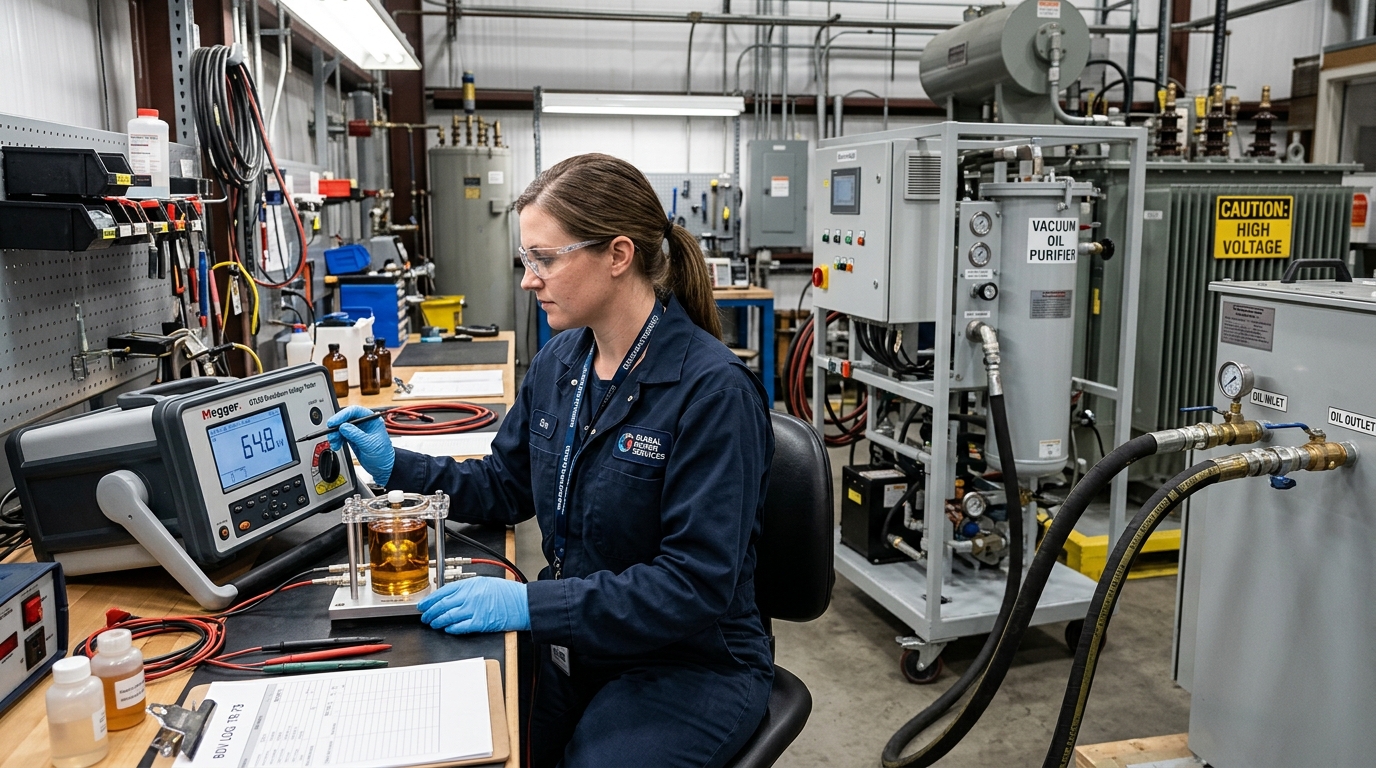
How On-Site Dielectric BDV Breakdown Testing is Executed
TransfoLine's mobile testing van carries portable automated 80 kV high-voltage oil testing vessels complying with IEC 60156 specifications. Our certified test engineers execute the breakdown test right inside your factory substation yard in 30 minutes:
- Sampling Hygiene: The bottom drain valve is flushed with 2 liters of oil to remove stagnant pipe residue. A clean, moisture-free 500ml borosilicate glass sample bottle is filled without creating air bubbles.
- Electrode Calibration: The test vessel utilizes spherical brass electrodes polished to a mirror finish, calibrated to an exact $2.50 \pm 0.05 ext{ mm}$ gap using a precision feeler gauge.
- Automated Voltage Ramp: The oil sample rests for 5 minutes to release dissolved air bubbles. The test set automatically ramps up high voltage at a steady rate of $2.0 ext{ kV/sec}$ until an electrical spark jumps across the gap, triggering the primary breaker.
- Statistical Breakdown Averaging: The procedure is repeated automatically six consecutive times on the same sample with a 2-minute rest pause between breakdowns. The final reported BDV value is the mathematical average of the six breakdown voltages.
The Moisture-Dielectric Curve: How 30 ppm Destroys Insulation
The relationship between moisture content and dielectric breakdown voltage is non-linear and aggressive. A dry transformer oil containing less than 10 ppm of water can easily withstand 70 kV to 80 kV across a 2.5mm gap.
However, as moisture ingress increases:
- At 25 ppm moisture: Dielectric breakdown voltage drops sharply by 40% down to approximately 42 kV.
- At 40 ppm moisture: BDV collapses below 25 kV—reaching the critical threshold where 11kV operational voltage spikes can trigger catastrophic internal phase-to-ground flashover.
- At 60 ppm moisture: The oil is essentially saturated; free water droplets separate and settle into the paper winding insulation, cutting the solid insulation dielectric withstand by up to 90%!
The 4-Stage High-Vacuum Dehydration & Degassing Process
When oil BDV drops below 35 kV or moisture exceeds 30 ppm, high-vacuum thermal dehydration is the gold-standard engineering remedy. TransfoLine operates high-capacity mobile oil conditioning rigs stationed in Lahore with processing rates from 1,500 to 6,000 liters per hour.
Our mobile vacuum filtration rig executes a continuous 4-stage treatment cycle:
- Thermostatically Controlled Pre-Heating: Oil is drawn from the bottom valve and passed through indirect, low-watt-density electric heaters, raising temperature to 60°C–65°C. Heating lowers oil viscosity and breaks the molecular bonding between water molecules and oil hydrocarbons.
- Primary Coarse Filtration: The fluid flows through magnetic traps and cleanable stainless-steel mesh filters that capture coarse metallic particles, rust scale, and paint chips.
- Two-Stage High-Vacuum Degassing & Dehydration Column: The warm oil is injected into a cylindrical vacuum chamber operating at deep vacuum (< 0.05 mbar). Patented raschig-ring atomization nozzles spray the oil into micro-thin films, exposing maximum surface area. Under deep vacuum, water boils into vapor at just 35°C (far below normal 100°C), flash-evaporating along with dissolved combustible gases (hydrogen, methane, acetylene) and venting harmlessly into the atmosphere.
- Micro-Fine Sub-Micron Filtration: The dehydrated, degassed oil is forced through 0.5-micron pleated micro-glass cartridges that capture sub-microscopic carbon soot and cellulose fibers.
Online Energized Filtration vs. Offline Outage Filtration
Factory managers in Lahore often face the dilemma: "Can we filter our transformer oil without shutting down factory operations?"
TransfoLine offers both methodologies based on substation design:
- Online Energized Dehydration: Feasible on transformers equipped with conservator tanks, Buchholz relays, and standard upper/lower ball valves. The mobile plant runs in a closed loop while the transformer remains energized under production load. Continuous oil circulation gradually extracts moisture not only from the oil but also pulls deep-seated moisture out of the solid winding paper insulation through osmotic equilibrium. Requires specialized gas-trap safety interlocks.
- Offline Dehydration: Mandatory on hermetically sealed corrugated-tank transformers or units exhibiting severe inter-turn faults or active gas trips. Executed during a scheduled 8-to-12 hour planned weekend shutdown.
Economic Audit: Dehydration vs. Total Oil Replacement
Is it better to filter existing oil or drain and refill with brand-new transformer oil? The financial economics for a typical 630 kVA or 1,000 kVA transformer in Lahore are heavily in favor of dehydration:
| Cost Parameter (1,000 kVA Unit) | On-Site Vacuum Dehydration | Complete Oil Replacement |
|---|---|---|
| Volume of Insulating Oil | 1,400 Liters (Existing oil preserved) | 1,400 Liters (New virgin oil required) |
| Oil Material Cost (2026 PKR) | PKR 0 (Zero new oil purchase) | PKR 630,000 – 770,000 (@ PKR 450–550/L) |
| Service & Mobilization Expense | PKR 65,000 – 95,000 | PKR 45,000 (Flushing & filling labor) |
| Old Oil Disposal / Scrapping | No hazardous waste generated | Must arrange safe disposal/resale |
| Final Breakdown Voltage Achieved | > 65 kV (Like New) | > 65 kV (Virgin) |
| Total Factory Expenditure | PKR 65,000 – 95,000 | PKR 675,000 – 815,000 |
Conclusion: Unless transformer oil has turned into thick acidic sludge (acidity > 0.40 mg KOH/g), high-vacuum dehydration delivers identical dielectric performance at less than 15% of the cost of new oil, saving hundreds of thousands of PKR per substation.
Frequently Asked Questions
FAQ How long does on-site transformer oil filtration take in Lahore?
For a standard 400 kVA to 1000 kVA transformer containing 800 to 1,500 liters of oil, complete vacuum dehydration, degassing, and particulate filtration typically takes 6 to 10 hours of continuous circulation to achieve BDV > 65 kV and moisture < 15 ppm.
FAQ Can TransfoLine test our transformer oil breakdown voltage on-site?
Yes. Our mobile engineering vehicle is permanently equipped with an automated 80 kV IEC 60156 dielectric test set. We sample the oil and provide verified, printed BDV test results on-site within 30 minutes across all Lahore industrial estates.
FAQ What is the minimum acceptable BDV for an 11kV transformer in Pakistan?
According to WAPDA DDS-84 and IEC 60422 standards, in-service oil in an 11kV distribution transformer must have a breakdown voltage of at least 40 kV. If BDV drops below 30 kV, immediate filtration is mandatory to prevent flashover trips.
FAQ Do we need to transport our transformer to your workshop for oil filtration?
No. Our high-vacuum oil dehydration plants are completely mobile, mounted on dedicated service vehicles with on-board vacuum booster pumps and heating columns. We execute the entire filtration process inside your factory substation yard.
FAQ How often should an industrial transformer undergo oil testing in Lahore?
Due to Lahore's high ambient summer temperatures and humid monsoons, we recommend an on-site BDV test every 6 months, and an annual comprehensive laboratory test including Karl Fischer moisture analysis and Dissolved Gas Analysis (DGA).

TransfoLine Electrical Engineering Team
Specialized in industrial high-voltage substations, transformer rewinding, and power quality diagnostics across Pakistan. Based on Raiwind Road, Lahore with 18+ years of field experience and 10,000+ energized installations.
Urgent Transformer Breakdown in Lahore?
Our emergency mobile testing team arrives on-site in Sundar, Kot Lakhpat, Multan Road, or Sheikhupura within 2 to 4 hours. Standby loaner transformers available.