
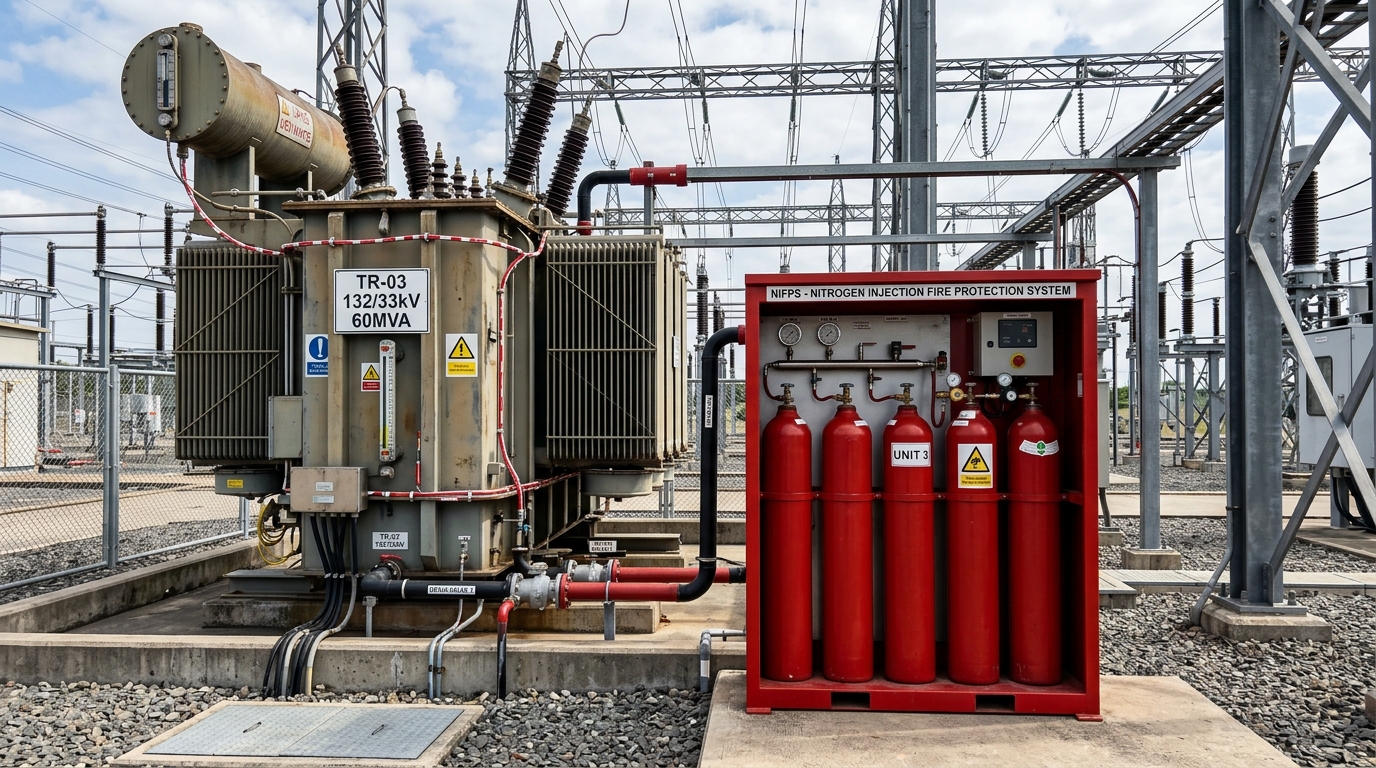
Direct Engineering Answer: A 10 MVA to 40 MVA transformer contains 10,000 to 25,000 liters of combustible mineral oil. Nitrogen Injection Fire Protection Systems (NIFPS) automatically drain tank oil and inject high-pressure nitrogen gas into the tank base within 30 seconds upon simultaneous Buchholz, differential, and PRV relay trips, extinguishing fires without water damage.
1. High-Voltage Substation Fire Hazards & Conflagration Risks
Large high-voltage power transformers (10 MVA to 40 MVA / 132kV) contain vast inventories of combustible mineral insulating oil—ranging from 10,000 liters in a 10 MVA unit to over 30,000 liters in a 40 MVA grid transformer. In the event of a high-energy catastrophic failure—such as a 132kV condenser bushing puncture, internal winding flashover, or tank rupture—electrical arc temperatures exceeding 3,000°C instantly vaporize oil into explosive hydrocarbon gases.
If the tank ruptures, atomized burning oil spray creates an intense conflagration with heat release rates exceeding 100 Megawatts. Such fires can rapidly engulf adjacent transformers, destroy 11kV switchgear buildings, and threaten plant personnel. Designing effective fire containment and automatic fire suppression is paramount. Explore TransfoLine's high-voltage power transformer solutions.
2. Limitations of Conventional Water Deluge (HVWS) Systems
Traditionally, substations installed High-Velocity Water Spray (HVWS) deluge systems around transformer bays. While water deluge cools the outer steel tank and adjacent structures, it suffers from severe engineering limitations in Pakistan:
- No Internal Extinguishment: Water spray operates only on the exterior of the tank and cannot extinguish internal fires burning inside a ruptured transformer tank.
- Massive Water Infrastructure: Requires 100,000+ liter dedicated water storage tanks, high-pressure diesel fire pumps, and extensive underground piping prone to corrosion.
- Environmental Runoff: Water washing over burning oil creates massive contaminated runoff that can overflow soak pits and pollute surrounding soil.
3. Operating Physics of Nitrogen Injection Fire Protection Systems (NIFPS)
The Nitrogen Injection Fire Protection System (NIFPS) provides a dry, water-free active fire suppression solution. Operating on the principle of thermal stirring and inert gas blanketing, NIFPS extinguishes internal transformer fires within 30 seconds of fault initiation:
- Fast Oil Drain: A high-speed electro-pneumatic drain valve opens, draining the top 10% to 15% of oil volume into the underground containment pit to relieve internal tank pressure.
- High-Pressure Nitrogen Injection: High-purity nitrogen gas (N2 > 99.99%) stored at 150 bar in steel cylinders is injected into the bottom of the transformer tank through non-clogging diffuser nozzles.
- Thermal Stirring: The bubbling nitrogen vigorously stirs the bulk oil mass, bringing cool bottom oil to the surface to rapidly depress the oil temperature below its flashpoint (140°C).
- Oxygen Starvation: Nitrogen fills the gas space above the oil surface, displacing atmospheric oxygen (O2 < 8%) and starving the flame instantly.
4. Automated Trigger Logic & Relay Interlocking Mechanisms (2oo3)
To eliminate accidental false discharges, NIFPS utilizes a strict Two-Out-of-Three (2oo3) logic interlock combining electrical and mechanical fault signals:
AND [ Mechanical Pressure Trip (Buchholz Relay 63 OR Pressure Relief Valve PRV 63X) ]
AND [ Thermal Fire Sensor Trip (Linear Heat Detector Cable 79°C) ]
5. Oil Drain Valve Actuation & Pressure Blanketing Sequence
Upon verified fire detection, the NIFPS control unit closes the conservator isolation valve within 1 second to prevent oil from feeding the fire, opens the oil drain valve within 2 seconds, and initiates continuous nitrogen injection for 30 minutes to ensure permanent extinguishment and cool the core.
6. Reinforced Concrete Fire Separation Blast Walls & Soak Pits
TransfoLine designs comprehensive substation physical protection per NFPA 850 standards, including 4-hour fire-rated reinforced concrete blast barrier walls between adjacent transformer bays and crushed pebble-filled oil soak pits designed to hold 100% of transformer fluid volume.
7. Compliance with NFPA 850 & Central Electricity Authority Standards
NIFPS systems supplied by TransfoLine comply fully with international fire codes (NFPA 850, IS 3034, and IEEE 979), ensuring compliance with international industrial safety audits and qualifying facilities for optimal insurance terms.
8. Maintenance, Testing & Nitrogen Cylinder Pressure Inspection
Preventative testing of NIFPS installations must be conducted semi-annually. TransfoLine certified technicians inspect cylinder manifold pressure (150 bar at 20°C), test pneumatic solenoid valves, verify oil conservator shutoff gate valve sealing, and perform end-to-end trip logic simulations without discharging nitrogen.
9. TransfoLine Turnkey Safety Engineering & Substation Integration
TransfoLine engineers provide turnkey supply, pneumatic piping erection, nitrogen cylinder pressure monitoring, and annual functional testing of NIFPS installations across Pakistan. Learn more about our turnkey substation EPC solutions.
10. Comparative Reliability & Maintenance Costs: NIFPS vs Water Deluge
A comprehensive engineering comparison of active fire protection technologies for 10 MVA+ power transformers highlights key operational metrics:
- Extinguishment Time: NIFPS achieves complete fire suppression and inert gas blanketing in under 30 seconds; Water deluge takes 3 to 10 minutes and cannot extinguish internal tank fires.
- Post-Fire Cleanup: NIFPS uses clean nitrogen gas leaving zero residue; water deluge floods the substation with thousands of liters of oil-contaminated water requiring hazardous waste disposal.
- Freezing & Corrosion Risk: Nitrogen cylinders maintain stable pressure across all temperatures; water deluge pipes are prone to rust, sediment clogging, and freezing in northern Pakistani winters.
- Annual Maintenance: NIFPS requires only semi-annual pressure checks; water deluge requires weekly diesel pump test runs and pipe flushing.
11. Case Study: Successful NIFPS Fire Suppression at a 20 MVA Grid Station
During a heavy thunderstorm near Sheikhupura, a direct lightning strike induced a severe overvoltage surge that breached the 132kV bushing on a 20 MVA power transformer. The resulting internal arc flash tripped the differential relay (87T) and triggered the mechanical Buchholz gas surge relay simultaneously. Within 3 seconds, the linear heat detection cable registered a local flame temperature of 82°C.
The integrated NIFPS immediately tripped the conservator isolation valve, opened the quick-drain valve, and began high-pressure nitrogen injection into the transformer base. The flame was completely extinguished in 22 seconds without any external fire brigade intervention or water damage to adjacent 11kV switchgear, saving over 50 Million PKR in surrounding substation infrastructure.
Frequently Asked Questions
FAQ How does NIFPS extinguish a transformer fire without water?
By injecting high-pressure nitrogen into the bottom of the tank, which stirs cold oil to the surface and creates an oxygen-free inert blanket over the oil, suffocating the fire in under 30 seconds.
FAQ What prevents accidental nitrogen discharge during routine maintenance?
The system requires multi-sensor confirmation (electrical differential relay + Buchholz gas surge + thermal heat detector) and features manual safety lockouts for maintenance.
FAQ How long does nitrogen injection continue after a fire trip?
Nitrogen injection continues for 30 to 45 minutes to cool the active core and windings and prevent re-ignition.
FAQ Are fire barrier walls required between transformers in Pakistan?
Yes, for power transformers rated 10 MVA and above situated within 8 to 15 meters of each other, 4-hour fire-rated reinforced concrete blast walls are mandatory.
FAQ Does TransfoLine service and recharge nitrogen cylinders?
Yes, we provide on-site nitrogen cylinder hydrostatic testing, pressure inspection, and certified gas refilling services across Pakistan.
Need Direct Technical Assistance or a Factory-Direct Quote?
TransfoLine supplies, installs, overhauls, and repairs heavy industrial transformers across Pakistan with nationwide 48-hour delivery, genuine WAPDA P-10 compliance, and 12-month full warranty.