
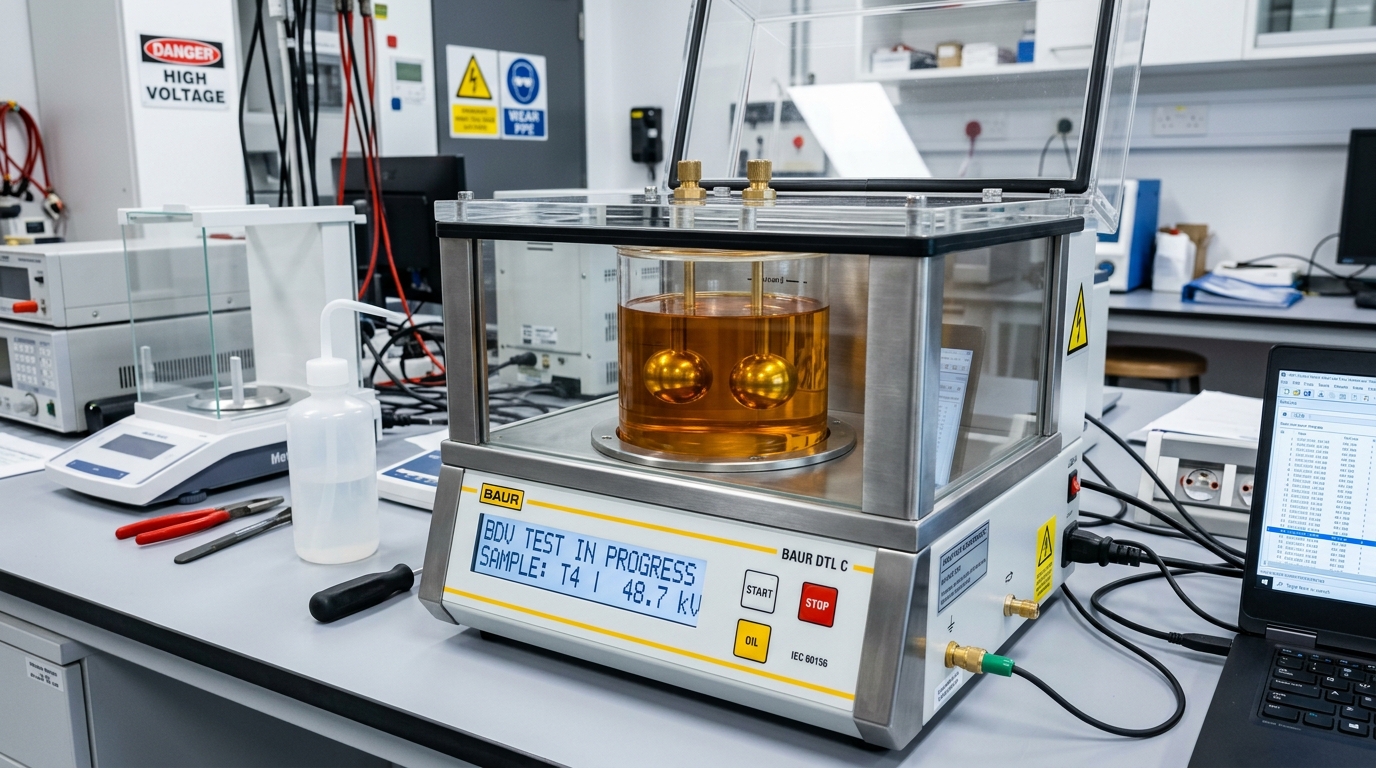
Direct Engineering Answer: Dielectric oil breakdown voltage (BDV) testing per IEC 60156 measures the insulating capability of transformer mineral oil across a 2.5mm spark gap. Fresh oil must exceed 60 kV; in-service oil below 30 kV indicates hazardous moisture or carbon contamination requiring immediate on-site mobile vacuum dehydration and filtration.
1. The Critical Function of Dielectric Mineral Oil
In all liquid-immersed distribution and power transformers operating across Pakistan, refined uninhibited mineral insulating oil (or synthetic ester fluid) serves two vital and indispensable roles: electrical insulation and thermal heat dissipation. It fills every microscopic void between paper-insulated copper turns, barrier pressboard cylinders, and magnetic core laminations, providing high dielectric withstand strength while transferring heat away from internal windings to external radiator surfaces.
However, transformer oil is not static. Over months of industrial operation under high ambient temperatures (45°C+), seasonal humidity breathing, and cyclical overloading, the oil undergoes oxidation and absorbs moisture. Without regular monitoring, degraded oil triggers sudden dielectric flashover, destroying the transformer. Explore our dedicated mobile oil dehydration and filtration services.
2. What is Breakdown Voltage (BDV) & Why Does it Decay?
Dielectric Breakdown Voltage (BDV) is the measure of the electrical voltage stress an insulating liquid can withstand before an electrical arc punches through it. It is expressed in Kilovolts (kV). In clean, dry, degassed mineral oil, dielectric molecules resist electrical conduction up to very high electric field gradients (> 60 kV to 80 kV).
However, when microscopic moisture droplets, cellulose paper fibers, and carbon particles enter the oil, they align themselves along the electric field lines between energized conductors, forming a conductive bridge that triggers a catastrophic low-voltage electrical puncture.
3. IEC 60156 Standard Test Method & Electrode Spark Gap Geometry
Breakdown voltage is measured using specialized automatic oil dielectric test sets (such as BAUR DTA / Megger OTS) according to IEC 60156 standards:
- Test Cell & Electrodes: A precision glass/polyamide test vessel fitted with two polished spherical or mushroom-shaped brass electrodes separated by an exact 2.50 mm ± 0.05 mm spark gap.
- Voltage Ramp Rate: High AC voltage is applied across the gap, ramping upward steadily at a rate of 2.0 kV per second until dielectric flashover occurs.
- Statistical Averaging: Six consecutive breakdown measurements are taken on the same oil sample with 2-minute pauses between sparks; the arithmetic mean represents the official BDV rating.
4. International Dielectric Acceptance Limits (Fresh vs In-Service Oil)
| Transformer Oil Status | BDV Voltage (2.5mm Gap) | Moisture Content (ppm) | Required Maintenance Action |
|---|---|---|---|
| Brand New Oil (IEC 60296) | > 60 kV – 70 kV | < 15 ppm | Ready for vacuum filling into new/rebuilt units. |
| Good Operating Condition | 45 kV – 60 kV | < 25 ppm | Normal service; schedule re-testing in 6–12 months. |
| Marginal / Warning Status | 30 kV – 44 kV | 25 – 35 ppm | Plan scheduled on-site vacuum oil filtration. |
| Critical Fault Danger | < 30 kV | > 35 ppm | Immediate shutdown & high-vacuum dehydration required. |
5. The Dangerous Chemistry of Moisture, Sludge & Acidity (Total Acid Number)
Moisture in oil does double damage: it lowers electrical BDV and dramatically accelerates the chemical aging of solid paper insulation. Water reacts with cellulose chains via acid hydrolysis, reducing the paper's Degree of Polymerization (DP value). Simultaneously, oil oxidation produces peroxides and organic acids (measured as Total Acid Number - TAN). When TAN exceeds 0.20 mg KOH/g, insoluble polymer sludge precipitates out, clogging radiator cooling fins and causing severe thermal runaway.
6. On-Site High-Vacuum Oil Dehydration & Degassing Technology
Replacing hundreds of thousands of liters of oil is expensive. TransfoLine operates high-flow Mobile Vacuum Oil Dehydration & Purification Plants (1,000 to 5,000 Liters/Hour capacity):
- Micro-Filtration: 0.5-micron coalescer filters remove sub-micron carbon particles and suspended fibers.
- Vacuum Degassing Chamber: Oil is heated to 60°C–65°C and atomized across Raschig ring columns inside a high-vacuum chamber (< 0.1 mbar), boiling off dissolved moisture and trapped gases.
- Dielectric Restoration: Returns oil moisture content to < 10 ppm and restores BDV to > 65 kV to 75 kV on site.
7. Comprehensive Transformer Oil Health Matrix (BDV, Moisture & IFT)
A comprehensive oil assessment includes BDV, Karl Fischer moisture testing, Interfacial Tension (IFT), and Dissolved Gas Analysis (DGA). Review our 16 certified electrical testing procedures.
8. Inhibited vs Uninhibited Mineral Oil Comparison (DBPC Additives)
Uninhibited mineral oil contains only natural oxidation inhibitors, whereas inhibited oil includes synthetic anti-oxidant additives such as 2,6-di-tert-butyl-p-cresol (DBPC). Inhibited oil resists oxidation up to 3 times longer in high-temperature environments, making it ideal for furnace and heavy industrial transformers in Pakistan.
9. TransfoLine 24/7 Mobile Testing Vans & Dehydration Service
TransfoLine deploys fully equipped mobile oil testing vans and vacuum dehydration trailers across Lahore, Faisalabad, Gujranwala, Sialkot, Sheikhupura, Multan, and Karachi for emergency on-site oil restoration.
10. Complete Laboratory Oil Quality Assessment Parameter Guide
| Diagnostic Test Parameter | Standard Test Method | New Oil Value | In-Service Action Limit | Diagnostic Significance |
|---|---|---|---|---|
| Breakdown Voltage (BDV) | IEC 60156 | > 60 kV / 2.5mm | < 35 kV / 2.5mm | Dielectric insulation capability across spark gap. |
| Water / Moisture Content | IEC 60814 (Karl Fischer) | < 15 ppm | > 30 ppm | Dissolved moisture accelerates paper degradation. |
| Dielectric Dissipation (&tan;δ) | IEC 60247 @ 90°C | < 0.005 | > 0.05 | Measures dielectric dielectric loss & aging sludge. |
| Total Acid Number (TAN) | IEC 62021 | < 0.01 mg KOH/g | > 0.15 mg KOH/g | Organic acid content indicating oil oxidation. |
| Interfacial Tension (IFT) | ASTM D971 | > 40 mN/m | < 22 mN/m | Detects polar contaminants and soluble sludge. |
| Specific Resistance (Resistivity) | IEC 60247 @ 90°C | > 60 × 10¹² Ω·cm | < 5 × 10¹² Ω·cm | Electrical resistivity of liquid dielectric. |
11. Field Oil Sampling Best Practices & ASTM D923 Compliance
Accurate oil diagnostics depend entirely on correct sampling methodology. Contaminating an oil sample with ambient moisture, airborne dust, or improper plastic containers invalidates laboratory results. TransfoLine technicians follow strict ASTM D923 protocols: sampling from the bottom drain valve after flushing 2 to 4 liters of stagnant oil, using hermetically sealed amber glass bottles or gas-tight syringes, and testing on-site within 30 minutes to prevent atmospheric moisture absorption.
Frequently Asked Questions
FAQ What is the minimum acceptable BDV for in-service transformer oil in Pakistan?
In-service distribution transformer oil should maintain a BDV of at least 40 kV; any reading below 30 kV requires immediate vacuum dehydration.
FAQ Can transformer oil be filtered while the factory is running?
Yes, for distribution and power transformers with upper and lower sampling valves, TransfoLine performs online vacuum circulation without plant shutdowns.
FAQ How does moisture enter transformer oil?
Moisture enters through air breathing during daily thermal load cycles when silica gel breathers become saturated, as well as from internal cellulose paper aging.
FAQ How long does mobile vacuum oil dehydration take?
A standard 1,000 kVA transformer (approx. 1,500 liters of oil) takes 4 to 6 hours of high-vacuum circulation to restore BDV above 65 kV.
FAQ What testing equipment does TransfoLine use for on-site oil tests?
TransfoLine uses calibrated BAUR DTA-100 automatic dielectric testers and Metrohm Karl Fischer moisture titrators.
Need Direct Technical Assistance or a Factory-Direct Quote?
TransfoLine supplies, installs, overhauls, and repairs heavy industrial transformers across Pakistan with nationwide 48-hour delivery, genuine WAPDA P-10 compliance, and 12-month full warranty.