
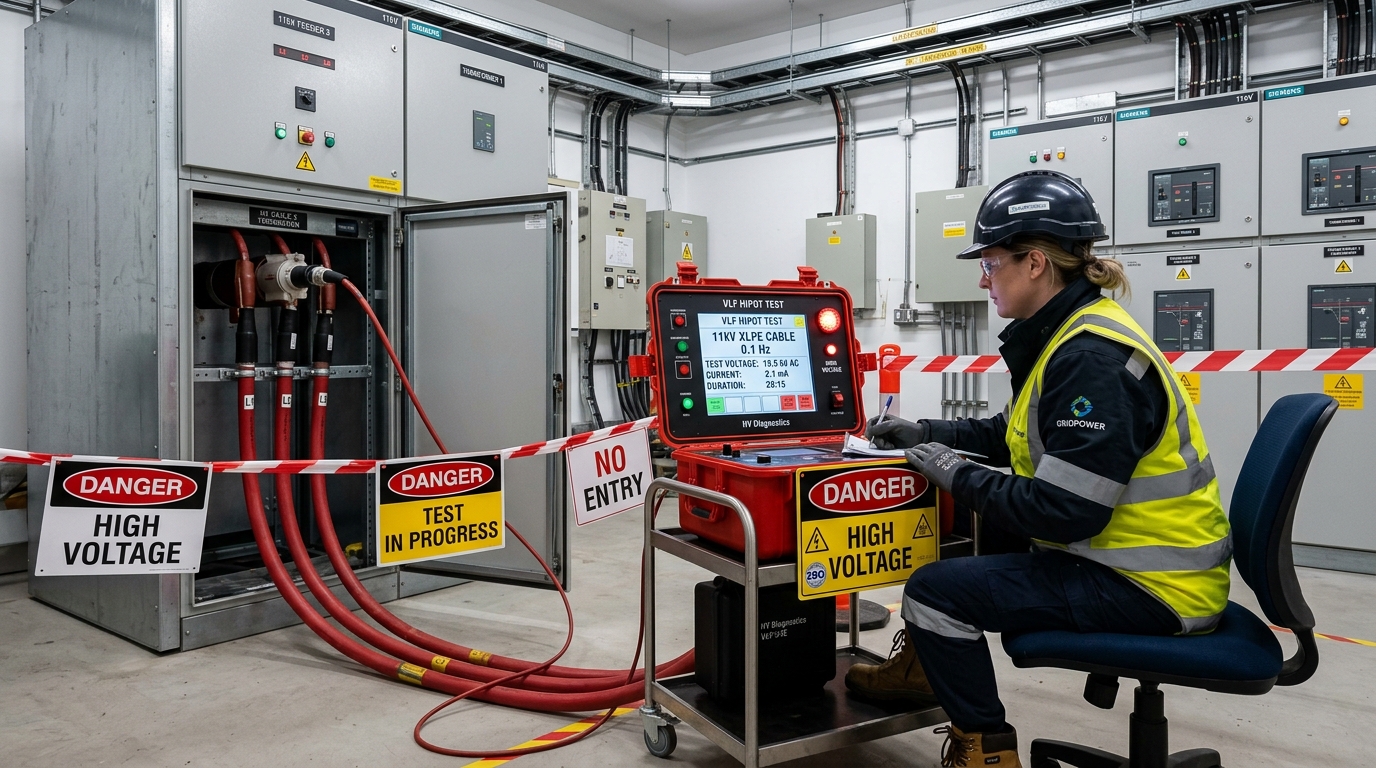
Direct Engineering Answer: DC Hipot is prohibited on XLPE cables because it injects trapped space charges that cause post-energization dielectric puncture. 0.1Hz VLF AC Hipot provides true alternating dielectric stress with 500x less charging current power. TransfoLine provides certified 0.1Hz VLF Hipot testing up to 60kV RMS for 11kV and 33kV cable networks nationwide.
The Dangerous Flaw with DC Hipot on XLPE Cables
Over 95% of medium-voltage underground cable installations across Pakistan (including LESCO, K-Electric, DHA, and industrial estates) now utilize Cross-Linked Polyethylene (XLPE) solid dielectric insulation.
When DC voltage is applied to an XLPE cable, it forces charge carriers into micro-cavities and water trees, creating trapped space-charge concentrations. When the cable is subsequently re-energized on 50Hz AC grid voltage, the trapped space charge superimposes upon the AC peak voltage, triggering instant dielectric puncture. IEEE 400 and IEEE 400.2 explicitly forbid DC Hipot on in-service XLPE cables.
Comparing AC Power-Frequency, DC, and 0.1Hz VLF Hipot
| Method | Frequency | Equipment Weight | Suitability for XLPE Cables |
|---|---|---|---|
| Power-Frequency AC | 50 Hz | Multi-ton trucks (resonant sets) | Safe & accurate, but physically impractical for field testing. |
| DC Hipot | 0 Hz (DC) | Compact suitcase units | Destructive to XLPE. Only permitted on old PILC paper cables. |
| VLF AC Hipot | 0.1 Hz / 0.05 Hz | Portable field units (40–70kg) | IEEE 400.2 standard of choice. True AC stress with zero space-charge trapping. |
How 0.1Hz VLF Solves the Cable Capacitance Problem
High-voltage underground cables have high capacitance. Testing a 2 km 11kV cable at 50Hz requires massive charging current (~68 kVA power). By lowering test frequency to 0.1 Hz, charging current drops by 500 times (down to ~130 VA), making portable high-voltage field testing possible without sacrificing true alternating dielectric stress.
IEEE 400.2 VLF Hipot Test Voltage Standards
| Cable System Voltage | Phase-to-Ground U0 | Installation / Acceptance (New) | Maintenance Test (In-Service) |
|---|---|---|---|
| 11 kV (6.35/11kV) | 6.35 kV | 19 kV RMS (28 kV Peak) · 60 min | 13 kV RMS (19 kV Peak) · 15–30 min |
| 33 kV (19/33kV) | 19.0 kV | 57 kV RMS (80 kV Peak) · 60 min | 38 kV RMS (54 kV Peak) · 15–30 min |
How TransfoLine Conducts High-Voltage Commissioning
TransfoLine deploys digital BAUR and Megger 0.1Hz sinusoidal VLF Hipot test systems with integrated Tan Delta and Partial Discharge monitoring across Pakistan, delivering non-destructive commissioning reports and switchgear testing up to 70kV.
Need Certified Diagnostic Testing or Emergency Support?
TransfoLine's PEC-registered engineers mobilize nationwide within 24 hours with mobile testing vans and complete diagnostic instrumentation.
Consult with a Testing Engineer →Frequently Asked Questions
Why is DC Hipot testing prohibited on aged XLPE medium-voltage cables?
Applying high DC voltages to XLPE cables injects trapped space charges into microscopic water tree voids. When re-energized on AC utility power, these trapped charges superimpose upon the AC peak voltage, triggering instant electrical breakdown.
What is the recommended test voltage for 11kV XLPE cables under VLF 0.1Hz Hipot?
Per IEEE 400.2, new 11kV XLPE cables undergoing initial commissioning are tested at 3 x U0 = 19kV RMS (28kV Peak) at 0.1Hz for 60 minutes. In-service aged maintenance cables are tested at 2 x U0 = 13kV RMS for 15 to 30 minutes.