
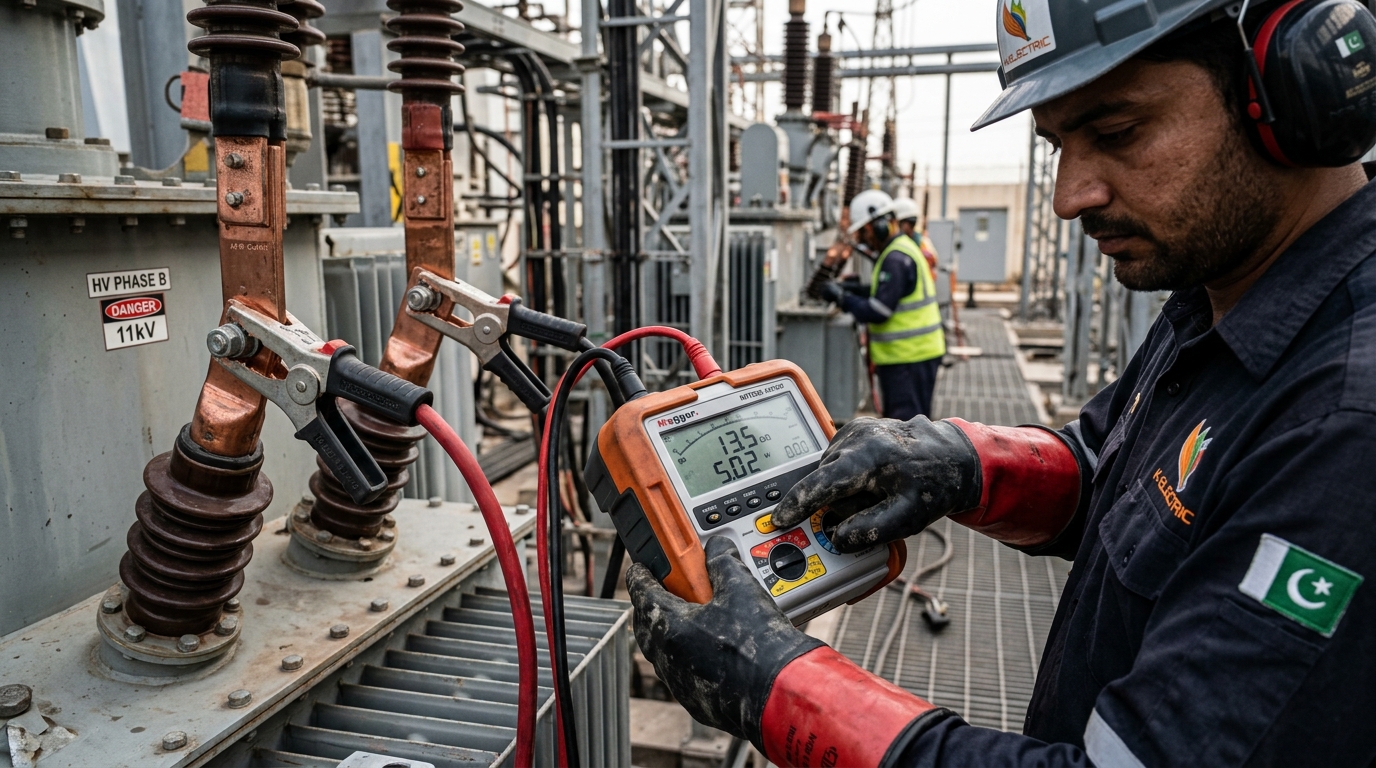
Direct Engineering Answer: For 11kV industrial equipment in Pakistan, Megger testing should be conducted at 2,500V or 5,000V DC with readings normalized to 40°C. A Polarization Index (PI = R10min / R1min) ≥ 2.0 confirms dry, healthy insulation, while the Guard (G) terminal eliminates false low readings caused by humid surface leakage.
The Anatomy of Total Insulation Current
When high DC voltage is applied across electrical insulation, the total measured current consists of four distinct components: Capacitive Charging Current (decays in seconds), Dielectric Absorption Current (polarization current decaying over 10 minutes), Surface Leakage Current (flowing over dirty porcelain), and True Volumetric Conductive Leakage Current (flowing through bulk insulation).
1. Selecting the Correct Test Voltage (IEEE 43 / NETA)
| Equipment Rated Voltage | Recommended DC Test Voltage | Minimum Acceptable IR (at 40°C) |
|---|---|---|
| 230V Single Phase / 415V 3-Phase | 500V – 1,000V DC | ≥ 2 MΩ – 5 MΩ |
| 3.3kV – 6.6kV Medium Voltage | 2,500V DC | ≥ 100 MΩ |
| 11kV Distribution Transformers / VCBs | 2,500V – 5,000V DC | ≥ 1,000 MΩ (1 GΩ) |
| 33kV Substation Power Equipment | 5,000V – 10,000V DC | ≥ 5,000 MΩ (5 GΩ) |
2. Time-Resistance Testing: DAR & Polarization Index (PI)
Time-resistance ratios provide definitive diagnostic proof of insulation dryness and cleanliness:
- Dielectric Absorption Ratio (DAR = R60s / R30s): Values > 1.4 indicate dry, healthy insulation; values < 1.1 indicate moisture or carbon contamination.
- Polarization Index (PI = R10min / R1min): Per IEEE 43, PI ≥ 2.0 confirms healthy Class B, F, and H insulation. A flat curve (PI < 1.0) warns of a dangerous conductive moisture path.
3. Mastering the Guard (G) Terminal to Eliminate Surface Leakage
In Pakistan's humid monsoon season, ceramic bushing surfaces become coated in conductive grime, pulling down an otherwise pristine internal winding reading from 2 GΩ down to 15 MΩ. Connecting a bare copper wire around the porcelain collar directly to the Guard (G) Terminal intercepts surface currents, ensuring the Megger measures only true volumetric insulation resistance.
How TransfoLine Restores Insulation Integrity
TransfoLine deploys digital Fluke 1555 and Megger S1 5kV/10kV automated testers with noise rejection up to 8mA. If insulation testing reveals low PI, we provide on-site high-vacuum thermal dry-out to restore assets to full IEEE 43 compliance.
Need Certified Diagnostic Testing or Emergency Support?
TransfoLine's PEC-registered engineers mobilize nationwide within 24 hours with mobile testing vans and complete diagnostic instrumentation.
Consult with a Testing Engineer →Frequently Asked Questions
What DC voltage should be used for Megger testing 11kV equipment in Pakistan?
Per IEEE 43 and NETA ATS standards, equipment rated between 5,000V and 12,000V (such as 11kV distribution transformers, vacuum switchgear, and HT motors) should be tested at 2,500V DC or 5,000V DC. Low-voltage 415V systems should be tested at 500V DC or 1,000V DC.
Why is temperature correction essential when recording Megger values?
Insulation resistance drops by approximately 50% for every 10°C rise in temperature. An insulation reading of 500 MΩ measured at 50°C during Lahore summer heat corresponds to an excellent 1,000 MΩ when corrected to the standard reference temperature of 40°C.