
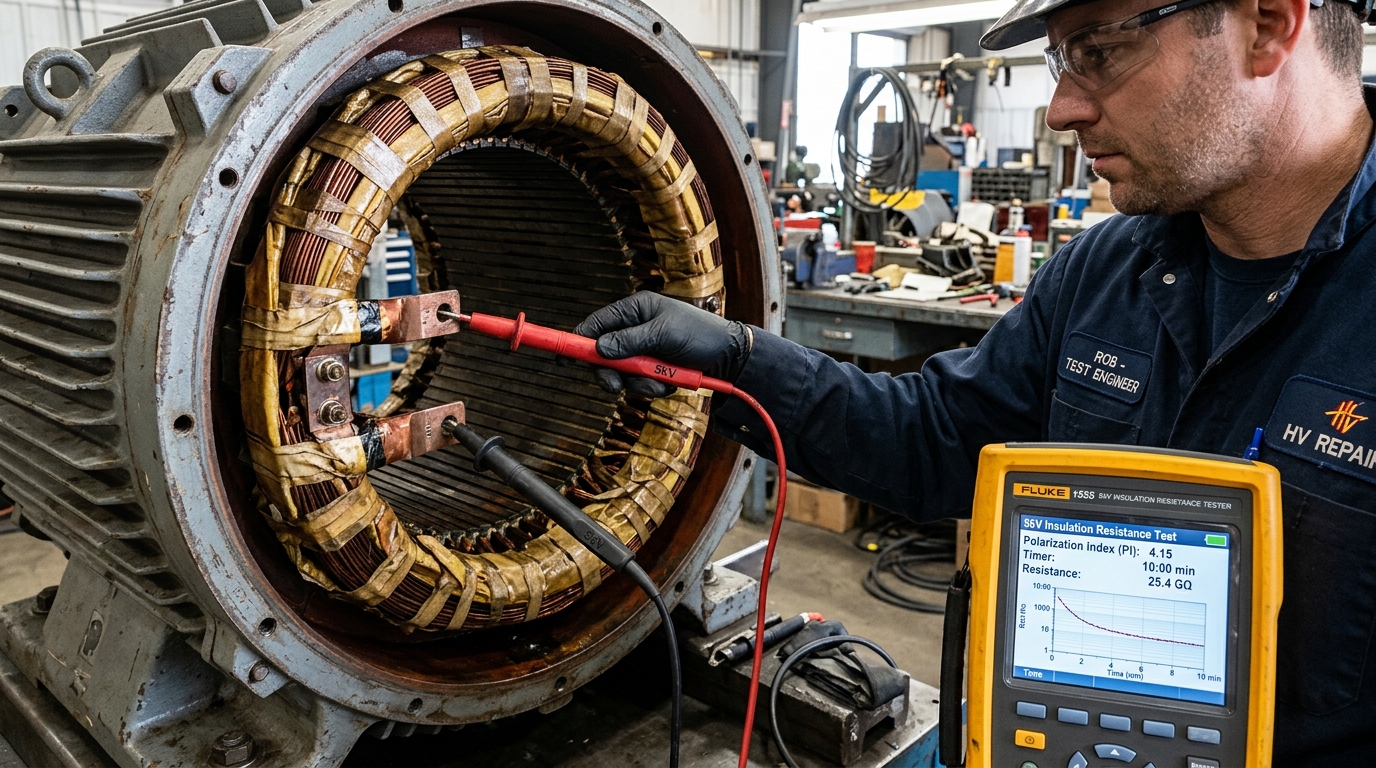
Direct Engineering Answer: The Polarization Index (PI = R10min / R1min) per IEEE 43 is the definitive measure of winding dryness and dielectric health in HT motors and transformers. A PI ≥ 2.0 confirms healthy Class F/H insulation, while a flat curve (PI < 1.0) indicates severe moisture contamination requiring oven baking at 105°C before energization. TransfoLine provides on-site motor surge, PI testing, and workshop VPI overhauls nationwide.
The Science of Polarization Index Testing
When continuous DC voltage (typically 2.5kV or 5kV) is applied to a stator winding, current flows into the insulation. In dry, healthy mica/resin insulation, dielectric absorption current steadily decays over 10 minutes as polar molecules align with the electric field. Consequently, apparent resistance rises continuously over time.
If the insulation is contaminated with moisture, carbon dust, or conductive grease, steady-state conductive leakage current dominates from the first second, causing the resistance curve to remain flat (PI = R10min / R1min).
IEEE 43-2013 Pass / Fail Diagnostic Thresholds
| PI Value Ratio | Insulation Condition | Curve Characteristic | Recommendation |
|---|---|---|---|
| < 1.0 | Dangerous / Severe Contamination | Downward slope | DO NOT ENERGIZE. Major moisture ingress. |
| 1.0 – 1.49 | Poor / Moisture Laden | Flat horizontal curve | Bake in thermal drying oven at 105°C; re-test. |
| 1.5 – 1.99 | Fair / Older Class A | Moderate upward rise | Acceptable for older machines; monitor closely. |
| 2.0 – 4.0 | Good / Optimal (Class B, F, H) | Steep continuous rise | Safe to energize and place in continuous service. |
| > 5.0 | Brittle / Aged (or Modern Epoxy) | Rapid rise to > 100 GΩ | Normal for new VPI resin; indicates dry brittle insulation in 25+ yr old assets. |
How to Execute an IEEE 43 Compliant PI Test
- Lockout / Tagout (LOTO): Isolate all 3-phase incoming connections and discharge residual capacitive charges to earth for at least 15 minutes.
- Clean Terminals: Wipe dust and moisture from ceramic or resin terminal blocks. Connect the Guard (G) lead if testing in humid conditions.
- Apply Constant DC Voltage: Apply 2.5kV or 5kV DC continuously without interruption.
- Log Exact Readings: Record insulation resistance precisely at 30 seconds, 1 minute, and 10 minutes.
- Complete Discharge: Ground the motor winding for at least 40 minutes to safely dissipate trapped dielectric energy.
How TransfoLine Restores Motor Insulation Integrity
TransfoLine delivers complete diagnostic and workshop restoration for high-voltage motors: motor surge and PI testing up to 5,000 kW, electric oven baking at 110°C, and Vacuum Pressure Impregnation (VPI) with Class H insulating varnish.
Need Certified Diagnostic Testing or Emergency Support?
TransfoLine's PEC-registered engineers mobilize nationwide within 24 hours with mobile testing vans and complete diagnostic instrumentation.
Consult with a Testing Engineer →Frequently Asked Questions
Why is Polarization Index (PI) considered temperature-independent?
Because both the 1-minute and 10-minute resistance readings are taken on the same winding at the exact same temperature during a continuous 10-minute test, the temperature correction factor cancels out mathematically (PI = R10 / R1).
What is the minimum acceptable PI value for modern Class F/H electric motors?
Per IEEE 43-2013 Table 4, the minimum acceptable Polarization Index for Class B, Class F, and Class H insulated rotating machinery (motors and generators) is 2.0. Any motor exhibiting a PI below 1.5 must undergo thermal oven baking and re-varnishing before energization.