
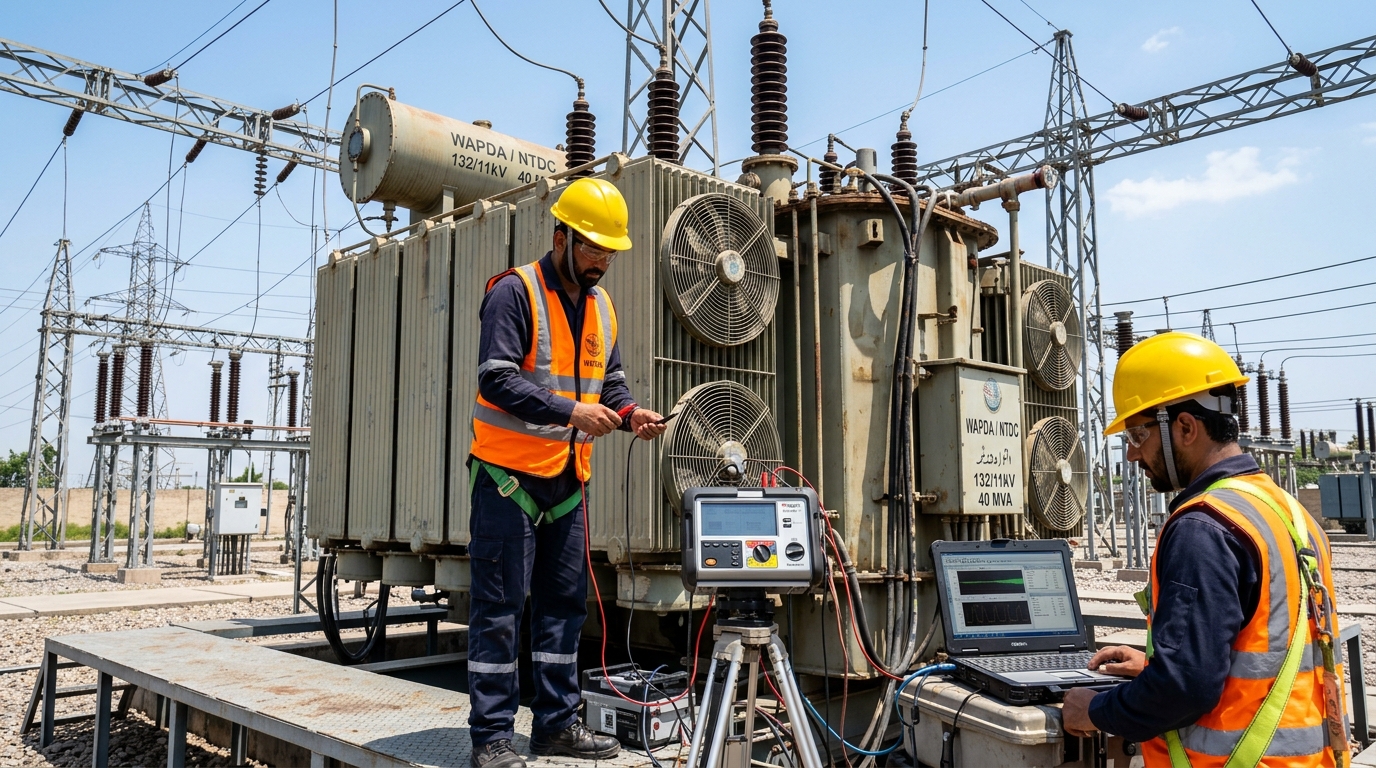
Direct Engineering Answer: Routine transformer testing in Pakistan must include Turns Ratio (TTR ±0.5%), Kelvin 4-wire Winding Resistance (balance within 1%), 5kV Insulation Resistance (PI > 2.0), Oil BDV (≥ 50kV), and Dissolved Gas Analysis (DGA) to detect active arcing (acetylene) or thermal hotspots. TransfoLine provides 24/7 on-site mobile testing vans with certified test dossiers nationwide.
The Real Industrial Cost of Skipping Transformer Diagnostics
In Pakistan's severe industrial climate—characterized by ambient summer temperatures surpassing 45°C, pervasive industrial dust, and erratic utility grid fluctuations across LESCO, GEPCO, MEPCO, and K-Electric networks—power transformers operate under extreme thermal and electrical stress.
Without proactive diagnostic testing, internal winding insulation degrades silently. Minor partial discharges evolve into inter-turn short circuits, acidic sludge destroys insulating paper, and loose clamping bolts lead to mechanical winding deformation during routine short-circuit faults. Implementing systematic diagnostic tests transforms reactive firefighting into predictable, scheduled maintenance.
1. Transformer Turns Ratio (TTR) Test
The Transformer Turns Ratio (TTR) test verifies the exact ratio between the number of primary turns and secondary turns across every tap changer position per IEC 60076-1. It is the primary tool for detecting open-circuited windings, shorted turns, and incorrect tap selector connections.
Acceptance Criteria: The measured voltage ratio must be within ±0.5% of the nameplate design ratio across all phases and tap settings. A deviation exceeding 0.5% indicates damaged winding insulation or a physical tap changer fault. Explore our dedicated transformer testing service page.
2. DC Winding Resistance Measurement (Kelvin 4-Wire)
Using a digital micro-ohmmeter with a 4-wire Kelvin bridge, our engineers measure the milliohm DC resistance of each phase winding on both HV and LV sides. This test detects broken copper strands, loose internal bolted joints, high-resistance tap changer contacts, and uneven winding resistance balance.
Acceptance Threshold: Phase resistance balance across all three legs must not vary by more than ±1% to 2% from each other and must closely match factory baseline data after temperature correction to 75°C.
3. Insulation Resistance (Megger) & Polarization Index (PI)
Measured using 2.5kV to 5kV DC motorized Meggers between HV-to-LV, HV-to-Earth, and LV-to-Earth. Continuous resistance readings at 1 minute and 10 minutes determine the Polarization Index (PI = R10min / R1min) per IEEE 43.
- PI > 2.0: Good dielectric condition (dry, clean insulation).
- PI < 1.5: Warning — significant moisture penetration or carbon contamination inside the cellulose pressboard barrier. See our detailed Megger & PI testing guide.
4. Insulating Oil Dielectric Breakdown Voltage (BDV)
Using calibrated BAUR or Megger automatic oil test sets per IEC 60156, oil samples extracted from the bottom drain valve are tested across a 2.5 mm electrode gap. Fresh oil must withstand ≥ 50kV, while in-service oil must exceed 35kV. Oil below 30kV requires immediate vacuum oil dehydration and filtration.
5. Dissolved Gas Analysis (DGA)
Often termed the 'blood test' of a transformer, gas chromatography measures combustible gases (Hydrogen H2, Methane CH4, Acetylene C2H2, Ethylene C2H4, and Carbon Monoxide CO) dissolved in the oil. The presence of Acetylene (C2H2 > 2 ppm) immediately signals active, high-energy electrical arcing inside the tank requiring emergency shutdown.
6. Sweep Frequency Response Analysis (SFRA)
When a heavy short-circuit fault occurs on downstream 11kV/415V feeders, electromechanical forces can bend or displace internal winding coils. SFRA injects low-voltage frequency sweeps (20Hz to 2MHz) to map the transformer's transfer function. Comparing curve signatures against factory baselines detects sub-millimeter coil shifts without un-tanking the transformer.
7. Tan Delta (&tan;δ) & Capacitance Testing
Measures dielectric power factor dissipation across HV/LV windings and condenser bushings at 10kV AC. Healthy new transformers exhibit a Tan Delta ≤ 0.5% at 20°C. An increase above 1.0% reveals severe moisture contamination or thermal aging of the paper-oil insulation system.
Summary Matrix: 10 Essential Transformer Tests
| Test Name | Governing Standard | Defect Detected | Frequency |
|---|---|---|---|
| 1. Turns Ratio (TTR) | IEC 60076-1 | Turn-to-turn short, tap changer errors | Commissioning / 2 Yrs |
| 2. Winding Resistance | IEEE C57.12.90 | Loose connections, broken strands | Commissioning / 2 Yrs |
| 3. Insulation Resistance (PI) | IEEE 43 | Moisture ingress, paper aging | Annually |
| 4. Oil BDV (Breakdown Voltage) | IEC 60156 | Dielectric oil breakdown, free water | Semi-Annually |
| 5. Dissolved Gas Analysis (DGA) | IEC 60599 | Internal arcing, core overheating | Annually |
| 6. Sweep Frequency (SFRA) | IEC 60076-18 | Mechanical winding deformation / shift | Post-fault / 3 Yrs |
| 7. Tan Delta / Power Factor | IEEE C57.12.90 | Bushing degradation, bulk dielectric loss | 2–3 Years |
| 8. Magnetic Balance & Excitation | IEEE C57.152 | Core limb unbalance, inter-turn shorts | Commissioning |
| 9. Buchholz & PRD Functionality | IEC 60076 | Gas accumulation, overpressure trips | Annually |
| 10. Applied & Induced Hipot | IEC 60076-3 | High voltage dielectric withstand | FAT / Post-Rewind |
How TransfoLine Solves Transformer Diagnostic Challenges
At TransfoLine, we maintain mobile diagnostic vans equipped with OMICRON, Megger, BAUR, and Fluke testing sets. Our Pakistan Engineering Council (PEC) registered electrical engineers provide:
- Rapid 24-Hour Mobilization: On-site testing across Lahore, Karachi, Faisalabad, Multan, Rawalpindi, and industrial estates nationwide.
- Comprehensive NETA/IEC Test Dossiers: Certified reports complete with analytical graphs, severity ratings, and prioritized repair recommendations.
- Turnkey Remediation: If testing reveals degraded oil or damaged coils, we provide on-site high-vacuum oil dehydration, precision coil rewinding, or certified replacement transformers from our stock.
Need a Comprehensive Transformer Health Audit?
Our certified testing engineers mobilize within 24 hours anywhere in Pakistan with complete multi-function diagnostic rigs.
Book On-Site Transformer Audit →Frequently Asked Questions
Why is transformer testing critical for industrial facilities in Pakistan?
Pakistan's industrial grid experiences severe ambient heat (up to 48°C), frequent utility load shedding, high-voltage switching surges, and extreme phase unbalance. These factors accelerate cellulose paper aging and oil oxidation. Regular diagnostic testing identifies hot spots, inter-turn shorts, and moisture accumulation before an expensive catastrophic blowout occurs.
What is the acceptable tolerance for a Transformer Turns Ratio (TTR) test?
Per IEC 60076-1 and IEEE C57.12.90 standards, the measured turns ratio must not deviate by more than ±0.5% from the calculated nameplate ratio across all voltage tap positions.
How often should power transformers undergo comprehensive diagnostic testing?
Routine oil BDV and insulation resistance (Megger) checks should be conducted semi-annually. A comprehensive electrical health audit—including SFRA, Tan Delta, Winding Resistance, and DGA—should be executed every 24 to 36 months, or immediately following an upstream short-circuit fault.