
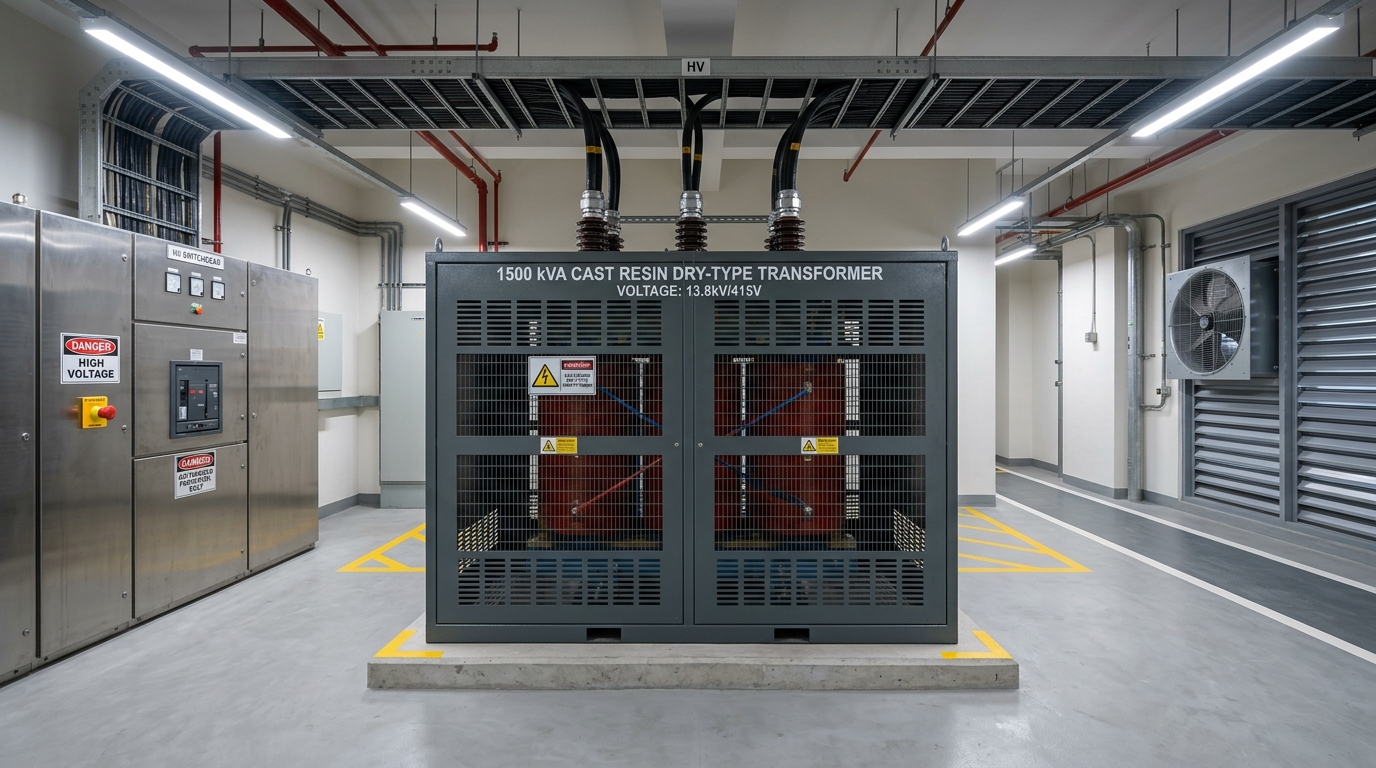
Direct Engineering Answer: Under the Building Code of Pakistan (Fire Safety Provisions 2016) and international standards (IEC 60076-11), oil-immersed transformers present severe explosive and toxic smoke hazards in enclosed basements. Cast Resin Dry-Type (CRT) transformers are 100% fire-safe, non-flammable, self-extinguishing (Class F1), and eliminate the need for concrete oil soak pits or deluge systems.
1. Urban Commercial Growth & The Basement Substation Challenge
Over the past decade, major metropolitan centers in Pakistan—including Lahore (Gulberg, DHA Phase 5/6/8, MM Alam Road, and Johar Town), Karachi (Clifton, DHA, Shahrah-e-Faisal, and Bahria Town Karachi), and Islamabad (Blue Area, G-11, and the New Islamabad Airport corridor)—have witnessed a massive boom in high-density commercial real estate. Modern multi-story shopping malls, 20+ story corporate headquarters, five-star hotels, and mixed-use luxury apartment towers concentrate massive electrical loads ranging from 1,000 kVA to 10,000 kVA (10 MVA) within compact urban footprints.
Due to severe land constraints, municipal zoning restrictions, and architectural aesthetics, outdoor 11kV electrical yards are rarely feasible. Consequently, MEP consultants must position the primary step-down substations inside the building structure—almost universally in the lowest basement levels (Basement-1, Basement-2, or Basement-3) or on dedicated intermediate plant room floors. This architectural necessity fundamentally changes transformer safety requirements. Explore our specialized dry-type cast resin transformers engineering division.
2. The Fire Hazards of Oil-Immersed Transformers Indoors
Traditional distribution transformers rely on thousands of liters of combustible hydrocarbon mineral insulating oil for electrical dielectric strength and thermal cooling. In an indoor basement setting, an oil-immersed transformer creates severe life-safety and structural risks:
- Catastrophic Arc-Flash Explosion: A severe high-voltage inter-turn or phase-to-earth electrical fault vaporizes mineral oil into combustible hydrocarbon gases (hydrogen, acetylene, and methane), causing internal tank overpressure and explosive rupture.
- Asphyxiating Smoke Propagation: Burning mineral oil releases immense plumes of dense, toxic, carbonaceous black smoke that rapidly travels through building elevator shafts, stairwells, and HVAC air ducts, trapping building occupants.
- Structural Concrete Damage: Burning oil fires reach temperatures exceeding 1,000°C, causing structural concrete spalling and weakening primary building support columns.
3. Building Code of Pakistan (Fire Safety Provisions 2016) Mandates
To eliminate catastrophic indoor electrical fires, the National Disaster Management Authority (NDMA) and Pakistan Engineering Council (PEC) established the Building Code of Pakistan (Fire Safety Provisions 2016). The code strictly regulates electrical equipment installed inside public and commercial structures:
- Mandatory Non-Flammable Equipment: Transformers installed inside or immediately adjacent to occupied buildings must utilize non-combustible solid dielectric insulation or high-fire-point liquids.
- Toxic Gas Prohibition: Dielectric insulation must be halogen-free, generating zero corrosive hydrogen chloride (HCl) or toxic cyanide fumes under external flame impingement.
- Emergency Egress Protection: Substation rooms must be isolated with minimum 2-hour fire-rated partitions and self-closing fire doors.
4. International IEC 60076-11 Fire Classification (F1 / C2 / E2)
TransfoLine Cast Resin Dry-Type Transformers are manufactured and certified according to the strictest international standards (IEC 60076-11), achieving the highest safety classifications:
| Standard Rating Class | Classification Grade | Operational Performance Guarantee |
|---|---|---|
| Fire Behavior Class | Class F1 | Self-extinguishing within seconds; zero flame propagation; minimal, non-toxic optical smoke density. |
| Climatic Class | Class C2 | Capable of operating, transport, and storage at extreme ambient temperatures down to -25°C and up to +50°C. |
| Environmental Class | Class E2 | Immune to heavy condensation, humidity breathing (>95%), and severe atmospheric industrial dust/pollution. |
5. Space Savings & Architectural Optimization in Basement Parking
In high-density commercial developments, parking spaces represent direct commercial value and municipal approval requirements. Standard oil-immersed transformers require extensive physical separation clearances (at least 3 to 5 meters from building walls), blast-proof separation barriers, and heavy access avenues for oil tankers.
Cast resin dry-type transformers occupy 35% to 50% less physical volume and can be placed directly against walls or integrated inside standard modular IP21/IP23 indoor switchgear enclosures. This allows real estate developers to maximize vehicle parking bays and leaseable basement storage space.
6. Eliminating Costly Oil Containment Pits & Deluge Piping
Installing an oil-immersed transformer in a basement legally mandates civil construction of an impermeable reinforced concrete oil catch basin (soak pit) capable of holding 100% of the transformer oil volume, plus automatic sump pump separators and dedicated High-Velocity Water Spray (HVWS) deluge systems. These civil additions add millions of rupees to construction budgets. Cast resin transformers require zero oil containment pits and zero fire water deluge piping, dramatically lowering initial MEP infrastructure costs. Explore our commercial plaza power solutions.
7. Indoor Air Quality & Zero Toxic Fume Emissions
In the event of an external building fire, standard insulating varnishes can release halogenated toxic vapors. TransfoLine uses flame-retardant epoxy resins formulated with aluminum trihydrate (ATH) and silica fillers. When subjected to intense external heat, the resin releases only water vapor and carbon dioxide without emitting corrosive hydrogen halide gases.
8. Insurance Premium Reductions for Commercial Property Developers
Major corporate insurance underwriters in Pakistan (such as EFU, Jubilee, and Adamjee) assess commercial property fire risk based on NFPA and BCP guidelines. Buildings powered by certified Cast Resin Dry-Type substations enjoy 15% to 25% lower annual property fire insurance premiums, generating compounding financial savings over the 30-year operational life of the facility.
9. Forced Ventilation & HVAC Heat Load Integration
Proper substation ventilation is essential to dissipate internal transformer core and coil heat. TransfoLine MEP engineers calculate required CFM air exchanges (approximately 3 to 4 m³/min per kW of loss) and design integrated forced-draft louvers and exhaust fans linked to ambient temperature sensors.
10. TransfoLine Class F/H Cast Resin Supply & MEP Engineering
TransfoLine engineers, supplies, and commissions 50 kVA to 5,000 kVA (5 MVA) Cast Resin Dry-Type Transformers with Class F (155°C) and Class H (180°C) epoxy encapsulation, integrated PT100 temperature monitoring, forced-air AF booster fans, and nationwide 24/7 engineering support.
11. Life-Cycle Cost Comparison: 1,000 kVA Dry-Type vs Oil-Cooled in Commercial Real Estate
When evaluating electrical infrastructure for a 15-story commercial plaza in Lahore or Karachi, the total cost of ownership over a 25-year lifespan reveals significant financial advantages for Cast Resin Dry-Type transformers:
- Initial Equipment Cost: A 1,000 kVA Oil Transformer costs approx. Rs. 3.2M vs Rs. 4.6M for a 1,000 kVA Cast Resin unit (Initial difference: +Rs. 1.4M).
- Civil & Fire Protection CapEx: Oil transformer requires reinforced concrete soak pit (Rs. 450,000), 2-hour fire blast walls (Rs. 350,000), and water deluge piping with booster pump (Rs. 850,000). Total civil savings with dry-type: Rs. 1,650,000.
- Maintenance OpEx over 25 Years: Oil transformer requires semi-annual BDV tests, periodic oil dehydration, and gasket replacements averaging Rs. 95,000/year (Rs. 2,375,000 total). Dry-type transformer requires only annual vacuum cleaning averaging Rs. 15,000/year (Rs. 375,000 total). Total maintenance savings: Rs. 2,000,000.
- Insurance Premium Savings: Property fire insurance discount of 15% averages Rs. 120,000/year savings (Rs. 3,000,000 over 25 years).
- Net Financial Advantage: Installing a Cast Resin Dry-Type transformer delivers net lifecycle savings of over Rs. 5.2 Million PKR while guaranteeing total building fire safety.
Frequently Asked Questions
FAQ Are cast resin dry-type transformers mandatory in Pakistani commercial high-rises?
Yes, the Building Code of Pakistan (Fire Safety Provisions) and municipal development authorities (LDA, CDA, SBCA) mandate oil-free or fireproof transformers in indoor basement substations.
FAQ What is the difference between Class F and Class H insulation?
Class F insulation is rated for maximum continuous operating temperature of 155°C (100°C rise), while Class H is rated for 180°C (125°C rise), offering superior thermal overload endurance.
FAQ Do cast resin transformers require oil testing or maintenance?
No, cast resin units contain zero liquid dielectric fluid, completely eliminating oil BDV testing, gas chromatography (DGA), and dehydration maintenance.
FAQ Can TransfoLine provide customized indoor enclosures for basement substations?
Yes, we provide custom IP21 indoor and IP23 drip-proof steel enclosures complete with lockable mesh doors and forced ventilation blowers.
FAQ What is the warranty period for TransfoLine cast resin transformers?
All TransfoLine dry-type cast resin transformers come with a 12-month comprehensive replacement warranty backed by on-site emergency support.
Need Direct Technical Assistance or a Factory-Direct Quote?
TransfoLine supplies, installs, overhauls, and repairs heavy industrial transformers across Pakistan with nationwide 48-hour delivery, genuine WAPDA P-10 compliance, and 12-month full warranty.