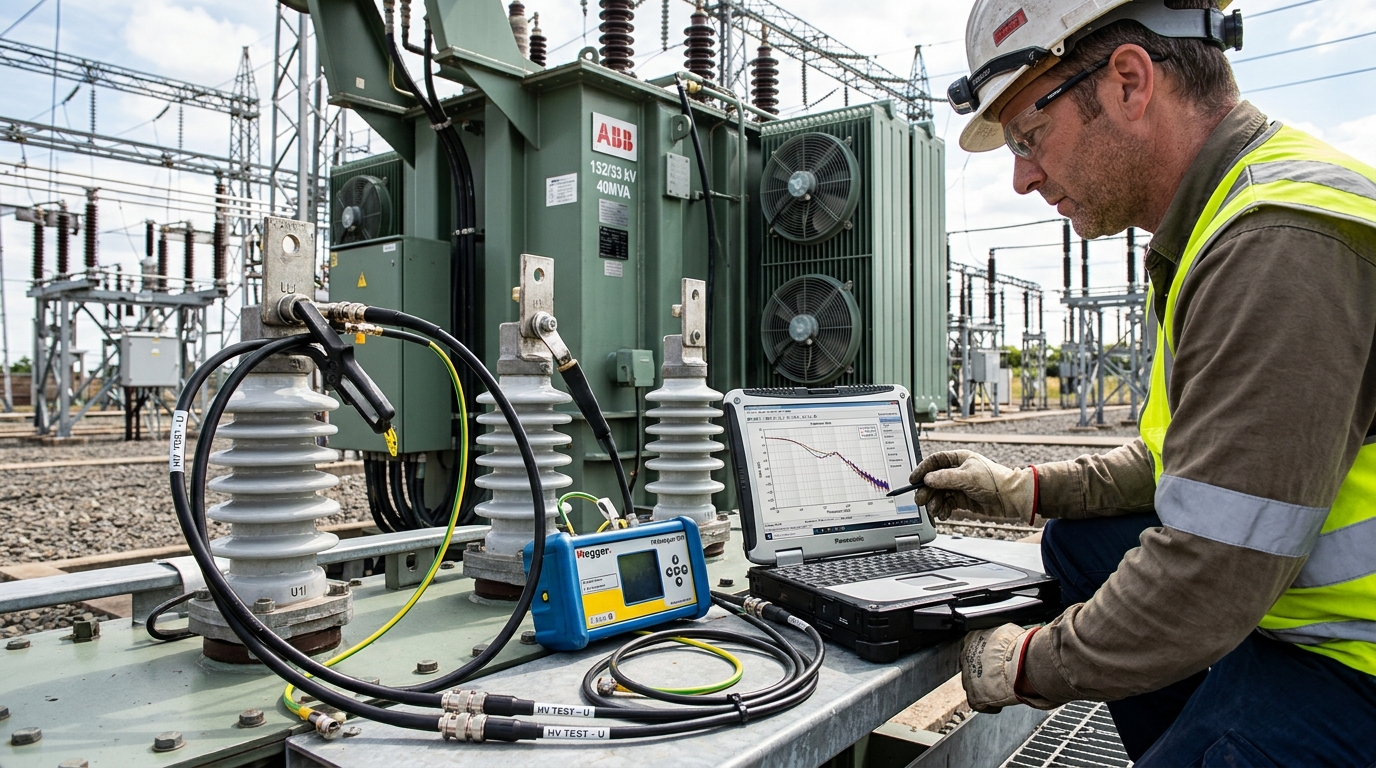
Direct Engineering Answer: Standard Megger and TTR tests cannot detect physical coil bending or loose core clamping. SFRA testing per IEC 60076-18 injects a 20Hz–2MHz frequency sweep to map winding capacitance and leakage inductance. TransfoLine deploys high-bandwidth SFRA analyzers for post-fault diagnosis and used transformer verification across Pakistan.
Why Mechanical Failures are the Deadliest Transformer Hazard
Electromagnetic forces generated during short-circuit faults increase with the square of the current (F ∝ I2). A 10-times fault current produces 100 times the mechanical bursting force on the winding coils. Over time, recurring through-faults cause cumulative coil deformation: disc tilting, hoop buckling, and loss of clamping pressure.
Eventually, the damaged winding shifts slightly during a routine load change, tearing brittle paper insulation and causing a catastrophic phase-to-phase explosion. SFRA testing detects these physical displacements while the transformer is still intact.
1. The Physics of SFRA Testing (IEC 60076-18)
A transformer winding is a complex distributed network of resistors (copper resistance), inductors (core and leakage inductance), and capacitors (inter-turn, inter-disc, and winding-to-ground capacitance). Any physical displacement—even by 1 millimeter—alters these micro-capacitances and inductances.
An SFRA test set injects a low-voltage sinusoidal signal into one bushing terminal and sweeps across frequencies from 20 Hz to 2 MHz, measuring the transmitted signal at another terminal. The result is plotted as a logarithmic attenuation curve in decibels versus frequency.
2. Interpreting the 4 SFRA Frequency Sub-Bands
| Frequency Sub-Band | Frequency Range | Dominant Component | Defects Detected |
|---|---|---|---|
| Band 1 (Low) | < 2 kHz | Core magnetizing inductance | Core ground fault, residual core magnetization, shorted laminations |
| Band 2 (Med-Low) | 2 kHz – 20 kHz | Core-to-winding interaction | Bulk winding deformation, main insulation shifts |
| Band 3 (Med-High) | 20 kHz – 400 kHz | Winding structure & inter-disc capacitance | Radial buckling, axial winding collapse, disc tilting |
| Band 4 (High) | 400 kHz – 2 MHz | Internal leads, tap connections & bushings | Loose tap changer leads, bushing capacitance degradation |
3. The 3 Methods of SFRA Trace Comparison
SFRA diagnosis relies on comparing measured curves against a reliable reference:
- Time-Based Comparison (Best): Comparing current on-site trace against factory baseline fingerprint recorded during initial FAT testing.
- Phase-to-Phase Comparison: In symmetric 3-phase transformers, comparing Phase A, B, and C traces against each other.
- Sister-Unit Comparison: Comparing test curves against an identical design transformer manufactured on the same production line.
How TransfoLine Diagnoses Mechanical Integrity
TransfoLine deploys high-bandwidth SFRA diagnostic instruments (Megger FRAX / OMICRON FRANEO) operated by experienced substation testing engineers across Pakistan for post-fault rapid response, used transformer verification, and workshop clamping overhauls.
Need Certified Diagnostic Testing or Emergency Support?
TransfoLine's PEC-registered engineers mobilize nationwide within 24 hours with mobile testing vans and complete diagnostic instrumentation.
Consult with a Testing Engineer →Frequently Asked Questions
Why can't standard Megger or Turns Ratio (TTR) tests detect mechanical winding deformation?
Megger and TTR tests only measure static DC resistance and bulk dielectric insulation. A winding can experience severe radial buckling or axial shifting after a through-fault while maintaining copper continuity and turns count. SFRA uses high-frequency AC signals sensitive to minute microhenry and picofarad shifts.
When is an SFRA test mandatory on a power transformer?
SFRA testing is mandatory: (1) After factory manufacturing for baseline fingerprinting, (2) Following relocation or rough road transportation, (3) Immediately after an external heavy short-circuit through-fault, and (4) Prior to purchasing a used substation transformer.