
Direct Engineering Answer: In-service transformer oil in Pakistan must maintain a minimum Dielectric Breakdown Voltage (BDV) ≥ 35 kV (IEC 60156). Acetylene (C2H2 > 2 ppm) in Dissolved Gas Analysis (DGA) indicates active high-energy arcing requiring emergency isolation. TransfoLine provides on-site mobile vacuum dehydration trailers to restore oil BDV ≥ 65 kV nationwide.
Why Oil Testing is the Single Most Critical Preventative Action
Inside an operating power transformer, the insulating oil is in direct physical contact with copper windings, magnetic core steel, and cellulose paper insulation. Over 75% of unexpected transformer explosions in Pakistan originate from neglected oil degradation.
As moisture accumulates and dielectric breakdown voltage drops below 30kV, internal flashovers occur across winding discs. By systematically analyzing oil dielectric strength and dissolved gas concentrations, plant engineers gain non-invasive visibility into the internal operating health of their high-voltage assets.
1. Dielectric Breakdown Voltage (BDV) Testing (IEC 60156)
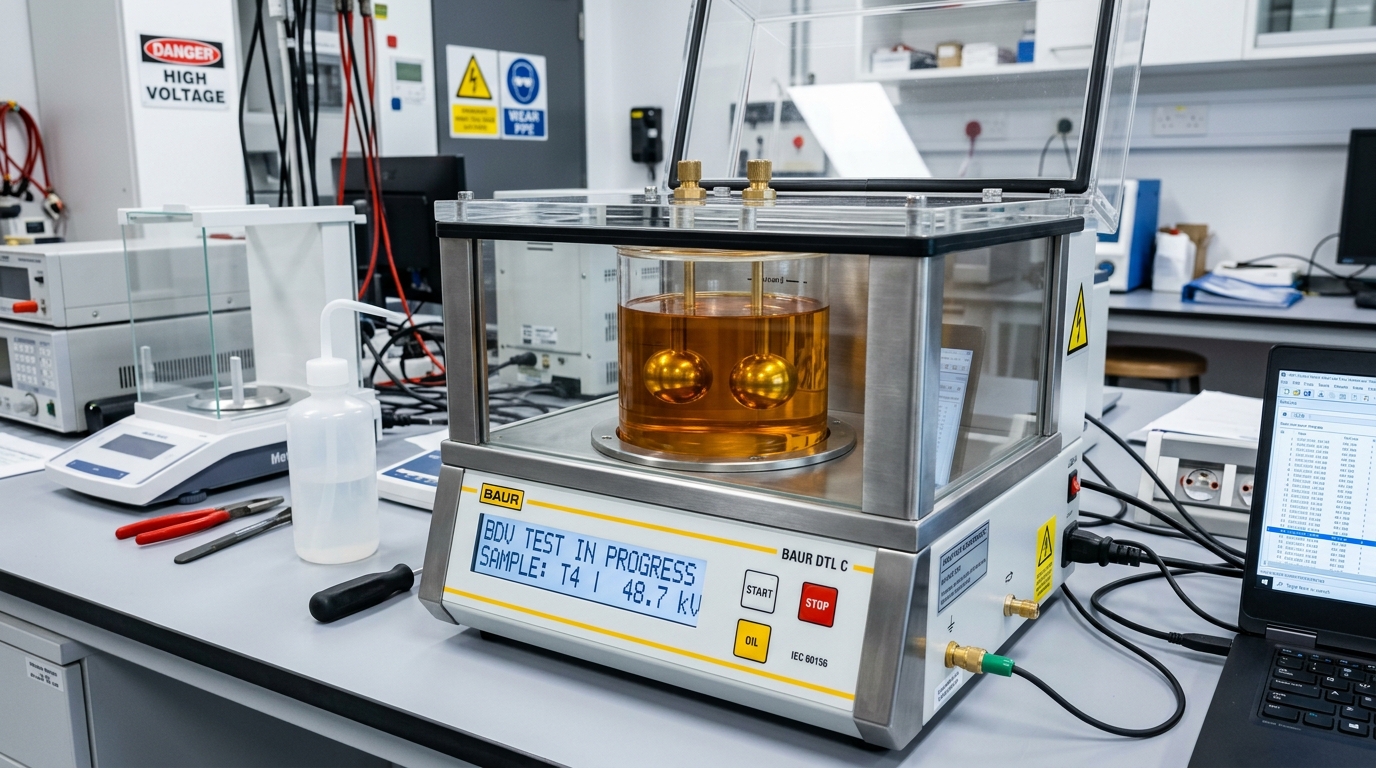
The Breakdown Voltage (BDV) test measures the electrical withstand capability of the oil. Using an automated oil test set (e.g. BAUR DTL C or Megger OTS), a 400ml oil sample is placed in a test vessel fitted with two spherical brass electrodes spaced exactly 2.5 mm apart.
AC voltage is ramped up smoothly at 2.0 kV/second until a spark discharge bridges the gap. The test is repeated 6 times on the same sample, and the average breakdown voltage is calculated.
BDV Severity & Action Thresholds
| Oil Condition Status | Measured BDV (2.5mm Gap) | Required Engineering Action |
|---|---|---|
| Good / Optimal | ≥ 50 kV | Normal operational service; re-test in 6 to 12 months. |
| Fair / Degraded | 35 kV – 49 kV | Moisture ingress detected; plan scheduled oil dehydration during next shutdown. |
| Critical / Failure Risk | < 30 kV | Immediate high-vacuum oil dehydration required; high risk of flashover under load. |
2. Dissolved Gas Analysis (DGA) — Key Hydrocarbon Signatures
Different internal fault mechanisms produce distinct combustible gases at specific thermal thresholds per IEC 60599 and IEEE C57.104:
- Hydrogen (H2): Generated by partial discharge (corona) and low-energy electrical sparking.
- Methane (CH4) & Ethane (C2H6): Generated by low-temperature localized overheating (< 300°C) such as overloaded joints or core clamping bolts.
- Ethylene (C2H4): Generated by high-temperature thermal faults (> 300°C to 700°C) involving oil decomposition around bad contacts.
- Acetylene (C2H2): The most dangerous gas. Only forms at temperatures exceeding 700°C. Its presence indicates active high-energy electrical arcing across winding coils.
- Carbon Monoxide (CO) & Carbon Dioxide (CO2): Produced by thermal degradation of solid paper cellulose insulation. A CO2/CO ratio below 3 indicates severe paper degradation and impending coil burnout.
3. Duval Triangle Method: Precise Fault Diagnosis
The internationally recognized Duval Triangle 1 method plots the relative percentage of three key hydrocarbon gases: % CH4, % C2H4, and % C2H2 to categorize fault zones without guessing.
| Duval Zone | Diagnosed Fault Type | Dominant Gas | Physical Plant Cause |
|---|---|---|---|
| PD (Partial Discharge) | Corona discharge in gas bubbles | H2 > 98% | Moisture pockets, poorly impregnated paper |
| T1 (Thermal < 300°C) | Low-temperature overheating | CH4 dominant | Overloaded connections, blocked radiator tubes |
| T2 (Thermal 300°–700°C) | Medium-temperature thermal fault | C2H4 dominant | Core ground circulation currents, loose lugs |
| T3 (Thermal > 700°C) | Severe thermal fault | C2H4 >> CH4 | Core lamination short circuits, heavy carbonization |
| D1 (Low Energy Arcing) | Discharges of low energy (sparking) | C2H2 > 10% | Floating metal particles, loose shielding |
| D2 (High Energy Arcing) | Continuous high-energy arcing | C2H2 dominant | Winding-to-winding flashover, tap changer failure |
4. Moisture Content (PPM) & Total Acidity Limits
Beyond BDV and DGA, two chemical tests determine the aging state of the oil:
- Moisture (Karl Fischer Method - IEC 60814): Water dissolves in oil and migrates into the paper. In 11kV/33kV transformers, moisture should remain below 15 to 20 PPM. Moisture exceeding 30 PPM cuts paper mechanical tensile strength in half every 3 years.
- Total Acidity (IEC 62021): Measures acidic oxidation byproducts. Acidity above 0.15 mg KOH/g accelerates metallic corrosion and forms sludge that blocks cooling channels.
How TransfoLine Restores Degraded Transformer Oil
TransfoLine operates specialized mobile high-vacuum oil dehydration trailers and oil testing rigs across Pakistan. When our engineers test your transformer, we provide instant on-site BDV reports, certified laboratory DGA interpretation, and on-site high-vacuum dehydration that restores BDV to ≥ 65kV without removing the unit from service.
Need Certified Diagnostic Testing or Emergency Support?
TransfoLine's PEC-registered engineers mobilize nationwide within 24 hours with mobile testing vans and complete diagnostic instrumentation.
Consult with a Testing Engineer →Frequently Asked Questions
What is the minimum acceptable BDV for transformer oil in Pakistan?
Per IEC 60156 standards: New unused mineral oil must achieve ≥ 60 kV; oil for newly energized transformers must exceed 50 kV; in-service oil must maintain at least 35 kV. If measured BDV falls below 30 kV, immediate high-vacuum oil dehydration is required.
What does acetylene (C2H2) in transformer oil indicate?
Acetylene only forms at extremely high temperatures exceeding 700°C. Its presence in concentrations greater than 1 to 2 ppm indicates active, high-energy electrical arcing across winding turns or tap changers, requiring immediate shutdown.
How does moisture enter transformer oil?
Moisture enters through damaged silica gel breathers, leaking tank gaskets during heavy monsoon rains, or as a natural chemical byproduct of paper cellulose aging under continuous thermal overloading.